Choosing a battery pack manufacturer is a fleet-risk decision, not simply a sourcing exercise. The supplier affects vehicle uptime, route completion, charging schedules, maintenance workload, warranty exposure, replacement planning, and the ability to scale from a pilot to a stable commercial rollout.
The strongest supplier is therefore not automatically the supplier with the lowest quotation or the largest headline specification. Fleet buyers need a partner that can translate real operating conditions into a battery system that stays consistent across routes, payloads, shifts, climates, charging windows, and vehicle platforms.
For buyers managing several commercial vehicle classes, FEBATT’s power battery solutions for commercial fleets can help frame the application differences among electric motorcycles, electric tricycles, forklifts, golf carts, RVs, and other power-driven vehicles before supplier comparison begins.
What Does a Battery Pack Manufacturer Need to Deliver for Fleet Projects?
A battery pack manufacturer should do more than assemble cells into an enclosure. For B2B fleet projects, the supplier needs to convert vehicle and duty-cycle requirements into an integrated electrical, mechanical, thermal, and control system.
That normally includes cell selection, pack architecture, BMS configuration, current-path design, enclosure engineering, connectors, communication protocols, thermal protection, testing, traceability, and controlled production documentation. A capable lithium battery pack manufacturer should also explain why each major design choice fits the application and what trade-offs the buyer is accepting.
The distinction between product availability and application engineering matters. A catalog pack can work when dimensions, current demand, charging method, communication, mounting, and environmental exposure already match. A custom battery pack manufacturer becomes more relevant when the vehicle requires dedicated geometry, CAN or RS485 communication, unusual connectors, removable-pack handling, defined thermal behavior, or production-level integration.
For motorcycle programs with platform-specific constraints, This custom lithium battery guide for electric motorcycle applications shows how vehicle data should guide pack design instead of forcing the vehicle around a generic pack offering.
Application experience should also match the fleet. Delivery motorcycles may prioritize compact packaging and frequent use, while forklifts may require predictable multi-shift availability and high peak power. A battery manufacturer for fleets should understand how these differences change engineering, validation, maintenance, and spare-stock planning.
What Should Fleets Define Before Requesting a Quote?
A precise RFQ gives a battery pack manufacturer a better basis for engineering and pricing. Sending only nominal voltage, capacity, and a target price encourages superficial quotations and makes battery supplier selection harder.
Fleet buyers should define the operating envelope first. The most useful inputs are shown below.
| RFQ area | What the fleet should provide | Why it matters |
|---|---|---|
| Application | Vehicle type, route or work cycle, payload, gradients, stop frequency, operating hours, shifts | Defines real energy and power demand |
| Environment | Temperature range, rain/dust exposure, road or warehouse conditions, vibration | Drives enclosure, thermal, sealing, and validation needs |
| Integration | Available space, mounting, connector, communication, controller limits, pack handling | Prevents fitment and interface problems |
| Operations | Charging windows, pack swapping/removal, downtime limits, service model | Shapes usable energy, charging strategy, and maintainability |
| Commercial | Pilot quantity, forecast volume, target date, warranty expectations, spare-parts policy | Improves quotation comparability and scale-up planning |
Cargo fleets should also document payload variation and route intensity. This commercial electric tricycle battery guide provides a useful application reference for buyers translating load, stop-start duty, road conditions, and shift patterns into a supplier RFQ.
A disciplined battery pack manufacturer will use these inputs to clarify assumptions before proposing a design. If a supplier quotes immediately without asking how the vehicle actually works, procurement should question whether the proposal is application-engineered or simply adapted from an existing product.
How Should Fleets Compare Battery Pack Manufacturers?
Battery pack manufacturers should be compared through a weighted evaluation rather than a price table alone. The objective is to identify which supplier can deliver repeatable fleet performance at an acceptable lifecycle cost.
- A practical battery manufacturer selection scorecard should cover:
- Application engineering and relevant fleet experience
- Cell sourcing transparency and approved alternatives
- BMS development and vehicle communication capability
- Mechanical, thermal, and connector design competence
- Quality-control procedures and serial traceability
- Sample validation and failure-analysis support
- Production capacity and scale-up readiness
- Compliance documentation for the exact configuration
- Warranty process and response responsibility
- Lead time, MOQ, tooling, spare stock, and change control
The battery pack manufacturer should be scored on evidence, not promises. Ask for drawings, interface definitions, test plans, quality records, traceability examples, production controls, and a clear process for handling nonconforming material or field failures.
Price still matters, but it should be normalized against equivalent scope. One supplier may include engineering, testing, packaging, technical support, and spare-part commitments that another supplier treats as separate costs. A slightly higher pack price can still produce lower fleet cost if it reduces downtime, redesign, replacement, or warranty friction.
Which Battery Design Factors Matter Most in Daily Fleet Operation?

Add Your Heading Text Here
Fleet buyers should compare usable performance rather than catalog numbers. A battery pack manufacturer should provide enough information to evaluate usable energy, continuous and peak current, charge rate, operating temperature, recommended depth of discharge, cycle-life test conditions, weight, dimensions, ingress protection, communication, and protection logic.
The question is how those specifications affect the workday. Can the vehicle finish the required route with a reasonable reserve? Can the pack support repeated acceleration under payload? Can charging fit the available window? Can the battery remain usable during hot delivery shifts, cold mornings, or demanding warehouse operation?
The BMS deserves particular attention because it influences protection, diagnostics, communication, and serviceability. The supplier should explain cell-voltage and temperature monitoring, current limits, balancing, state-of-charge estimation, fault logging, communication, derating, and shutdown behavior. For large fleets, useful diagnostics can reduce unnecessary pack replacement by helping technicians separate vehicle, charger, connector, environmental, and battery faults.
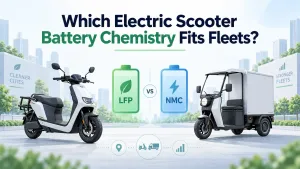
Chemistry should also follow the application. LiFePO4 may be attractive when cycle durability, thermal stability, and predictable long-term use are priorities. NMC may be considered when energy density and pack mass are more restrictive. A lithium battery pack manufacturer should describe the engineering trade-off rather than present chemistry as a universal answer.

Oversizing is not automatically safer or more economical. A larger pack can increase purchase cost, vehicle mass, packaging difficulty, and charging demand without fixing a poor duty-cycle match. The goal is a pack that supports the real operating envelope with controlled margins.
Which Compliance, Safety, and Quality Evidence Should Buyers Verify?
A battery pack manufacturer should connect safety controls to foreseeable failure modes across the complete installed system. Buyers should review cell qualification, protection strategy, fusing or switching devices where applicable, insulation, temperature sensing, short-circuit protection, enclosure strength, vibration resistance, connectors, ingress protection, and BMS fault behavior.
Compliance requirements depend on the destination market, transport route, product design, and end use. UN 38.3 is central to lithium-battery transport. Depending on the project, buyers may also need relevant IEC, UL, CE conformity, EMC, or regional documentation. ISO 9001 can indicate a quality-management system, but it does not replace product-specific evidence.
Do not accept a generic certificate folder as proof. The supplier should identify which report applies to the exact model and revision being purchased. Check model numbers, report scope, issue dates, laboratory information, and whether later changes to cells, BMS, enclosure, or critical components affect the evidence.
Production quality matters just as much as prototype quality. Ask about incoming cell inspection, cell matching, component verification, welding or connection controls, torque management, insulation checks, software version control, end-of-line testing, aging procedures, calibration, serial-number traceability, and nonconformance handling.
Change control is a major B2B risk. A reliable manufacturer should not substitute cells, BMS hardware, connectors, or other critical parts without an agreed approval process. Uncontrolled changes can create inconsistent range, communication, service life, safety behavior, or compliance status across the fleet.

How Should Fleets Evaluate Cycle Life, Warranty, and Lifecycle Cost?
Cycle life is meaningful only when the test conditions are known. When a battery pack manufacturer quotes a cycle figure, fleets should ask about depth of discharge, charge and discharge rates, temperature, rest periods, end-of-life threshold, and test methodology.
Laboratory cycle data should then be interpreted against the real duty cycle. High payloads, frequent acceleration, repeated short charging windows, temperature swings, and irregular operating patterns can change field aging. The more useful question is whether the battery will retain enough usable energy to complete the fleet’s required route or shift over the planned service period.
Warranty terms should be reviewed beside those assumptions. The manufacturer should clearly define duration, operating exclusions, retained-capacity criteria where applicable, claim evidence, response time, freight responsibility, replacement procedure, and responsibility for vehicle-side integration issues.
Lifecycle cost should combine purchase price with expected replacement, downtime, maintenance labor, spare packs, charging infrastructure, freight, duties, warranty recovery, and service support. This is why battery manufacturer selection should not be reduced to unit price. A supplier with more stable quality, faster failure analysis, and better change control may generate lower total cost even with a higher initial quotation.
How Should Buyers Evaluate a Battery Pack Manufacturer for Electric Tricycles?
Electric tricycle fleets are a useful stress test for battery supplier selection because payload, frequent starts, delivery stops, rough surfaces, gradients, outdoor exposure, and multiple shifts can quickly expose weaknesses that are less visible in light-duty use.
A battery pack manufacturer serving this segment should ask about cargo mass, route distance, stop frequency, hill grade, average speed, road condition, shift duration, charging windows, pack-removal frequency, and seasonal temperature. These inputs are more valuable than simply asking the buyer to choose a larger capacity.
Mechanical integration deserves equal attention. The pack should fit securely, tolerate vibration, protect connectors, and remain serviceable. Where operators remove or swap packs, handles, locking features, connector alignment, pack mass, and error-proofing become daily operational issues.
Before scaling, fleets should test the proposed system on representative routes and record route completion, energy use, temperature, state-of-charge behavior, charging time, fault records, and end-of-shift reserve. A serious custom battery pack manufacturer should welcome defined acceptance criteria because they reduce disputes before mass production.
The final decision should combine pilot performance with production discipline. A battery pack manufacturer that performs well in a small trial but cannot maintain approved cells, firmware versions, quality records, and delivery consistency at volume still represents a fleet risk.
Conclusion
Choosing a battery pack manufacturer is ultimately a fleet-risk decision. The supplier must connect battery design to real vehicle duty cycles, charging behavior, safety, serviceability, production control, and long-term supply.
The most effective battery manufacturer selection process begins with application data, defines measurable acceptance criteria, validates samples under realistic conditions, and compares lifecycle cost before scaling. It also checks whether the battery pack manufacturer can preserve the approved design from prototype through mass production.
For fleet operators, the better purchasing question is not which battery pack manufacturer can supply the cheapest pack. It is which battery pack manufacturer can deliver predictable uptime, controlled change, repeatable quality, and responsive support throughout the fleet’s working life.
Frequently Asked Questions About Battery Pack Manufacturer
Q: What should fleets look for in a battery pack manufacturer?
A: Fleets should verify application engineering, BMS capability, quality control, traceability, compliance evidence, production consistency, warranty response, and proof that the supplier understands the real duty cycle.
Q: How do fleets compare battery pack manufacturers?
A: Use a weighted scorecard covering technical fit, sample results, quality systems, safety, supply stability, lifecycle cost, lead time, customization, change control, and after-sales support.
Q: Should fleets choose a custom battery pack manufacturer?
A: A custom battery pack manufacturer is useful when vehicles need specific dimensions, mounting, connectors, communication, thermal behavior, current capability, or operating logic that standard packs cannot provide.
Q: What compliance documents should a battery pack manufacturer provide?
A: Requirements vary by market and application. Buyers should verify UN 38.3 transport documentation and any relevant IEC, UL, CE, EMC, or regional evidence for the exact battery configuration.
Q: Is the cheapest battery pack manufacturer usually the best choice?
A: Not necessarily. Lower purchase price can be offset by downtime, shorter service life, inconsistent quality, weak warranty support, spare-stock needs, or redesign costs. Compare total lifecycle value.