For OEMs, distributors, delivery operators, and shared-mobility fleets, choosing an electric scooter battery is not simply a choice between LiFePO4 and NMC. The pack must finish the route, fit the vehicle, handle peak current, survive daily cycling, work with the charger and controller, and remain serviceable across the fleet.
For most modern commercial two- and three-wheel platforms, lithium is a better engineering starting point than lead-acid when lower mass, higher usable energy, repeated cycling, and operating efficiency matter. Within lithium, a LiFePO4 battery for fleets is often the better default for delivery and cargo duty, while an NMC battery is most useful when the electric scooter battery must be smaller or lighter for the same stored energy. An application-matched power battery solution should start with duty cycle, vehicle integration, and lifecycle targets rather than chemistry marketing.
Why Should Scooter and Tricycle Fleets Be Evaluated Differently?
A two-wheel electric scooter battery is often constrained by vehicle mass, removable-pack handling, installation volume, and daily route range. Delivery scooters may cycle hard, but compact packaging still matters because the pack may be swapped or installed inside a narrow frame. Buyers defining these limits can use an electric two-wheeler battery selection guide to map chemistry, range, weight, charging, and vehicle integration.
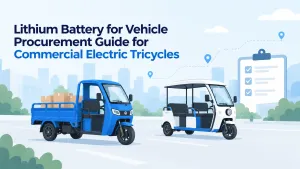
Cargo tricycles work differently. Payload, repeated starts, hill climbing, longer operating hours, and replacement cost usually matter more than minimum pack weight. Electric tricycle battery chemistry should therefore be evaluated together with continuous current, peak current, mounting, enclosure, connectors, and usable energy. A dedicated electric three-wheeler battery selection guide helps keep the pack specification tied to commercial duty.

For B2B projects, start with the duty cycle, not the chemistry label. Route, payload, charging, and integration requirements should be defined before the electric scooter battery or tricycle pack is approved. Projects with higher current or communication requirements should also review BMS selection for lithium motorcycle battery packs before prototype validation.
What Is the Difference Between LFP and NMC for an Electric Scooter Battery?
LFP and NMC are both lithium-ion chemistries, but they optimize different priorities. Battery University reference ranges place LFP around 90–120 Wh/kg specific energy and common NMC around 150–220 Wh/kg. NMC therefore provides higher battery energy density, while LFP normally provides stronger battery thermal stability and battery cycle durability.
| Fleet factor | LFP / LiFePO4 | NMC |
|---|---|---|
| Specific energy | ~90–120 Wh/kg | ~150–220 Wh/kg |
| Thermal stability | Stronger chemistry-level margin | Higher thermal-management demand |
| High-cycle duty | Often the stronger fit | Project-dependent |
| Weight / packaging | Larger for equal energy | More compact for equal energy |
| Typical B2B fit | Delivery, utility, cargo duty | Compact, removable, weight-sensitive packs |
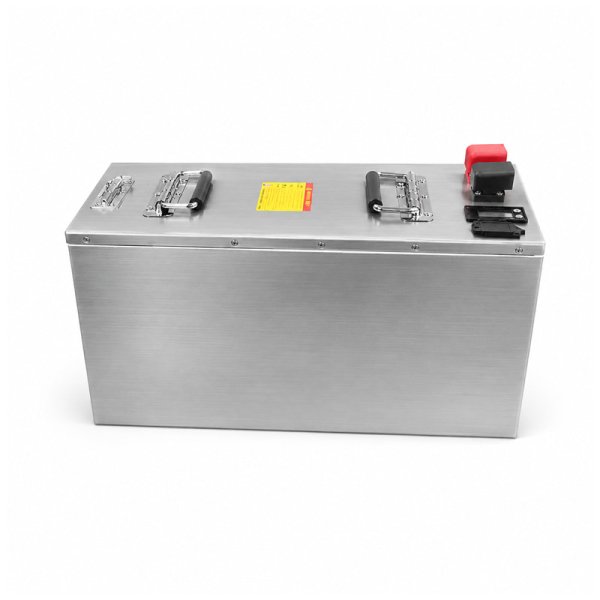
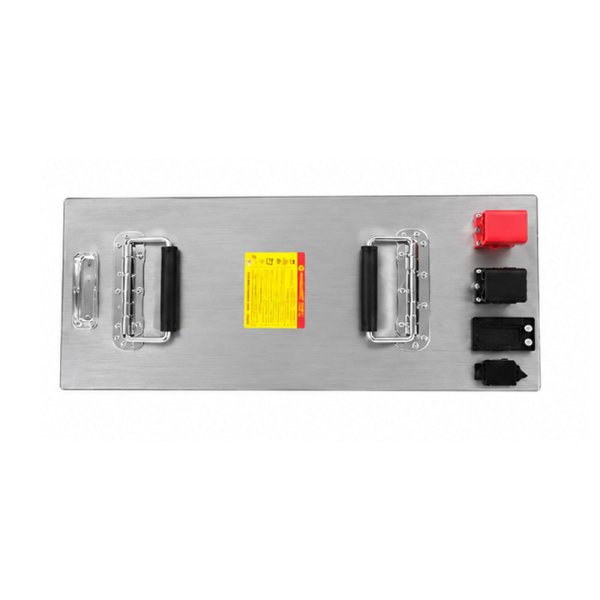
For an electric scooter battery, the choice should follow the job. Compact removable packs may benefit from NMC, while high-use fleets often gain more value from LFP. The 64V 60Ah LFP Power Battery Pack is one delivery-scooter and three-wheel application example; its listed 1,500-cycle lifespan is model-specific, not a universal LFP guarantee.
Why Is LiFePO4 Often the Better Electric Scooter Battery for Fleets?
High-utilization fleets consume cycles quickly, so an electric scooter battery with strong cycle durability can reduce downtime and replacement pressure. LFP is widely used where endurance matters because the chemistry is thermally stable and commonly supports long cycle life. Actual results still depend on cell quality, depth of discharge, temperature, charge rate, and current demand.

For delivery scooters, utility motorcycles, rental fleets, and cargo tricycles, a LiFePO4 electric scooter battery is often the safer business choice. Its advantage is not only chemistry-level safety: fewer replacement events can reduce technician time, vehicle downtime, and fleet battery total cost.
Lithium also gives modern fleets clear advantages over lead-acid. An electric scooter battery based on lithium can reduce vehicle mass, provide more usable energy in a smaller package, support repeated cycling, and simplify service planning. For high-frequency duty, LFP is often the first chemistry worth validating.
When Does NMC Make Sense for an Electric Scooter Battery?
An NMC battery makes sense when an electric scooter battery must maximize energy in limited space, minimize removable-pack weight, or support longer range without making the enclosure too large. This can matter in premium, compact, or frequently carried packs.
Cold-weather projects still need cell-level validation. All lithium-ion chemistries lose performance in cold conditions through higher internal resistance and reduced charging efficiency. NMC may retain a packaging or range advantage in some designs, but the electric scooter battery still needs real low-temperature discharge and charging limits.
For cargo tricycles, use NMC only when compactness or mass creates a measurable vehicle-level benefit. For high-load delivery, frequent stop-start work, or long daily cycling, LFP usually remains the more practical choice.
Why Do BMS and Charger Matching Matter for an Electric Scooter Battery?
Chemistry alone does not make a reliable electric scooter battery. Cell consistency, pack assembly, thermal paths, enclosure design, connectors, charger matching, and BMS protection all influence field performance. A good LFP pack with a weak BMS or unsuitable charger can still create downtime and warranty pressure.
B2B buyers should confirm over-charge, over-discharge, over-current, short-circuit, temperature protection, balancing, communication, and fault reporting where applicable. The charger profile must match the cell chemistry and pack limits; nominal voltage alone is not enough to approve an electric scooter battery system for fleet deployment.
What Should B2B Buyers Confirm Before Ordering an Electric Scooter Battery?
Start with the application rather than a voltage label. For an electric scooter battery fleet project, the supplier should receive the operating inputs that actually determine pack stress and service life.

- Daily route distance and maximum payload
- Motor/controller demand, hill grade, and stop-start frequency
- Operating hours, ambient temperature, and compartment limits
- Connector, charging schedule, and annual volume
- Cycle-test conditions and capacity-retention endpoint
- Continuous and peak current, BMS protection, and charger profile
- Destination-market compliance, warranty, and sample validation
For high-use delivery scooters and cargo tricycles, begin the chemistry review with LFP unless weight or installation volume gives NMC a clear system-level advantage. This keeps the electric scooter battery decision tied to lifecycle risk and fleet battery total cost instead of chemistry marketing.
Does Compliance Change an Electric Scooter Battery Decision?
Yes. Compliance is market-specific and should be checked before production. Chemistry selection does not replace product- and destination-market requirements for transport, safety testing, labeling, charger compatibility, and vehicle integration.
For each destination, confirm the required documentation, battery tests, labeling, charger rules, vehicle-level requirements, and local restrictions. An electric scooter battery should be approved as part of the complete vehicle and supply-chain plan, not as a cell chemistry in isolation.
Conclusion
The chemistry decision should follow the fleet job. Lithium is usually the stronger platform than lead-acid for commercial two- and three-wheel programs when lower mass, usable energy, repeated cycling, and service efficiency matter.
Within lithium, LFP is often the best default for a high-use electric scooter battery or cargo-tricycle project because durability and thermal margin directly support uptime. NMC remains valuable when compact size and removable-pack weight create a measurable vehicle benefit. The final electric scooter battery decision should combine chemistry with BMS design, charger matching, current demand, route conditions, compliance, and supplier validation.
Frequently Asked Questions About Electric Scooter Batteries
Q: What type of electric scooter battery is best for fleets?
A: For high-use fleets, LiFePO4 is often the best starting chemistry because it favors cycle durability and thermal stability. NMC is stronger when low weight and compact packaging are the main constraints.
Q: How long does an electric scooter battery last?
A: Service life depends on chemistry, depth of discharge, temperature, current demand, cell quality, charging, and BMS control. Compare supplier cycle-test conditions with the actual fleet duty cycle.
Q: Is LiFePO4 a good electric scooter battery chemistry?
A: Yes. LiFePO4 suits high-cycle commercial duty because it combines strong thermal stability with durable cycling. Its main trade-off is lower energy density than common NMC designs.
Q: Which electric scooter battery chemistry works better in cold weather?
A: Both LFP and NMC lose performance in cold conditions. NMC may retain a packaging or range advantage, but real low-temperature discharge and charging limits still need cell-specific validation.
Q: Can a tricycle use the same chemistry as an electric scooter battery?
A: Yes, but not necessarily the same pack design. Cargo tricycles usually need more peak current, payload support, mounting strength, heat control, and daily cycling, which often favors LFP.