A warehouse may own capable forklifts, pallet trucks and autonomous movers yet lose throughput when battery swaps, uneven runtime and incompatible spares dictate dispatch. A material handling battery affects more than propulsion: it determines equipment availability, maintenance workload and For high-utilization operations, lithium iron phosphate (LiFePO4) can offer a better operating model than flooded lead-acid: less routine servicing, approved partial-charge opportunities and useful battery-status data. But the right material handling battery must match each machine’s duty before a purchase order. Explore application-matched lithium power solutions when planning a fleet upgrade.
Why Do Mixed Equipment Fleets Need a Different Battery Strategy?
A counterbalanced forklift repeatedly lifts heavy pallets; a rider pallet jack travels short routes with frequent stops; an AGV may wait between tightly scheduled missions. Their peak loads, idle periods and recovery windows differ. Buying every material handling battery by nominal capacity alone can leave one group undersupplied while another carries unnecessary cost.
Start with daily operating hours, peak-season workloads, lifting frequency, route length, site temperature and existing charging opportunities. Separate vehicles by workload rather than purchasing department. This creates a realistic baseline for battery specifications and spare-stock decisions.

Why Is Lithium Often Better for Multishift Operations?
Lithium reduces tasks associated with flooded lead-acid watering and electrolyte handling. It may also accept planned top-ups during breaks when the charger, BMS and temperature limits allow. The U.S. Department of Energy industrial electrification framework describes lithium-ion forklifts as better suited to multishift operation than lead-acid alternatives, while noting higher initial cost.
For a material handling battery decision, assess recovered productive minutes rather than advertised charging speed. For example, if 12 vehicles genuinely avoid 15 minutes of nonproductive battery handling per operating day over 250 days, the arithmetic is 750 vehicle-hours annually. This is an illustrative scenario, not a measured FEBATT customer result; confirm it against site logs.
These 750 vehicle-hours represent potentially avoided handling downtime, not guaranteed additional production or labor savings. Actual benefits depend on utilization, staffing, scheduling and whether the recovered time can be used productively.

Which Equipment Needs Its Own Battery Priorities?
A shared lithium chemistry does not mean identical packs. Use the application as the first purchasing filter:
| Equipment | Dominant fleet pressure | Battery acceptance priority |
|---|---|---|
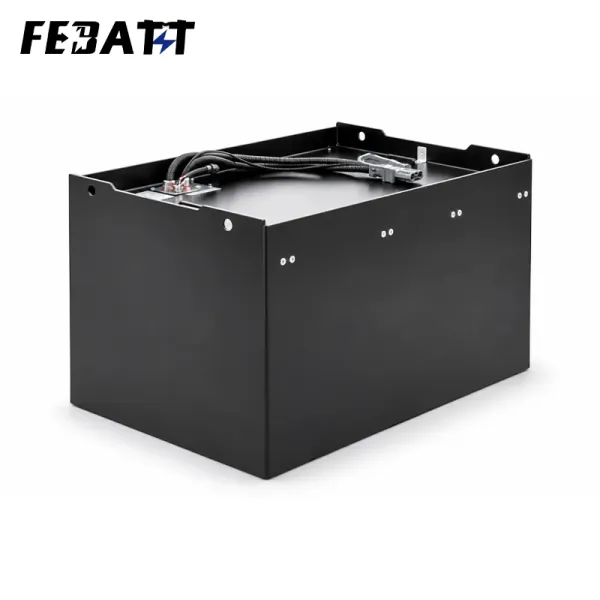
| Counterbalanced forklifts | Heavy lifting and repeated acceleration | Sustained power; manufacturer-approved pack mass and fit |
| Pallet jacks and stackers | Frequent starts and dense shift schedules | Usable runtime, compact mounting and predictable break-time recovery |
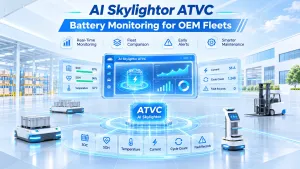
| AGV and AMR fleets | Unattended movements and dispatch synchronization | Controller communication, alarms and charging interoperability |
For busy shipping aisles, pallet jack battery planning for warehouse fleets explores the more specific downtime problem. Do not apply a forklift pack to a smaller truck simply because the electrical rating appears compatible.
How Should Charging Be Planned Around Real Workflows?
Opportunity charging is valuable only when energy replenishment fits the shift timetable. Map meal breaks, dispatch peaks, battery state of charge and charging-bay access. A material handling battery that can recharge quickly may still cause queues when several vehicles share one charger.
Calculate usable energy per shift, then validate charger compatibility, allowed charge current and ambient-temperature limits. Keep a contingency for missed breaks or seasonal demand. For automated vehicles, dock alignment and mission scheduling matter as much as the charge rate.
What Must OEMs Standardize Across Multiple Models?
Standardize what technicians and integrators must manage repeatedly, without forcing one enclosure or power rating onto every vehicle.
- Common elements: connector families where appropriate, fault-code definitions, service labels, BMS reporting fields and document formats.
- Model-specific elements: enclosure clearance, battery mass, continuous and peak current, thermal limits and validated charging profiles.
- Deployment controls: firmware versions, replacement procedures, approved charger lists and pilot-test criteria.
A material handling battery with CAN or RS485 support is not automatically plug-and-play with every controller. A South Korean AMR battery integration project illustrates why mechanical fit, communication and prototype validation should precede production.
How Can Fleets Control Safety and Lifecycle Cost?
Lithium avoids routine acid watering, but it does not eliminate electrical, thermal or handling hazards. Forklift operators must still observe site-specific charging controls. OSHA’s powered industrial truck requirements, including 29 CFR 1910.178(g), address charging areas, battery handling and related protections. Vehicle stability and approved counterweight requirements also remain critical after conversion.

Compare the material handling battery lifecycle using purchase price, chargers, energy, service labor, spare packs, downtime and planned replacements. Ask for tested system-cycle figures with stated depth of discharge and temperature conditions; cell-only claims are not equivalent to full-pack durability.
What Evidence Should Buyers Request Before Bulk Orders?
Request duty-cycle records, installation drawings, charger details, communication specifications and target quantities. Then commission pilot vehicles under representative loads, logging discharge peaks, low-SOC behavior, temperatures and fault responses. Freeze acceptance criteria before mass production.
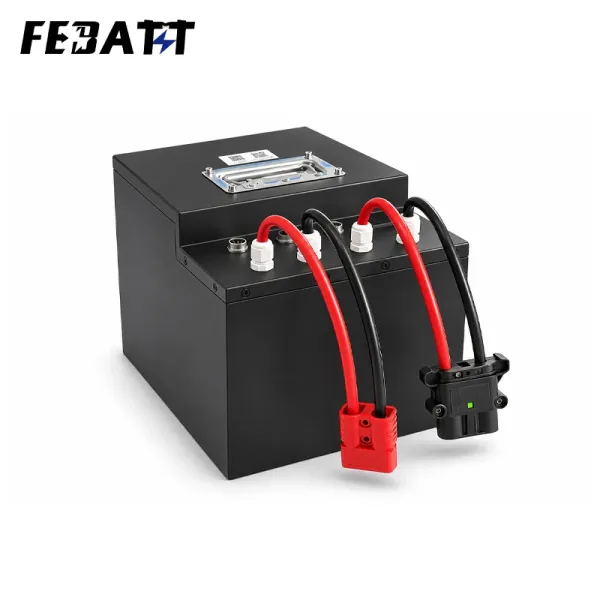
For a concrete specification reference, an industrial LiFePO4 pack for material-handling vehicles lists 10.08 kWh nominal energy, CAN communication and at least 2,000 rated complete-system cycles at 100% depth of discharge. These are product-specific published figures, not promises for every material handling battery. Check actual vehicle compatibility and agreed testing conditions.
For a comparable OEM quotation, buyers should provide the equipment model, nominal and operating voltage range, continuous and peak discharge-current requirements, battery compartment dimensions, permitted battery mass, connector details, BMS communication protocol and existing charging configuration. The RFQ should also distinguish prototype quantities, pilot orders and estimated annual demand. Agree on testing responsibilities, acceptance criteria, warranty coverage, technical-change control and replacement-part availability before approving serial production.
How Can Buyers Turn Battery Selection Into Reliable Fleet Capacity?
A successful material handling battery program starts with applications, not a universal pack. Choose lithium where its service and uptime advantages can be validated, standardize interfaces where practical and keep vehicle-specific safeguards. A staged pilot gives fleet purchasers stronger evidence for supplier qualification and repeat orders.
Planning a lithium battery upgrade for forklifts, pallet jacks, AGVs or a mixed warehouse fleet? Share your equipment models, operating conditions, current battery specifications, charging requirements and expected order volumes with FEBATT. Our team can review the project requirements, identify integration considerations and discuss a suitable battery configuration and validation plan before bulk procurement.
Frequently Asked Questions About Material Handling Batteries
Q: Can one material handling battery fit forklifts, pallet jacks and AGVs?
A: Not automatically. Shared chemistry or communication standards can simplify sourcing, but each machine needs verified fit, power demand, charging interfaces and, for counterbalanced trucks, approved battery mass.
Q: Are lithium forklift batteries better for multishift warehouses?
A: Often yes. Reduced routine servicing and compatible opportunity charging can improve availability. Savings depend on utilization, electrical infrastructure, acquisition costs and actual battery performance.
Q: What battery specifications matter most for pallet jacks?
A: Buyers should prioritize route demand, peak traction current, installation space, charging windows and connector compatibility. Validate runtime in actual picking and shipping cycles before ordering in volume.
Q: What should OEMs check in an AGV lithium battery?
A: Confirm BMS communication with the controller, fault handling, charging-station compatibility, temperature limits and recovery from low state of charge. Test the complete vehicle, not only the pack.
Q: How should buyers compare lithium and lead-acid battery costs?
A: Calculate total ownership cost across equipment life, including charging infrastructure, labor, replacement intervals, spare inventory and productive downtime. Use supplier test reports and site records instead of generic payback claims.