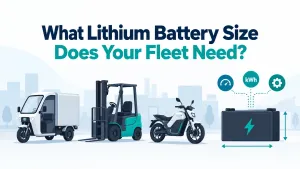
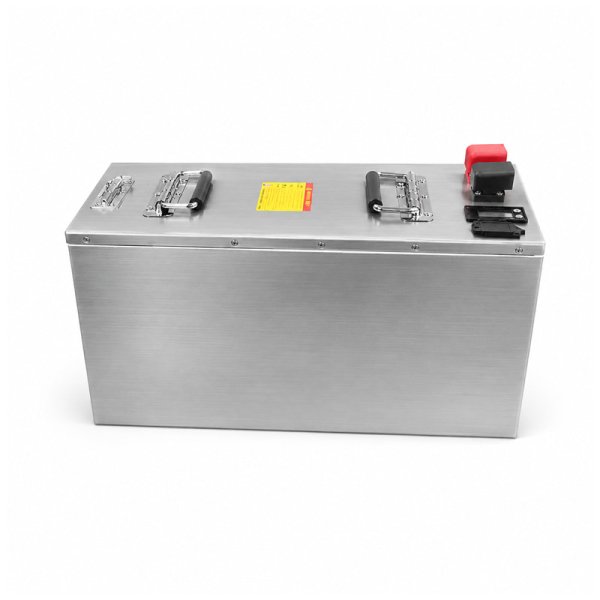
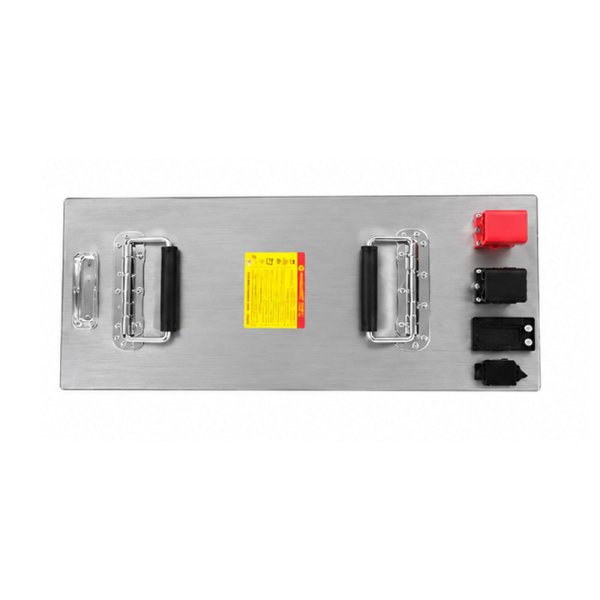
For electric forklifts, golf carts, RV auxiliary systems, electric tricycles, electric motorcycles, and other power-driven equipment, battery performance is not determined by voltage and amp-hour capacity alone. Lithium battery temperature influences usable energy, power output, charging acceptance, aging, protection limits, and daily fleet availability. A pack that performs normally in a test room may behave differently in a refrigerated warehouse, a sun-heated compartment, or an outdoor delivery route.
When cells become cold, ion transport slows, internal resistance rises, and voltage sag increases. When cells remain hot, unwanted side reactions proceed faster and can accelerate capacity loss and impedance growth. The objective is not to maintain one universal number, but to keep lithium battery temperature within the charge, discharge, and storage limits validated for the selected cells, pack design, current profile, and application.
For B2B buyers, the real question is whether the complete pack can measure, control, and tolerate expected thermal conditions without unpredictable derating, premature aging, or unsafe charging. This guide explains the temperature effect on capacity, the risks of cold weather charging, the causes of high heat battery degradation, and the role of a thermal management system.
Why Is Lithium Battery Temperature Important for Industrial Vehicles?
Commercial vehicles often operate for longer hours, carry changing loads, and follow more demanding charging schedules than privately used equipment. A forklift may complete repeated lift cycles and opportunity-charge during breaks. A golf cart may sit in direct sunlight before climbing grades with passengers. An electric tricycle may perform stop-and-go delivery work with variable payload. These conditions create heat through electrical resistance, current flow, contact resistance, and electrochemical reactions.
Buyers should distinguish among three measurements. Ambient temperature describes the surrounding air. Pack temperature is measured at one or more points inside the enclosure. Cell temperature describes the actual condition of individual cells, which may differ from the enclosure or ambient reading. A single external sensor cannot always detect a local hot spot near a busbar, connector, power switch, or poorly ventilated corner.
When reviewing FEBATT power battery solutions, procurement teams should match the climate, installation space, route, payload, motor demand, charging window, and thermal strategy as one system. A suitable lithium battery temperature plan should protect immediate performance while supporting predictable service life and total cost of ownership.
What Is a Practical Lithium Battery Temperature Range?
Many lithium-ion batteries deliver a favorable balance of efficiency, power, and aging performance near normal room temperature. A moderate target around 20°C to 30°C is often useful for daily operation, but it is not a universal approved range for every cell or pack. Some technical literature and battery designs use a broader preferred band, while product specifications may permit operation well outside that range under defined conditions.
The important distinction is between preferred and permitted conditions. A battery may be allowed to discharge at a temperature where charging is restricted. It may survive short exposure near a limit but should not remain there continuously. Storage limits can also differ from operating limits, particularly when the battery remains at a high state of charge for long periods.
A credible specification should therefore state separate limits for charging, discharging, storage, and any preheating or derating behavior. It should also explain whether the limits refer to ambient air, the pack enclosure, or measured cell temperature. Lithium battery temperature should be treated as a validated operating variable, not a single brochure number.
How Does Cold Weather Affect Capacity and Power?
The temperature effect on capacity from changing lithium battery temperature becomes noticeable as cells cool. Electrolyte conductivity decreases, ion transport slows, and charge-transfer resistance rises. Under load, the battery experiences greater voltage drop, so the vehicle may reach its low-voltage protection threshold before all stored energy can be delivered. Operators may observe less range, weaker acceleration, slower lifting performance, or an earlier low-state-of-charge warning.

The size of the reduction is not universal. It depends on chemistry, cell design, battery age, state of charge, discharge rate, voltage cutoff, and how long the pack has been cold. Fixed statements such as “every battery retains 85% at 0°C” should not be used without product-specific test data. A high-current forklift and a lightly loaded golf cart can show different results even when they use the same nominal chemistry.

Lithium battery temperature also affects power capability. A cold pack may still contain energy but be unable to supply the current demanded by a hill climb, heavy lift, or rapid acceleration without excessive voltage sag. This is why winter fleet planning should consider both kilowatt-hours and allowable current at the actual starting temperature.

Why Is Cold Weather Charging More Restrictive?
Cold weather charging requires tighter control than cold discharge. During normal charging, lithium ions move into the anode and are stored through intercalation. At a low lithium battery temperature, transport and diffusion become slower. If charge current is too high for the actual cell condition, lithium may deposit on the anode surface rather than entering it as intended. This is known as lithium plating.
Lithium plating can reduce available lithium, increase impedance, and shorten service life. Under severe or repeated conditions, metallic deposits may also increase safety risk. The probability is affected by cell design, state of charge, charge rate, aging, temperature distribution, and the charging protocol. It should not be reduced to one universal outdoor temperature rule.
Many graphite-anode lithium-ion packs restrict charging near or below 0°C, but the final limit must come from the selected cell and battery specification. A pack designed for cold climates may use reduced-current charging, an internal heater, insulation, or a controlled warm-up sequence. The charger, heater, sensors, BMS, and vehicle controls must work together.
A suitable BMS can block charging below a defined cell temperature, reduce current within an approved window, activate heating where fitted, and log temperature-related events. It cannot make cold weather charging safe by software alone if the hardware, cell design, and charger are not validated for the strategy.
Why Does High Temperature Accelerate Battery Aging?
A warmer cell may temporarily show lower resistance and stronger immediate power. That short-term response should not be confused with improved lifetime. Sustained high lithium battery temperature generally accelerates electrolyte decomposition, interphase growth, loss of active lithium, gas generation, and degradation of electrode or current-collector interfaces. These effects contribute to high heat battery degradation even when the battery continues to operate normally in the short term.

The aging rate depends on chemistry, state of charge, time, current, and thermal design. A battery held hot at a high state of charge may age differently from one that becomes warm briefly during a controlled discharge. Therefore, universal rules such as “capacity rises by 0.8% for every degree” or “life always halves for every 10°C” should not be presented as product guarantees.

Repeated exposure near the upper end of the approved range is cumulative. A pack may remain below its emergency shutdown threshold and still age faster if it spends many hours in direct sun, near a motor or exhaust heat source, or in a sealed compartment with limited airflow. Fast charging immediately after a demanding hot shift can add further thermal stress.

Lithium battery temperature should be monitored during representative duty cycles, not only during a short bench test. Useful warning signs include higher sensor spread, more frequent power derating, reduced range after hot shifts, increasing imbalance, or longer charging time. These indicators do not prove permanent damage by themselves, but they justify reviewing airflow, mounting position, cable connections, charge scheduling, and event logs.
What Is the Difference Between High Temperature and Thermal Runaway?
High heat battery degradation and thermal runaway are related but different. Elevated operation can accelerate aging without creating an immediate safety event. Thermal runaway is an extreme self-heating failure in which heat-generating reactions exceed the system’s ability to dissipate heat.
The onset varies with chemistry, state of charge, cell format, age, damage, and test method, so one universal threshold is misleading. Commercial packs should combine suitable cells, fusing, temperature sensing, BMS cutoffs, current derating, enclosure design, and fault handling.
Why Does Temperature Difference Inside a Battery Pack Matter?
Average lithium battery temperature can look acceptable while one region is consistently hotter or colder. Temperature variation occurs within individual cells and between cells in a module. Single-sided heating or cooling, dense packaging, poor thermal contact, uneven airflow, and nearby heat sources can all create gradients.
A hot region typically has lower resistance in the short term and may carry a different share of current. Over time, the hotter cell or area can age faster, increasing its resistance and heat generation. This feedback can enlarge the difference between cells. In a series-connected pack, the weakest cell can limit usable capacity and cause earlier protection events even when other cells remain healthy.
Temperature non-uniformity can also affect state-of-charge estimation and balancing. Sensors placed only at the enclosure edge may miss the thermal condition of center cells. A well-designed pack uses enough sensors in representative locations and provides effective heat paths so that localized conditions remain within validated limits.
Buyers should ask for the maximum expected sensor-to-sensor temperature spread during continuous rated current, peak load, charging, and environmental testing. The thermal management system should limit persistent hot spots rather than promise “perfectly equal” temperatures, which is unrealistic in practical equipment.
Which Thermal Management System Is Appropriate?
A thermal management system for lithium battery temperature control can include passive design features, active heating, active cooling, and BMS control. The best solution is not necessarily the most complex one. It is the simplest validated design that keeps cells within their approved limits and maintains acceptable temperature uniformity under the intended duty cycle.
Passive measures include heat spreaders, conductive paths, ventilation, reflective shielding, insulation, spacing, and separation from external heat sources. Their performance must be verified after installation because vehicle panels, dust, cargo, and restricted airflow can change heat transfer.
Active systems may use heaters, fans, pumps, or liquid circuits. Heating can support approved cold charging after the cells are warmed, while cooling may be needed for dense, high-power packs or long shifts. Each component adds controls, energy use, maintenance, and failure modes.
BMS temperature logic should coordinate warnings, charge restrictions, current derating, and shutdown with the charger and vehicle controller. Lithium battery temperature control is therefore a system-level engineering task. A BMS can enforce limits, but it cannot compensate for poor sensor placement, undersized conductors, trapped heat, or an unsuitable enclosure.
How Do Temperature Challenges Differ by Application?
Electric Forklifts and Material-Handling Equipment
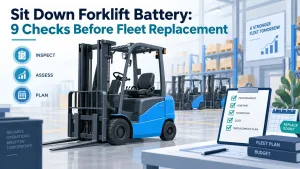
Forklifts combine high current, repeated lifting, regenerative events, and opportunity charging. As lithium battery temperature rises in multi-shift use, heat can accumulate; in refrigerated warehouses, resistance and charging restrictions become the main concern. Evaluation should reflect the route between warm and cold zones, payload, shift length, charging windows, and warm-up time.
Buyers reviewing FEBATT forklift battery options should request temperature mapping during representative lifting and charging cycles. Important data include the minimum cell temperature before charging, maximum temperature during the shift, temperature spread across sensors, and the BMS response to unsuitable conditions.
Golf Carts and Utility Vehicles
Golf carts often operate at moderate speed, but solar exposure can raise compartment temperature before the vehicle begins moving. Long outdoor parking, repeated hill climbing, passenger loads, and charging in a warm enclosed area can all influence lithium battery temperature.
A commercial golf cart battery should be evaluated with the actual compartment, ventilation, charger, route, and climate. Shaded parking, airflow, verified charger compatibility, and a cooling period after demanding use may support stable range and service life. FEBATT golf cart battery configurations provide a starting point, but the installation still requires validation.
RVs and Seasonal Auxiliary Power
Lithium battery temperature in RV compartments may differ substantially from cabin air. A pack near an exterior wall can cool quickly in winter, while one near heat-producing equipment can remain hot in summer. Storage duration and state of charge also matter when an RV is unused for weeks.
An RV thermal strategy may use insulation, ventilation, heating, remote monitoring, and temperature-based charge control. The correct combination depends on compartment location, climate, charging source, and load. Operators should verify the pack itself rather than assume cabin temperature represents cell temperature.
Electric Tricycles and Electric Motorcycles
Delivery tricycles and commercial electric motorcycles experience vibration, road splash, solar heating, hills, and repeated acceleration. Compact sealed enclosures can make heat removal difficult, while payload and stop-and-go routes create variable current demand.
The pack should define warning, derating, charge-restriction, and shutdown thresholds. Connector resistance, cable sizing, mounting position, enclosure sealing, and drainage should be reviewed together with the thermal design. Reliable lithium battery temperature control helps these vehicles deliver repeatable power and range without unpredictable protection events.
What Should B2B Buyers Verify Before Approval?
A broad advertised operating range is useful only when the supplier explains how it was obtained. Procurement teams should ask for the following information:
- Separate charging, discharging, and storage temperature limits.
- The selected cell model, chemistry, format, and manufacturer specifications.
- Whether limits refer to ambient, enclosure, sensor, or cell temperature.
- Sensor quantity, placement, accuracy, and fault detection.
- BMS warning, derating, charge-blocking, and shutdown thresholds.
- Heating or cooling method, control logic, and failure response.
- Temperature mapping under rated current, peak loads, and charging.
- Maximum sensor spread, test conditions, event logging, and acceptance criteria.
A practical validation plan should define the starting temperature, route or shift profile, payload, charging schedule, maximum permitted sensor reading, acceptable temperature spread, and pass/fail response. This converts lithium battery temperature from a marketing claim into a measurable engineering requirement.
Technical Relevant FAQ
1.What Is the Best Lithium Battery Temperature for Daily Use?
There is no single ideal value for every lithium-ion battery. Many systems perform efficiently near room temperature, and 20°C to 30°C may be favorable. However, the approved lithium battery temperature range depends on the cell, pack, current, state of charge, and operating mode. Follow separate charging, discharging, and storage specifications.
2.Why Does a Battery Deliver Less Range in Cold Weather?
Cold conditions slow ion transport and increase resistance. Voltage sag can make the vehicle reach its low-voltage limit earlier, reducing usable energy and peak power. The temperature effect on capacity varies with chemistry, current, age, and cutoff voltage. Some performance can return after warming if the battery remained within approved limits.
3.Is Cold Weather Charging Below 0°C Always Unsafe?
It should not be assumed safe unless validated by the manufacturer. Many graphite-anode packs restrict charging near or below freezing because lithium-plating risk increases as charge acceptance falls. Some use heating or reduced-current protocols. The cold weather charging procedure must be supported by the cells, BMS, charger, sensors, and control logic.
4.How Does Summer Heat Affect a Golf Cart or RV Battery?
Direct sunlight and enclosed compartments can raise lithium battery temperature above ambient. Prolonged heat can accelerate aging and trigger derating or charge restrictions. Shade, ventilation, correct spacing, and monitoring can reduce exposure, but the final solution depends on the installation and validated limits.
5.Can a BMS Solve Temperature Problems by Itself?
No. A BMS can measure sensors, block charging, reduce current, activate thermal hardware, and shut down the pack. It cannot correct inadequate airflow, poor conductor sizing, excessive contact resistance, or unsuitable mounting. An effective thermal management system combines mechanical, electrical, and control design.
6.Why Are Temperature Differences Especially Important in Forklift Packs?
Large forklift packs can develop hot center regions or local heat near high-current connections. Uneven lithium battery temperature can create different aging rates, allowing one weaker cell to limit the series-connected pack. Buyers should request temperature mapping during real lifting and opportunity-charging cycles.
Conclusion
Lithium battery temperature affects usable capacity, power capability, charging safety, aging, protection behavior, and fleet scheduling. Cold cells have higher resistance and reduced charge acceptance, while sustained heat accelerates side reactions and long-term degradation. Temperature differences inside a pack can create uneven aging even when the average reading appears normal.
For B2B fleets, effective lithium battery temperature control requires more than a wide specification range. It requires validated cells, appropriate sensor placement, BMS thresholds, suitable heating or cooling, correct installation, and tests that represent the real vehicle duty cycle. The right thermal management system should protect performance without adding unnecessary complexity or unpredictable downtime.
Fleet managers and OEM buyers should compare products using defined charging, discharging, and storage limits, application-level temperature maps, and measurable acceptance criteria. By treating lithium battery temperature as a system engineering requirement, businesses can improve reliability, protect service life, and make more defensible purchasing decisions for forklifts, golf carts, RVs, electric tricycles, electric motorcycles, and other commercial equipment.