Modern warehouses depend on predictable material flow. When a lift truck stops because its battery needs servicing, charging, or replacement, the interruption can affect operators, staging areas, picking schedules, and outbound delivery. For that reason, forklift truck batteries should be evaluated as part of the warehouse operating system rather than as isolated replacement components.
Lithium technology is particularly useful in multi-shift operations, high-throughput distribution centers, manufacturing plants, and facilities that want to reduce routine battery handling. Compared with flooded lead-acid systems, a correctly engineered lithium forklift truck battery can eliminate watering, support opportunity charging, maintain more consistent voltage through much of the usable state-of-charge range, and provide BMS-based monitoring. These advantages are valuable only when the battery is correctly matched to the truck, charger, duty cycle, environment, and counterweight requirements.
Last reviewed: August 2026. Technical scope: lithium traction batteries for industrial forklifts and warehouse material-handling applications. The buying decision should move from duty cycle → runtime and charging → truck integration → service model → TCO → supplier validation.
What Defines Modern Forklift Truck Batteries for Warehouse Duty?
The best forklift truck batteries are specified around duty cycle. Capacity in ampere-hours matters, but it does not describe how the truck will behave during repeated acceleration, hydraulic lifting, long travel, cold-room work, or continuous multi-shift operation. Buyers should also review nominal energy, continuous and peak current, charge-current limits, thermal behavior, cycle-life test conditions, BMS functions, dimensions, weight, connectors, communication, and charger compatibility.
LiFePO4 is commonly considered for industrial traction applications because it can offer strong thermal stability and long cycle-life potential when operated within the cell and pack manufacturer’s limits. However, chemistry alone does not guarantee safety or service life. Cell consistency, electrical joints, insulation, enclosure design, software thresholds, thermal sensing, production quality, and validation all influence the performance of a complete forklift truck battery.
Mechanical integration is equally important. Batteries for forklift trucks must fit the specified compartment and must not compromise truck stability. In many forklifts, battery mass contributes to the designed counterbalance, so a lighter lithium pack cannot automatically replace a heavier lead-acid battery without verifying the truck manufacturer’s minimum battery weight or approved ballast arrangement.
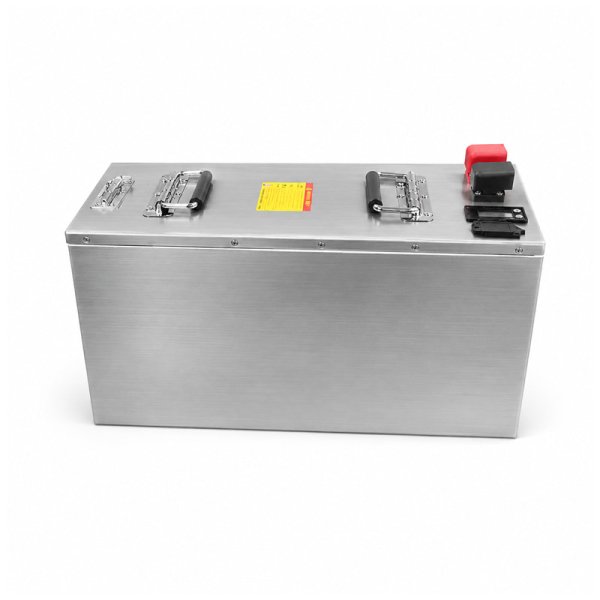
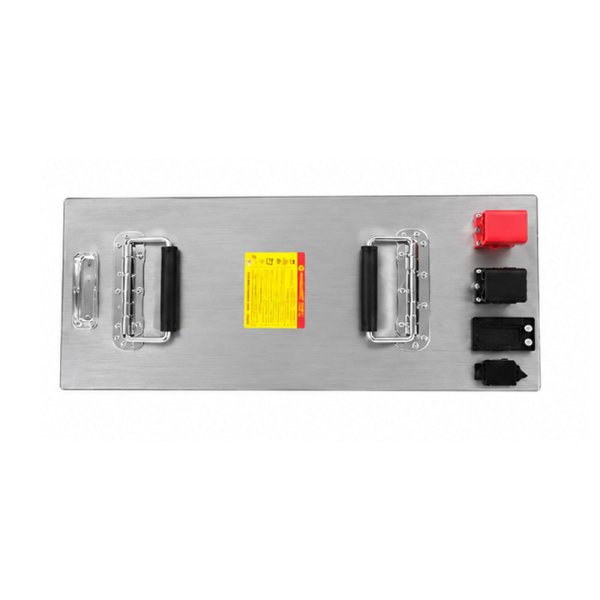
For compact or moderate-duty applications, a 48V configuration may offer a practical balance of packaging, power, and energy. FEBATT’s 48V 60Ah forklift battery is one example of a compact platform that B2B buyers can evaluate when the truck’s electrical specification, current demand, compartment, and operating schedule are compatible.
How Should 48V, 64V, and 72V Batteries Match Forklift Duty Cycles?
Voltage selection should begin with the forklift manufacturer’s specification, not with payload alone. Two trucks with similar rated capacities can have very different motor power, hydraulic demand, travel speed, lift height, shift length, and controller architecture. Forklift truck batteries therefore need to match the complete electrical system and real operating cycle.
A 48V platform is common in many electric material-handling applications, and electric forklift truck batteries in this voltage class can suit compact or medium-duty trucks when the equipment is designed around that voltage. The system should still be checked for continuous current, peak acceleration current, hydraulic demand, usable energy, charger profile, and the battery’s required mass.
A 64V architecture can be appropriate where a truck or custom industrial platform is specifically designed for an intermediate voltage. For applications requiring 105Ah of capacity, FEBATT’s 64V 105Ah forklift battery illustrates a higher-energy option that should be assessed against the vehicle’s actual electrical architecture, compartment dimensions, communication protocol, and thermal duty.
For trucks engineered around a higher-voltage platform, a 72V system can reduce current for a given electrical power compared with a lower-voltage architecture. That can reduce resistive losses in conductors when the complete system is properly designed. FEBATT’s 72V 105Ah forklift battery is an example for projects that require this voltage class and corresponding energy capacity.
Using the labeled nominal values, 64V x 105Ah is approximately 6.72 kWh and 72V x 105Ah is approximately 7.56 kWh. These calculations describe nominal energy, not guaranteed usable energy. Actual usable output depends on the product’s specified nominal voltage, BMS limits, temperature, current demand, state-of-health criteria, and the operating reserve required by the fleet.

The practical decision is therefore not “Which voltage is strongest?” It is “Which forklift truck batteries match the approved truck architecture while providing enough usable energy and current capability for the duty cycle?” Buyers comparing batteries for forklift trucks should document that match before approval.
Why Is Opportunity Charging Valuable in Multi-Shift Warehouses?
Opportunity charging means adding energy during natural pauses such as breaks, shift changes, staging periods, or scheduled idle time. It is one of the main reasons lithium forklift truck batteries can change fleet planning in high-utilization warehouses. Official forklift manufacturers describe lithium-ion systems as suitable for faster recharging and opportunity charging, but the benefit depends on a compatible battery-and-charger system.
Opportunity charging should never be improvised. The charger must match battery chemistry, nominal and maximum charge voltage, permitted charge current, connector and polarity, communication requirements, and temperature limits. BMS logic must also permit the intended charge rate. Charging locations should be designed so cables and parked trucks do not create hazards or obstruct pedestrian and material-flow routes.
How Does Low-Routine-Maintenance Lithium Reduce Forklift Downtime?
Flooded lead-acid batteries require recurring electrolyte-related tasks such as water-level checks, distilled-water replenishment, equalization according to the battery procedure, cleaning, and corrosion control. Across a large fleet, those tasks consume technician time and create opportunities for missed maintenance.
Lithium forklift truck batteries do not require routine watering or user-serviced electrolyte-level maintenance. This removes one of the most repetitive maintenance activities in traditional battery rooms. There is also no flooded lead-acid-style equalization routine unless a specific lithium system manufacturer defines another balancing or service procedure.
Low routine maintenance does not mean no inspection. Fleet teams should still check connectors, cables, mounting hardware, enclosure condition, charger performance, BMS alarms, software or firmware where applicable, and signs of impact or abnormal heating. Maintenance records should identify the truck and battery so repeated faults can be traced rather than treated as isolated incidents.
For electric forklift truck batteries, the operational value comes from shifting labor away from frequent electrolyte servicing toward condition-based inspection. For warehouses operating dozens or hundreds of batteries for forklift trucks, even a modest reduction in recurring service minutes can become meaningful when multiplied across shifts and a full year.
Which Forklift Battery Costs Matter Beyond Purchase Price?
Lithium-ion traction systems generally provide higher charge and discharge efficiency than conventional flooded lead-acid systems, although the exact difference depends on the battery, charger, operating temperature, current profile, and state of health. For fleet analysis, the relevant measure for electric forklift truck batteries is electricity purchased from the grid compared with productive work delivered by the truck.
Forklift truck batteries based on lithium chemistry also tend to maintain a flatter discharge-voltage profile than lead-acid packs. This can help the traction and hydraulic systems receive more consistent voltage during much of the usable discharge range. It does not eliminate controller limits or thermal constraints, but it can reduce the pronounced end-of-shift voltage sag associated with heavily discharged lead-acid batteries.
Energy savings should not be presented as one universal percentage. A defensible warehouse calculation should use charger input energy, battery output, truck operating hours, electricity tariff, and actual production data. If a new battery system reduces energy lost as heat and charging inefficiency, the financial effect can be calculated over thousands of annual charging events.
How Does an Integrated BMS Protect Forklift Truck Batteries Under Heavy Loads?
The battery management system is the electronic supervisory layer of modern forklift truck batteries. Depending on the design, it monitors individual cell voltage, pack voltage, current, temperature, state of charge, fault status, and sometimes state-of-health indicators. It can trigger warnings, limit operation, or disconnect the pack when defined protection thresholds are exceeded.
Heavy lifting and repeated acceleration create transient current demands. The BMS must therefore be coordinated with the cells, busbars, contactors, cables, connectors, controller, and thermal design. A battery that has adequate energy capacity can still be unsuitable if its continuous or peak current limits are lower than the truck requires.
Cell balancing is another important function. A BMS may use passive or active balancing strategies, depending on the architecture, to reduce cell-voltage differences. Buyers should ask when balancing occurs, what conditions trigger it, and how imbalance or weak-cell events are recorded.
Thermal protection matters in both hot and cold facilities. High temperature can accelerate battery aging, while low temperature may restrict charge acceptance. Forklift truck batteries intended for cold storage or other demanding environments should have clearly defined charge and discharge temperature limits and, where relevant, validated thermal-management features.

When Are 64V 105Ah and 72V 105Ah Batteries Suitable for Heavy-Duty Forklifts?
A 105Ah capacity can provide meaningful energy reserve for trucks that run long shifts or combine traction with frequent hydraulic lifting. However, neither 64V nor 72V is automatically a “heavy-duty” solution. The correct forklift truck battery is the one approved for the truck’s voltage architecture, current demand, battery compartment, counterweight requirement, charger, and communication system.
A 64V 105Ah pack using a 64V nominal rating represents about 6.72 kWh of nominal energy. A 72V 105Ah pack using a 72V nominal rating represents about 7.56 kWh. These figures are useful for initial energy planning but do not define actual runtime. Usable energy changes with BMS limits, temperature, load profile, aging, and the fleet’s reserve policy.
When comparing forklift truck batteries for demanding applications, ask the supplier for the battery’s continuous and peak current, dimensions, weight, connector drawing, CAN documentation where applicable, charging limits, thermal limits, and test conditions. That evidence is more useful than describing one configuration as universally “ideal.”
How Can Lithium Batteries Reduce Air-Quality and Acid-Handling Burdens?
Electric forklifts produce no local tailpipe exhaust during operation, regardless of whether they use lead-acid or lithium traction batteries. The battery-technology difference is more relevant in the charging and maintenance environment. Flooded lead-acid batteries can release hydrogen during charging and require work around sulfuric-acid electrolyte, which can create ventilation, corrosion, spill-control, and PPE requirements.
Lithium forklift truck batteries remove routine watering and flooded electrolyte handling during normal use. A sealed traction pack can therefore simplify some battery-room housekeeping and reduce routine exposure to acid-related maintenance. That does not make lithium risk-free: appropriate electrical protection, charger controls, temperature management, inspection, fire-risk assessment, and emergency procedures are still necessary.
How Should B2B Fleets Calculate Total Cost of Ownership?
Lithium forklift truck batteries often have a higher purchase price than conventional lead-acid alternatives, so acquisition cost alone can make the comparison misleading. A useful TCO model should cover the full planned operating period and use actual fleet assumptions.
Fleet battery TCO = batteries + chargers + electricity + maintenance labor + replacement batteries + spare-pack requirements + battery-handling infrastructure + downtime – residual value

The analysis should define the number of trucks, shifts per day, annual operating hours, electricity price, maintenance labor rate, expected charging pattern, replacement criteria, and cost of lost productive time for the forklift truck batteries under review. If the facility already owns lead-acid changing equipment, its remaining value should also be considered rather than automatically assigning the full historical cost to the comparison.
Opportunity charging can change the model because suitable lithium systems may reduce battery swaps and spare-pack requirements. Lower watering and corrosion-related labor can also reduce recurring service expense. Higher charging efficiency may decrease electricity use. Each benefit should be quantified from the site’s own data rather than presented as a guaranteed percentage.
How Can Warehouse Managers Select an OEM Forklift Battery Manufacturer?
For electric forklift truck batteries, a reliable supplier should be able to move beyond a catalog description and explain how the battery is engineered, manufactured, validated, and supported. When comparing forklift truck batteries, procurement teams should request evidence for cell sourcing, pack architecture, current capability, BMS functions, thermal safeguards, quality-control steps, traceability, and end-of-line testing.
Compatibility documentation is essential. Ask for nominal voltage, maximum charge voltage, capacity, nominal energy, continuous and peak current, dimensions, net weight, connector type, polarity, communication protocol, mounting information, operating temperature, storage requirements, and approved charger parameters. For replacement projects, verify the forklift manufacturer’s battery-weight and counterbalance requirements before approving a lighter lithium pack.
Manufacturing consistency also matters. A supplier should demonstrate how it controls cell matching, busbar or welding quality, insulation, torque processes, BMS programming, enclosure sealing, final functional tests, and serial-number traceability. Test reports and certifications should apply to the relevant product and market rather than being presented as generic company credentials.
OEM capability becomes important when standard batteries for forklift trucks do not fit the vehicle. B2B projects may require custom dimensions, connectors, communication, display interfaces, mounting, thermal features, charging parameters, or capacity. Customization should be handled through an engineering-change and validation process, not by modifying a finished pack without system verification.
What Should Buyers Verify Before Replacing Lead-Acid With Lithium?
Converting an existing forklift requires a system-level compatibility review. The replacement forklift truck battery should match the truck’s approved voltage, controller requirements, and electrical interfaces. Physical fit alone is not enough.
Before approval, confirm battery compartment dimensions, minimum and maximum permitted battery weight, counterbalance requirements, center of gravity, continuous and peak current, connector and polarity, fuse or protection arrangement, charger compatibility, CAN or other communication, mounting restraints, and service access. If ballast is required, it should follow the truck manufacturer’s approved approach.
For forklift truck batteries, the charger must also be treated as part of the conversion. A lead-acid charger should not be assumed compatible with lithium simply because the nominal voltage appears similar. Verify the exact maximum charge voltage, charge-current limits, charging profile, communication, connector, and temperature controls for the selected forklift truck batteries.
FAQ About Forklift Batteries
1.How long do lithium forklift truck batteries last?
There is no universal number of years or cycles that applies to every forklift truck battery. Service life depends on cell chemistry, depth of discharge, charge rate, operating temperature, current demand, calendar aging, maintenance, and the manufacturer’s end-of-life criterion. B2B buyers should compare cycle-life data only when the test conditions and remaining-capacity threshold are stated. Fleet replacement planning should use the specification for the exact battery model and actual duty-cycle data.
2.Can I replace a lead-acid battery with a lithium forklift battery directly?
Not without a compatibility review. The lithium replacement must match the forklift’s approved voltage and electrical requirements, fit the compartment, satisfy minimum battery-weight and counterbalance rules, support continuous and peak current, and use compatible connectors, communication, and charging equipment. A forklift truck battery that physically fits may still be unsafe or unsuitable if the weight distribution, charger, controller, or BMS integration is wrong.
3.How long does it take to charge a lithium forklift truck battery?
Charging time depends on battery capacity, starting state of charge, permitted charge current, charger output, temperature, BMS limits, and the final charge-control stage. Some commercial systems are designed for rapid or opportunity charging, while others use lower charge rates. Buyers should use the charge-time specification for the exact battery-and-charger combination rather than assuming a universal one-to-four-hour window.
4.What voltage options are used for industrial forklift truck batteries?
Industrial forklifts use different voltage platforms according to the truck’s electrical architecture and application. Common platforms include 24V, 36V, 48V, 72V, and 80V, while other configurations, including 64V systems, are used in specific equipment or projects. Always follow the forklift manufacturer’s specified voltage. FEBATT’s 48V, 64V, and 72V examples should therefore be selected only where the truck and charger are compatible.
5.Do lithium forklift truck batteries require daily watering?
No. Lithium forklift truck batteries do not require the routine distilled-water top-ups or user-serviced electrolyte-level maintenance associated with flooded lead-acid batteries. They still require periodic inspection of connectors, cables, mounting, enclosure condition, charger performance, BMS alerts, and other items defined by the manufacturer. Low routine maintenance should not be interpreted as no maintenance at all.
Conclusion
Forklift truck batteries affect far more than the distance a truck can travel between charges. In a modern warehouse, battery selection influences charging logistics, maintenance labor, equipment availability, electricity consumption, safety procedures, and total cost of ownership.
The right voltage and capacity cannot be selected from payload or nominal energy alone. A 48V, 64V, or 72V system must match the truck’s approved electrical architecture, current demand, compartment, weight requirements, charger, and communication. Opportunity charging can be valuable in multi-shift facilities, but only when the complete battery-and-charger system is designed for the intended charging pattern.
When the battery, truck, charger, warehouse process, and supplier are evaluated as one system, forklift truck batteries can help create a more predictable material-handling operation with less routine battery servicing, better use of scheduled charging windows, and more transparent lifecycle economics.