A forklift that completes its shift without interruption protects picking schedules, loading commitments and labor planning. Choosing a forklift battery size by rated motor power alone, however, can create an expensive mismatch. An oversized pack ties up purchasing budget and may add unnecessary weight; an undersized pack can force an unplanned stop before the shift ends.
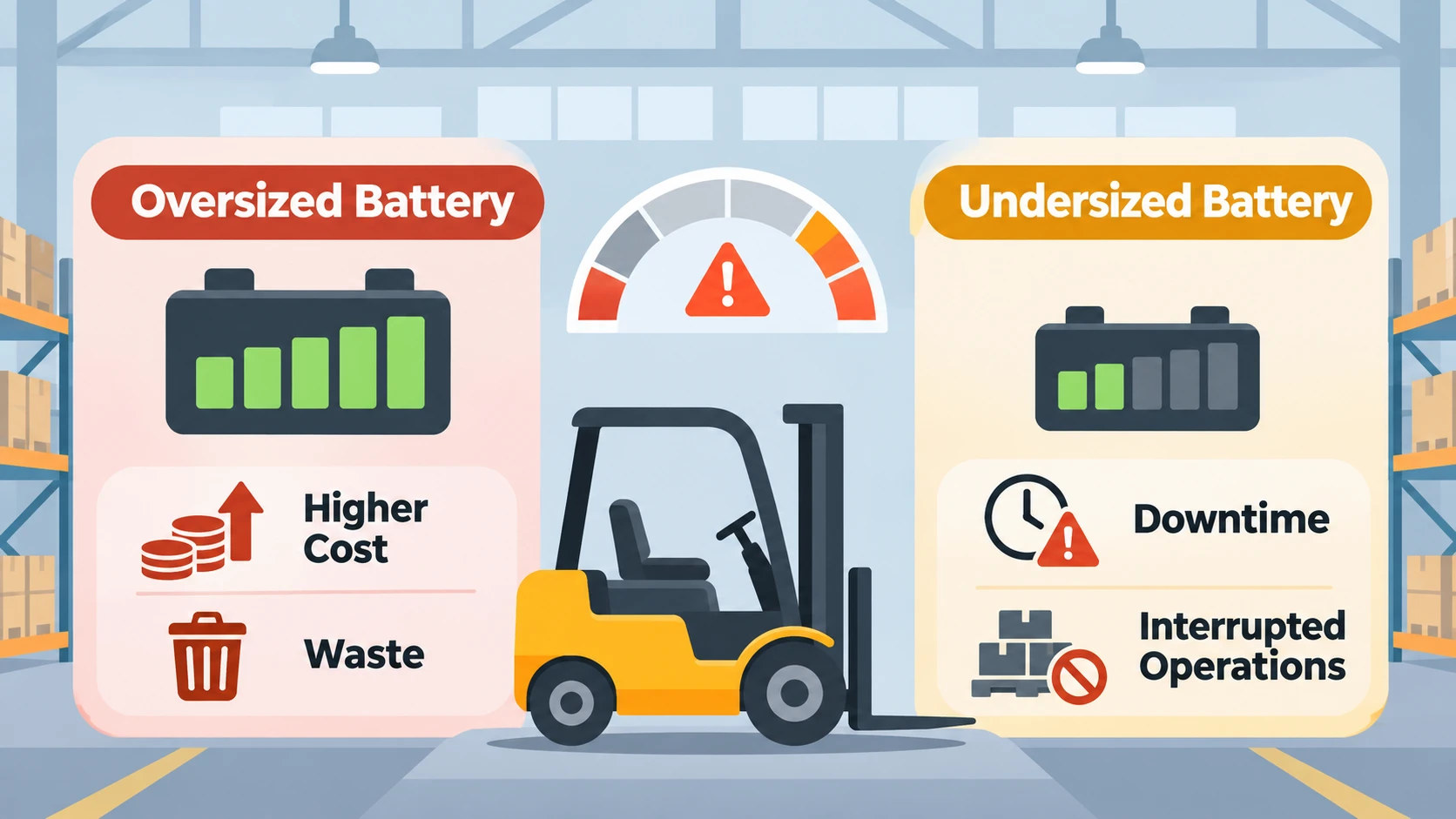
For a warehouse fleet, forklift battery size must reflect actual work, not a generic chart. Buyers should assess travel, lifting, auxiliary loads and charging opportunities, then validate the estimate with measured energy use. LiFePO4 is often a strong B2B option because it offers stable output, faster charging and less routine maintenance than lead-acid systems.
What Determines the Right Forklift Battery Size?
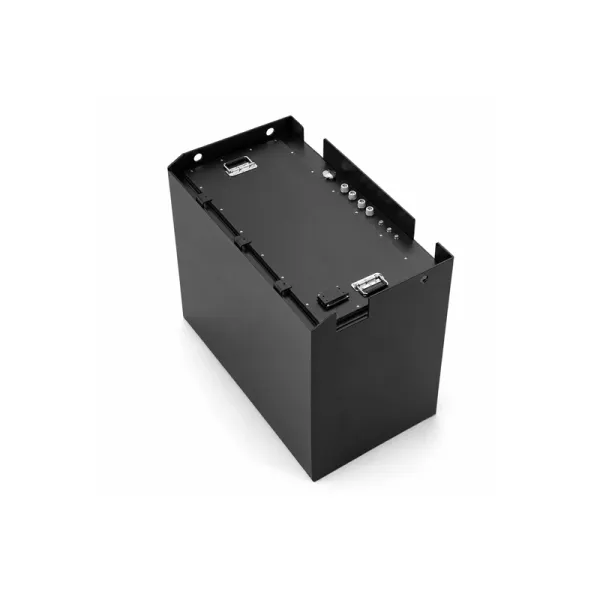
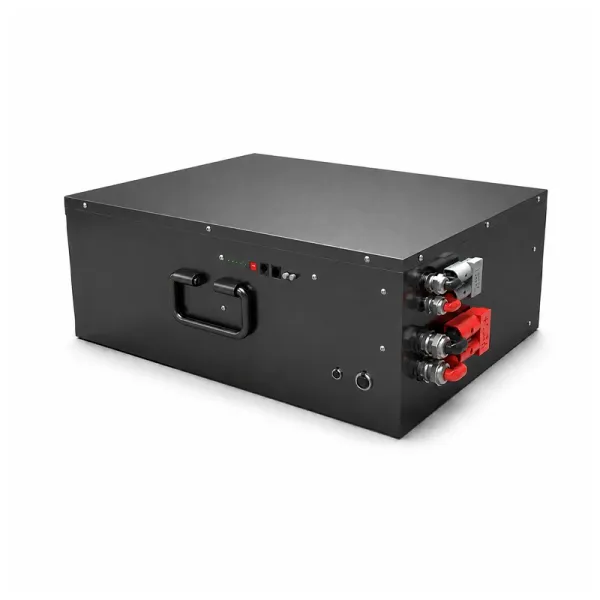
Forklift battery size also includes physical dimensions, voltage compatibility, and battery weight. Before selecting a replacement, confirm the battery compartment’s length, width, and height, the truck’s approved voltage, mounting requirements, connector position, and minimum battery weight. A battery with sufficient energy capacity may still be unsuitable if it does not meet the forklift manufacturer’s installation and stability requirements.

Three operating groups shape energy demand:
| Energy demand | Energy demand What changes consumption |
|---|---|
| Traction and travel | Loaded distance, acceleration, ramps, floor condition and stop-start frequency |
| Hydraulic lifting | Payload, lift height, lift frequency and time spent positioning loads |
| Controls and auxiliaries | Steering, displays, sensors, cooling fans and systems active during a shift |
These loads do not run continuously at rated power. A motor rating describes capability, not forklift battery size or shift energy use. Therefore, battery capacity should reflect the forklift’s actual duty cycle: the repeatable pattern of travel, lifting, waiting and handling. For B2B buyers, it is a fleet-planning decision, not a catalog lookup.
High-rack reach trucks and loading-yard counterbalance trucks can have different energy profiles despite similar nameplate power. Cold storage, ramps, attachments and peak loads also change forklift battery size requirements. No single load factor is universal. Battery selection must account for how the truck operates.
How Can Fleet Managers Estimate Forklift Battery Size?
Start with the interval the pack must cover: one shift, the time between charging breaks, or a full work window without opportunity charging. Collect measured energy data and record operating hours, payload, lift cycles, travel distance and idle time. A reliable capacity estimate uses energy records from the relevant operating interval.
Use this calculation as a starting point:
Required nominal energy (kWh) = measured energy demand ÷ usable-energy fraction
If the fleet needs an operating contingency, include it explicitly:
Required nominal energy = measured energy demand × (1 + contingency) ÷ usable-energy fraction
The usable-energy fraction and contingency must follow the supplier’s approved operating window and fleet risk requirements; neither is universal. ISO 23308-1:2025 provides general industrial-truck energy measurement criteria, including battery and charger efficiency for electric trucks.

A Worked Example: Verify Every Assumption
Consider an illustrative case with 10 kW total rated motor power, an eight-hour shift and an assumed 0.65 average load factor:
10 kW × 0.65 × 8 h = 52 kWh
But 0.65 is an assumption, not a universal forklift standard; replace it with measured consumption where possible. If the project also uses a 15% contingency and an 85% usable-energy assumption, the result is:
52 × 1.15 ÷ 0.85 = 70.35 kWh nominal
This is illustrative, not a universal 10 kW forklift recommendation. Under these assumptions, 60 kWh would be insufficient. A defensible forklift battery size calculation needs recorded data and documented assumptions.
Why Should Fleets Consider Lithium for Intensive Forklift Operations?
Nominal kWh is only one part of the decision. Buyers should compare usable energy, power delivery, charging windows, maintenance labor and replacement planning. LiFePO4 forklift batteries suit many intensive operations through stable high-current output, faster charging and reduced watering and maintenance. Results depend on pack design, charger compatibility, temperature and charging practice.
Lithium can simplify installation where weight and space are constrained, but the pack must meet the truck’s minimum weight and stability requirements. A lighter battery is not automatically suitable for a counterbalanced truck. See this lead-acid forklift battery vs. lithium guide for operating trade-offs.
What Should Buyers Verify Before Approving a Custom Battery?
Prepare a concise RFQ package before requesting a custom configuration:
- Forklift make, model, application and existing battery rating.
- Measured energy use per shift or charging interval.
- Typical and maximum payload, lift height and cycle frequency.
- Required operating time, charging opportunities and ambient temperature.
- Peak discharge current, connector, communication and charger requirements.
- Battery compartment limits and the vehicle’s minimum weight requirement.
For multi-shift fleets, match battery capacity to the actual charging schedule instead of assuming every truck needs one full-shift pack. This forklift battery charging guide explains charging-window planning.
A custom supplier should review duty-cycle data, document the capacity recommendation, propose a configuration and validate it through sample testing before volume production. FEBATT’s custom power battery solution supports application analysis, capacity configuration, BMS matching, testing and OEM/ODM supply for industrial fleets.
What Do Fleet Buyers Ask Before Ordering?
What Forklift Battery Size Is Needed for an Eight-Hour Shift?
Shift length alone is not enough. Provide energy use, active operating time, payload, lift frequency and charging opportunities. The selected pack should cover the longest interval between reliable charging opportunities.
How Do You Calculate Forklift Battery Size in kWh?
Use measured energy demand for the operating interval, then divide by the approved usable-energy fraction. Add a documented contingency only when the fleet’s duty cycle requires it.
How Many Amp-Hours Does a Forklift Battery Need?
First establish required nominal kWh. Convert it to Ah using nominal voltage: Ah = kWh × 1,000 ÷ V. Confirm that the final pack also meets current and fitment requirements.
Can a Lithium Battery Replace a Lead-Acid Forklift Battery?
Often, but not automatically. Verify voltage, dimensions, connector, charger settings, discharge capability, communication and counterweight requirements before approving a retrofit.
Is a Larger Forklift Battery Always Better?
No. Excess capacity can increase purchase cost and affect vehicle weight or fit. The right pack meets measured energy demand and the required operating reserve without compromising stability or performance.