Cold-weather performance is a major purchasing concern for manufacturers and fleet operators using electric forklifts, electric tricycles, golf carts, recreational vehicles, and electric motorcycles. Below 0°C, lithium-ion transport slows, internal resistance rises, and available power and energy can fall. At -20°C or -30°C, the impact may become operationally significant. A low temperature lifepo4 battery is therefore not simply a standard pack with a new label; it must combine suitable cells, validated electrochemical behavior, thermal design, and protective control logic.
Vinylene carbonate, commonly abbreviated as VC, is often used as a film-forming electrolyte additive because it can participate in formation of the solid electrolyte interphase on a graphite anode. The supplied Chinese source compared four VC concentrations in LiFePO4/graphite pouch cells at -30°C. Its results suggest that a moderate VC level can improve performance in one formulation, while excessive VC may increase interface resistance.
This article converts those findings into a B2B purchasing framework without treating one laboratory result as a universal specification. It explains what the data can and cannot prove, how cold climate lithium iron phosphate systems should be evaluated at cell and pack level, and what OEMs should request before selecting a low temperature lifepo4 battery. For procurement, a low temperature lifepo4 battery should be defined by validated operating conditions rather than a marketing label.
Why Does LiFePO4 Performance Decline in Cold Conditions?
A lithium-ion cell depends on lithium-ion movement through the electrolyte and electrode interfaces. As temperature falls, electrolyte viscosity generally rises, ionic conductivity declines, charge-transfer reactions slow, and voltage drop under load increases. Usable capacity and power therefore decrease even when the cell has not suffered permanent damage.
The graphite anode is especially sensitive during charging. At low temperature, lithium ions may not intercalate quickly enough, allowing metallic lithium to deposit on the surface if current is too high. This is why a low temperature lifepo4 battery may discharge below freezing but still require preheating or a reduced charging current.
Performance also depends on the complete electrolyte, electrode design, cell construction, formation process, and pack controls. VC cannot compensate for every limitation by itself.
What Role Can VC Play in a Low Temperature LiFePO4 Battery?
VC is commonly described as an SEI-forming additive. During formation, it can be reduced on the graphite surface and contribute to a protective interphase before excessive solvent decomposition occurs. A useful SEI should permit lithium-ion transport while limiting continued electrolyte consumption.
The source article attributes the improved -30°C results to a more stable interphase, changes in solvation, lower polarization, and reduced solvent crystallization. These mechanisms are plausible, but the article did not provide advanced surface characterization to prove each one directly. The correct conclusion is that VC concentration affected the tested cells; the precise mechanism needs further validation.
For B2B buyers, VC is one design variable rather than proof of a finished low temperature lifepo4 battery. Cell materials, separator properties, electrolyte volume, manufacturing consistency, BMS limits, and thermal management remain essential.
How Was the Low Temperature LiFePO4 Battery Experiment Designed?
The source describes four pouch-cell groups using a LiFePO4 cathode and artificial graphite anode. VC concentration was set at 3.0%, 3.2%, 3.5%, or 3.8%. The cells were produced under the same process conditions, followed by the same formation and capacity-grading procedures, and were tested at -30°C.
The reported evaluation covered discharge capacity, direct-current internal resistance, energy efficiency, and capacity retention after 300 cycles. Discharge capacity was reportedly calculated from the integrated area of cyclic-voltammetry curves. The article does not provide nominal cell capacity, current rate, voltage window, sample size, or statistical variation, so the data should be treated as a comparison rather than a product specification.
There was also no 0% VC control group. The experiment identifies the best result among four tested concentrations but cannot prove that all VC-containing cells outperform an otherwise identical formulation without VC.
Reported -30°C Results from the Supplied Source
| VC content | Discharge capacity | DCR | Energy efficiency | Capacity retention after 300 cycles |
|---|---|---|---|---|
| 3.0% | 4.6 Ah | Exact value not stated | Within reported 72.5%-79.0% range | Within reported 90.0%-96.1% range |
| 3.2% | 5.0 Ah | Exact value not stated | Within reported 72.5%-79.0% range | Within reported 90.0%-96.1% range |
| 3.5% | 5.6 Ah | 0.76 mΩ | 82.0% | 97.5% |
| 3.8% | 5.0 Ah | Reported as increased | Within reported 72.5%-79.0% range | Within reported 90.0%-96.1% range |
Source limitation: the original article did not provide individual DCR, efficiency, or cycle-retention values for every non-3.5% group. The ranges above are reproduced without inventing missing data.
What Did the Low Temperature LiFePO4 Battery Test Show at -30°C?
Reported discharge capacity was 4.6 Ah at 3.0% VC, 5.0 Ah at 3.2%, 5.6 Ah at 3.5%, and 5.0 Ah at 3.8%. The 3.5% formulation produced the highest measured value. Because performance declined at 3.8%, the test shows that more additive is not automatically better.

The result does not mean every low temperature lifepo4 battery should contain 3.5% VC. It shows that electrolyte additives require formulation-specific optimization. Buyers should request discharge curves for the exact cell model, including soak time, state of charge, current, cutoff voltage, and sample quantity.
The 5.6 Ah result is cell-level data. Finished forklift, RV, golf-cart, tricycle, and motorcycle packs have different configurations, BMS limits, wiring losses, thermal designs, and duty cycles.
How Did VC Affect Resistance and Efficiency in a Low Temperature LiFePO4 Battery?
The source reports that the 3.5% group achieved the lowest direct-current resistance at 0.76 mΩ.

Exact resistance values for the other groups were not provided. Lower resistance can reduce voltage sag and heat generation during cold discharge, but the value cannot be transferred directly to a complete pack.
At -30°C, reported energy efficiency reached 82.0% for the 3.5% group, compared with a stated 72.5% to 79.0% range for the other groups. The source does not define the efficiency equation or test current, so this should remain a study-specific comparison.

A supplier should disclose whether resistance was measured at cell or pack level, at what state of charge, after what soak period, and using which pulse duration. These conditions determine whether the result resembles real vehicle demand.
What Did the 300-Cycle Low Temperature LiFePO4 Battery Test Indicate?
After 300 reported cycles, the 3.5% group retained 97.5% of its capacity. The other groups were summarized within a 90.0% to 96.1% range. This is a promising comparative result, but it does not establish the service life or warranty of a finished battery pack.

Cycle-life interpretation requires charge and discharge rates, temperature profile, depth of discharge, rest periods, capacity threshold, and cell variation. Buyers should also confirm whether charging occurred at -30°C or after warming, because this changes lithium-plating risk.
A low temperature lifepo4 battery used daily in a freezer warehouse faces a different profile from an RV pack used only during winter trips. Product selection should use tests that match the real duty cycle.
Why Can Excessive VC Reduce Low Temperature LiFePO4 Battery Performance?
The 3.8% formulation did not outperform 3.5%. Its discharge capacity returned to 5.0 Ah and resistance increased. The source interprets this as evidence that excessive VC may form an overly thick or resistive interphase that restricts charge transfer.
The optimum therefore depends on the full electrolyte and manufacturing process. A concentration that performs well with one graphite type, solvent blend, electrode loading, or formation schedule may not transfer to another cell.
Buyers should evaluate verified cold-weather capacity, permitted charge current, power, resistance, cycle conditions, and safety controls rather than purchasing by VC percentage alone.
What Pack-Level Features Does a Low Temperature LiFePO4 Battery Need?
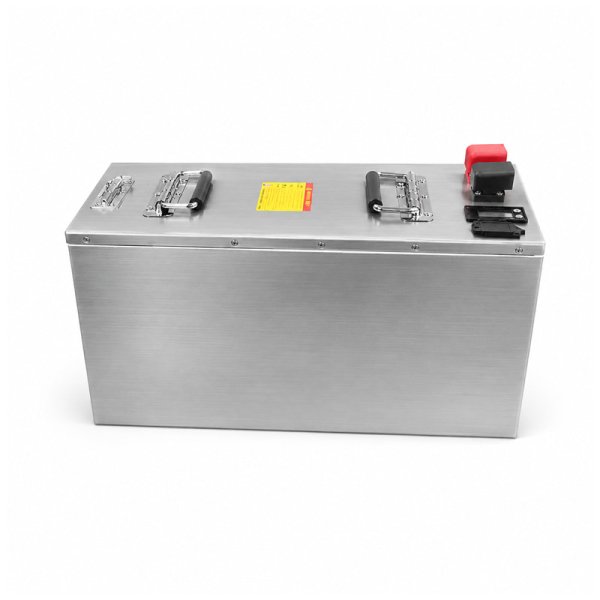
A commercial low temperature lifepo4 battery must address pack-level losses and environmental exposure. Important features include temperature sensors near the coldest cells, BMS current derating, suitable busbars and cables, stable cell mounting, moisture control, and an enclosure designed for condensation and vibration.
Charging below freezing may require controlled self-heating. The BMS should prevent charging until every monitored cell reaches the cell manufacturer’s approved threshold. Heater power, warm-up time, uniformity, and energy consumption should be tested.
Verification should include cold soaking, startup under load, repeated current pulses, charging after storage, condensation exposure, ingress protection, vibration, and fault behavior.
Which Vehicles Benefit Most from a Low Temperature LiFePO4 Battery?
Cold-storage warehouses are a clear use case for freezing weather forklift power. Forklifts may move between refrigerated rooms and warmer loading areas, creating condensation and temperature gradients. Buyers should verify lifting-current capability, voltage stability, charging restrictions, and heater behavior against the actual shift profile.
For recreational vehicles, sub-zero RV power storage must support lighting, electronics, pumps, and control systems during cold nights. Key data include usable energy after a defined cold soak, permitted charging temperature, heater consumption, and recovery across repeated cycles.
Winter golf cart power storage matters for resorts, campuses, security fleets, and utility carts. Operators should assess cold-start acceleration, hill climbing, route length, overnight storage temperature, and charging time. Heater energy must be included in route planning.
Electric tricycles and electric motorcycles also require stable current for cargo, inclines, and acceleration. Packaging limits may reduce space for insulation or heaters, so each low temperature lifepo4 battery should be validated within the complete vehicle.
How Should B2B Buyers Specify a Low Temperature LiFePO4 Battery?
Start with the duty cycle. Provide minimum storage, discharge, and charging temperatures; daily energy demand; peak and continuous current; motor or inverter data; payload; route duration; charging window; enclosure dimensions; ingress-protection target; and communication requirements.
Request evidence for the exact proposal: cell datasheet, cold discharge curves, resistance data, charging limits, cycle-test conditions, heater controls, BMS thresholds, drawings, and validation reports. International transport normally also requires the applicable cell or battery type to pass UN 38.3 testing and a test summary to be available.
FEBATT develops power-battery solutions for electric tricycles, golf carts, forklifts, RVs, electric motorcycles, and other power-driven equipment. Buyers can review FEBATT’s capabilities at FEBATT battery engineering and product capabilities and submit the actual vehicle profile for evaluation.
How Should Cell Data Be Converted into Low Temperature LiFePO4 Battery Expectations?
Cell data is the starting point, but buyers purchase a complete system. Pack voltage and capacity depend on the series-parallel configuration, while usable energy is reduced by BMS reserve limits, temperature-dependent voltage sag, wiring resistance, contactors, and cutoff settings. The heater may also draw energy before the vehicle begins work. A low temperature lifepo4 battery proposal should therefore show both nominal energy and measured usable energy after a defined cold soak.
Current capability must also be translated carefully. A cell pulse test cannot automatically prove that a forklift can lift a rated load or that an electric tricycle can climb a specified gradient. The supplier should model and test the complete current path, including busbars, fuses, contactors, connectors, and cables. Pack-level voltage at the controller is more relevant than cell voltage measured in isolation.
Temperature distribution is another major difference. Small laboratory cells can reach a uniform chamber temperature, while a large pack may contain warmer central cells and colder edge cells. Sensor placement, insulation, heater layout, and airflow determine whether the whole pack remains inside the permitted operating window. This is why a low temperature lifepo4 battery should be validated at the intended pack size, not inferred only from one pouch-cell result.
What Validation Plan Should a B2B Buyer Request?
A practical validation plan begins with temperature conditioning. The complete battery should remain at the target temperature long enough for the internal cells, enclosure, and electrical components to stabilize. The report should record soak duration, starting state of charge, cell temperatures, ambient temperature, and any heater activity before the test begins.
Discharge testing should reproduce the vehicle’s real load pattern. For freezing weather forklift power, that may include repeated traction and lifting pulses. For winter golf cart power storage, it may include acceleration, hills, and stop-and-go use. For sub-zero RV power storage, the profile may combine steady auxiliary loads with short inverter peaks. Electric tricycles and motorcycles should be tested at realistic payload and controller demand.
Charging tests are equally important. The supplier should demonstrate how the BMS responds when the pack is too cold, how long self-heating takes, how much energy it consumes, and when charging current is enabled. A complete low temperature lifepo4 battery test plan should also include recovery after warming, repeated cold cycles, condensation exposure, communication faults, sensor faults, and safe shutdown behavior. These records provide stronger purchasing evidence than an isolated additive percentage.
How Should Buyers Verify a Low Temperature LiFePO4 Battery Supplier?
Confirm that the supplier separates cell data from finished-pack data. Review sensor placement, heater uniformity, cold-charge protection, cell traceability, welding quality, insulation, fuses, contactors, sealing, vibration resistance, software control, and end-of-line tests.
Ask for acceptance criteria rather than statements such as ‘works at -30°C.’ A useful report specifies soak time, state of charge, load profile, cutoff limits, measured energy, and pass/fail requirements.
Compare usable energy at the target temperature, charging availability, heater consumption, warranty conditions, technical support, and downtime risk. Price per kilowatt-hour alone does not define the value of a low temperature lifepo4 battery.
Technical Relevant FAQ
1.What makes a low temperature lifepo4 battery different from a standard LFP pack?
It uses cells and controls validated for a defined cold-weather range. The design may include an optimized electrolyte, temperature sensing, current derating, insulation, and controlled self-heating. Buyers should request data for the exact configuration rather than relying on the label.
2.Is 3.5% VC the correct formulation for every battery?
No. It was the best result only among four concentrations in one LiFePO4/artificial-graphite pouch-cell experiment. The optimum can change with solvent blend, salt, graphite, electrode loading, electrolyte volume, and formation process.
3.Can a low temperature lifepo4 battery be charged below 0°C?
Only when the selected cells and charging strategy are approved for that condition. Many systems block charging until a heater raises every monitored cell above the minimum permitted temperature. Cold discharge capability does not prove cold charging is safe.
4.Does self-heating remove every winter limitation?
No. Heating consumes energy and time and must warm cells uniformly. Buyers should verify heater power, warm-up time, energy use, sensor placement, BMS interlocks, and fault behavior.
5.Can the same pack operate in hot climates?
Only if high-temperature storage, charging, and discharge have also been validated. Insulation that helps in winter can make summer heat rejection more difficult, so both temperature ranges must be specified.
6.How should cycle-life claims be compared?
Request temperature, C-rates, depth of discharge, voltage limits, rest periods, sample quantity, and end-of-life threshold. A cycle number without these conditions is not enough for a fleet-cost calculation.
7.What data should forklift and RV buyers request?
Request cold-soak discharge tests, pack resistance, usable energy, current capability, charging limits, heater operation, BMS settings, cycle conditions, mechanical tests, ingress protection, and transport documentation.
8.What is the main conclusion from the VC experiment?
Among the tested concentrations, 3.5% produced the best reported capacity, resistance, efficiency, and 300-cycle retention at -30°C. Because there was no 0% control and mechanism characterization was limited, the result supports formulation-specific optimization rather than a universal prescription for every low temperature lifepo4 battery.
Add Your Heading Text Here
Lorem ipsum dolor sit amet, consectetur adipiscing elit. Ut elit tellus, luctus nec ullamcorper mattis, pulvinar dapibus leo.