For OEMs, distributors, and equipment manufacturers, battery chemistry affects usable energy, payload, charging strategy, thermal behavior, maintenance, replacement frequency, and total cost of ownership. That is why a lithium ion phosphate battery has become a frequent search topic for buyers of forklifts, electric tricycles, golf carts, RV systems, electric motorcycles, and other commercial motive-power equipment.
A terminology note is important. The technically correct name is lithium iron phosphate battery, abbreviated LiFePO4 or LFP. The phrase lithium ion phosphate battery is widely used as a search term, but this guide uses it only to refer to lithium iron phosphate chemistry. LFP is itself a lithium-ion battery chemistry, not a separate category from lithium-ion batteries.
The strongest LiFePO4 battery advantages are the relatively stable cathode structure, long cycle-life potential, predictable voltage behavior, and fit for applications that prioritize durability over maximum energy density. Those advantages do not make every LFP pack automatically safe, long-lived, or suitable for fast charging. Cell grade, BMS calibration, current capability, thermal design, enclosure construction, charger compatibility, production consistency, and the duty cycle remain decisive.
This guide combines the useful material in the supplied source with updated B2B guidance for heavy-duty electric vehicle batteries and industrial power solutions.
What Is a Lithium Ion Phosphate Battery?
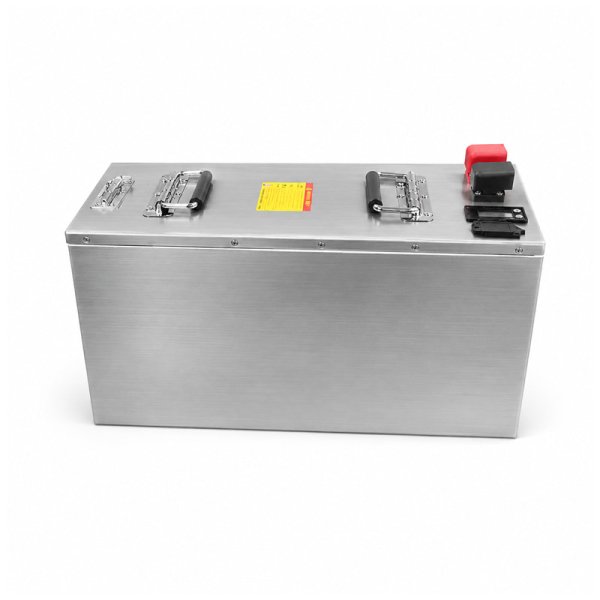
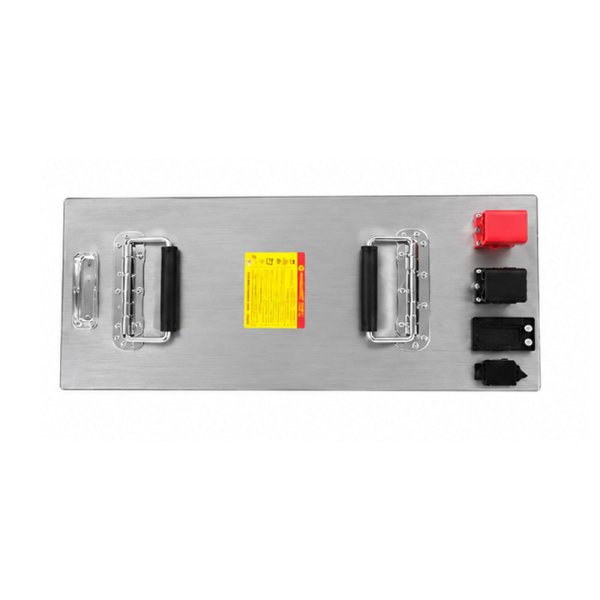
A lithium ion phosphate battery uses lithium iron phosphate, LiFePO4, as the positive-electrode material. Most commercial LFP cells pair that cathode with a graphite-based negative electrode, a lithium-salt electrolyte, a porous separator, aluminum and copper current collectors, and a sealed enclosure. A finished pack also requires interconnections, current protection, temperature sensing, a battery management system, connectors, insulation, and a mechanical case.
A typical LFP cell has a nominal voltage near 3.2 V. Many cell designs use an upper charge limit near 3.65 V, but the permitted charging voltage, discharge cutoff, current, and temperature range must come from the specific cell datasheet. Use product-level limits rather than generic values.
The cathode’s olivine structure and strong phosphate bonding contribute to LFP’s reputation for thermal stability. Compared with many nickel-rich layered oxide cathodes, LFP generally releases less oxygen when heavily heated and tends to react less energetically under comparable abuse conditions. This is an important safety margin, not proof that an LFP system is fireproof.
For B2B buyers, the useful question is not whether a lithium ion phosphate battery is “the best” chemistry in every situation. The better question is whether its balance of thermal stability, cycle life, power capability, package size, temperature behavior, cost, and supplier support matches the vehicle.

How Does a Lithium Ion Phosphate Battery Work?
During discharge, lithium ions move through the electrolyte from the graphite-based negative electrode toward the LFP positive electrode while electrons travel through the external circuit to power the vehicle. During charging, the ion movement reverses. The separator keeps the electrodes electrically isolated while allowing ionic transport.
LFP’s phosphate framework remains comparatively stable during repeated lithium insertion and extraction, which supports long-cycle operation when the cell is kept within appropriate voltage, temperature, and current limits. Pack engineering is equally important. A forklift may require high continuous current and opportunity charging, while an electric tricycle may experience vibration, rain, frequent acceleration, and long daily routes.
For OEM and fleet projects, FEBATT’s power battery solutions help match voltage, capacity, current, BMS communication, installation space, and environmental requirements.
What Are the Seven Main LiFePO4 Battery Advantages?

1. Why Does LFP Offer Strong Thermal Stability?
One of the most important LiFePO4 battery advantages is the relative stability of the phosphate cathode. Strong P-O bonding helps the cathode retain oxygen more effectively during severe heating than many layered nickel-rich materials. LFP therefore often shows a wider thermal-safety margin and lower heat-release severity under comparable abuse tests.
This does not mean a lithium ion phosphate battery cannot vent, ignite, or enter thermal runaway. Severe overcharge, internal short circuit, crushing, penetration, external fire, manufacturing defects, or incorrect integration can still create hazardous failure. Buyers should ask for product-specific safety testing rather than accept claims such as “will never burn.”
2. Why Can LFP Deliver Long Cycle Life?
Modern LFP cells are widely valued for repeated cycling, and well-designed products can achieve several thousand cycles under defined conditions. Cycle count is meaningful only when the supplier states the depth of discharge, C-rate, temperature, rest periods, and end-of-life capacity threshold.
A lithium ion phosphate battery operated at moderate temperatures and conservative limits may last much longer than one repeatedly exposed to high state of charge, aggressive current, heat, or deep cycling. Calendar aging also continues while a vehicle is parked, so cycle count does not automatically equal a fixed number of years.
For commercial fleets, long life can reduce replacement labor, downtime, and warranty exposure.
3. How Does the Stable Voltage Profile Help Equipment?
LFP normally provides a relatively flat discharge-voltage profile through much of its usable state-of-charge range. That can support predictable power delivery through a shift.
A lithium ion phosphate battery still needs sufficient cell current capability, low-resistance busbars, correctly sized cables, suitable connectors, and BMS limits that match the controller. Chemistry cannot compensate for undersized electrical hardware. Buyers should request continuous current, peak current, peak duration, voltage-sag, and temperature-rise data.
4. Can LFP Support Fast or Opportunity Charging?
LFP can be a good fit for opportunity charging, but no universal C-rate applies to every cell. Some designs can accept high charge rates, while others require lower current to protect cycle life and avoid excessive polarization or lithium plating.
For a lithium ion phosphate battery, charging capability depends on cell temperature, state of charge, cell design, charger profile, BMS control, connector rating, and heat dissipation. The practical benefit is flexible charging potential, not an automatic promise of a 40-minute full charge.
5. Why Is Routine Maintenance Lower Than Lead-Acid?
Sealed LFP packs eliminate flooded lead-acid tasks such as electrolyte watering and acid-spill cleanup. This can reduce labor and improve fleet cleanliness.
A lithium ion phosphate battery should not be described as requiring zero attention. Operators still need to inspect connectors, cables, mounting hardware, seals, enclosure damage, charger behavior, thermal components where fitted, and BMS fault logs. “Low maintenance” is more accurate than “maintenance-free.”
6. Can LFP Reduce Weight Compared with Lead-Acid?
For equivalent usable energy, an LFP system can often be significantly lighter than a lead-acid system. The exact difference varies with cell format, enclosure, BMS, protection hardware, and how much rated capacity is routinely usable.
Reduced mass can help an electric tricycle preserve payload, reduce energy consumption, or improve packaging. In an RV, lower battery mass can free weight allowance for other equipment. A lithium ion phosphate battery should not be marketed with a universal “one-third of the weight” claim unless two specified products are being compared.
7. What Are the Material and Supply-Chain Advantages?
LFP cathodes do not rely on nickel or cobalt. Iron and phosphate inputs can provide supply-chain and cost advantages, although total pack cost still depends on lithium, manufacturing, electronics, enclosure materials, testing, labor, and logistics.
LFP still has environmental impacts across mining, manufacturing, transport, and recycling, and finished packs require applicable safety, transport, environmental, and recycling compliance.
For buyers comparing industrial power solutions, the practical benefit is an established cathode chemistry without nickel or cobalt, not a zero-impact claim.
What Are the Main Lithium Iron Phosphate Battery Disadvantages?
A balanced decision must also consider lithium iron phosphate battery disadvantages. LFP is highly competitive for many commercial applications, but it is not optimal for every vehicle or climate.

1. Lower Energy Density Than Nickel-Rich Chemistries
LFP typically offers lower gravimetric and volumetric energy density than high-nickel NMC designs. If a vehicle has a very limited battery compartment or must maximize range for the lowest possible mass, NMC may provide an advantage.
For forklifts, golf carts, and utility vehicles, that trade-off may be acceptable; compact electric motorcycles can be more packaging-sensitive.
2. Reduced Performance and Charging Acceptance in Cold Conditions
Cold weather is one of the most important lithium iron phosphate battery disadvantages for outdoor fleets. As cell temperature falls, electrolyte transport and interfacial kinetics slow, internal resistance rises, and available power and capacity can decrease.
Discharging at low temperature may be permitted within the cell specification, but charging requires tighter control because lithium plating can occur on graphite anodes when current is too high for the temperature and state of charge. A lithium ion phosphate battery intended for sub-zero use may therefore need charge-current derating, preheating, insulation, or integrated heating.
Buyers should request separate charging, discharging, and storage temperature limits rather than rely on one broad “working temperature” number.
3. Fast-Charge and High-Power Claims Are Cell-Specific
A commercial pack cannot inherit a fixed charge or discharge rate simply because it uses LFP. Electrode loading, particle design, electrolyte, cell format, internal resistance, tab design, and cooling all influence current capability.
A lithium ion phosphate battery used in a forklift or electric motorcycle must be validated at the actual current profile. Procurement teams should request voltage sag, temperature rise, current derating, peak-duration limits, and cycle-life data at the proposed charge rate.
4. Manufacturing Consistency Matters
LFP material production, electrode coating, cell assembly, formation, grading, and pack matching all require controlled manufacturing. Variations in capacity, internal resistance, self-discharge, or state of charge can become more visible when many cells are connected together.
Poorly matched cells can cause earlier BMS cutoffs, reduced usable energy, uneven heating, and faster divergence. A lithium ion phosphate battery supplier should demonstrate cell traceability, matching criteria, end-of-line testing, and pack-level validation.
The old claim that LFP consistency is inherently unsolvable is no longer credible. The real issue is whether the manufacturer has adequate process control.
5. Upfront System Cost and Integration Can Be Higher Than Basic Lead-Acid
LFP cells can provide strong lifecycle value, but the initial system cost may exceed a low-cost lead-acid option. A complete pack requires a BMS, electrical protection, enclosure, connectors, charger matching, and sometimes vehicle communication.
A lithium ion phosphate battery retrofit may also require changes to charging voltage, controller settings, mounting, state-of-charge display, or low-voltage protection. Treating lithium as an automatic drop-in replacement can create compatibility problems.
For B2B projects, total cost of ownership should include purchase price, replacements, maintenance labor, charging efficiency, downtime, service requirements, and expected operating years.
How Do LFP, NMC, and Lead-Acid Compare for B2B Vehicles?
No single chemistry wins every category. The following are typical design tendencies rather than universal specifications.
LFP offers strong thermal stability, long-cycle potential, low routine maintenance, and good fit for frequent cycling. Its main constraints are lower energy density than high-nickel NMC and reduced cold-temperature performance.
NMC lithium-ion offers high energy density and compact packaging, but generally needs tighter thermal and charging control, particularly in high-energy designs.
Lead-acid offers a low upfront price and mature supply in legacy equipment, but it is heavier, provides less usable energy, charges more slowly, and flooded types need routine maintenance.
For a lithium ion phosphate battery project, fleet duty cycle, space, payload, current, charging schedule, temperature, service strategy, warranty, and target cost should determine the final chemistry.
Where Does a Lithium Ion Phosphate Battery Fit Best in Commercial Fleets?
Electric Forklifts and Material Handling
Forklifts benefit when long cycle life, opportunity charging, predictable power, and reduced routine maintenance matter more than minimum battery mass. A heavy-duty LFP pack must still be designed for high current, repeated lifting, vibration, connector heating, and multi-shift operation.
Buyers should verify current limits at the expected pack temperature, charger compatibility, communication protocol, counterweight requirements, and thermal data from continuous-duty testing.
Electric Tricycles and Commercial Motorcycles
For electric tricycle power and commercial electric motorcycles, LFP can suit delivery, utility, municipal, and fleet platforms that value durability and safety margin. Lower energy density than NMC means designers must balance battery size against route range and payload.
A lithium ion phosphate battery should be sized using watt-hours, continuous and peak current, route profile, gradients, payload, ambient temperature, and charging window. Voltage and amp-hours alone are not enough.
Golf Carts and Utility Vehicles
Golf carts typically prioritize simple operation, long service life, low maintenance, and predictable daily range. LFP can replace lead-acid in many platforms, but the conversion must confirm voltage window, charger, mounting, current demand, state-of-charge display, and weight distribution.
RV Energy Systems
RV energy storage benefits from lower mass, high usable energy, and low routine maintenance. A lithium ion phosphate battery can be attractive for auxiliary power, but the installation should include suitable charging from shore power, solar, alternator-based systems, or DC-DC equipment as applicable.
Cold-weather charging deserves particular attention because an RV may be stored or operated below freezing. Buyers should verify whether the pack blocks low-temperature charging, derates current, or includes controlled heating.
How Should B2B Buyers Evaluate a Lithium Ion Phosphate Battery Supplier?
The best supplier discussion begins with measurable requirements rather than broad chemistry claims. Before approving a sample or production order, request:
- Cell manufacturer, model, grade, production traceability, and cell specifications.
- Nominal voltage, operating voltage window, rated energy, dimensions, and complete-pack weight.
- Continuous current, peak current, peak duration, and the temperature conditions behind those limits.
- Charging profile, maximum charge current, low-temperature charge strategy, and charger compatibility.
- BMS functions, sensor locations, current derating, communication protocol, and fault logging.
- Mechanical protection for vibration, impact, moisture, dust, mounting loads, and connector retention.
- Cycle-life data with depth of discharge, C-rate, temperature, and end-of-life capacity stated.
- Pack-level tests, end-of-line inspection, serial traceability, and applicable transport or market documentation.
- Warranty terms, service process, replacement strategy, and expected spare-part support.
A lithium ion phosphate battery should be approved as a complete engineered system. Chemistry provides the foundation, but quality control and integration determine whether the theoretical advantages survive real commercial use.
Technical Relevant FAQ
1.Is a lithium ion phosphate battery safer than NMC?
LFP generally offers greater cathode thermal stability and less aggressive oxygen release than many nickel-rich NMC chemistries under comparable abuse conditions. That can reduce the likelihood or severity of some heat-driven failure modes. It does not eliminate fire risk. Cell quality, state of charge, BMS protection, fusing, enclosure design, charger compatibility, and application testing remain necessary.
2.How long can an LFP battery last compared with lead-acid?
A high-quality LFP cell can provide several thousand cycles under defined test conditions, while many deep-cycle lead-acid batteries provide fewer cycles under frequent deep discharge. Actual service life depends on depth of discharge, temperature, current, charging strategy, storage state of charge, maintenance, and the capacity threshold used to define end of life.
3.Can LFP batteries operate below 0°C?
Many LFP cells can discharge below 0°C within manufacturer-defined limits, although available power and capacity decline as temperature falls. Charging is more restrictive because low-temperature charging can promote lithium plating. A lithium ion phosphate battery for cold climates may need current derating, preheating, or integrated heating.
4.Is an LFP battery maintenance-free?
LFP normally requires much less routine maintenance than flooded lead-acid because there is no electrolyte watering. Commercial packs still require periodic inspection of cables, connectors, mounting points, enclosure condition, seals, charger behavior, thermal components where fitted, and BMS fault records.
5.Why does cell consistency matter in a lithium ion phosphate battery?
Series-connected packs are limited by the cells that reach voltage or temperature limits first. Differences in capacity, resistance, self-discharge, or aging can therefore reduce usable energy and trigger earlier BMS protection. Good cell grading, traceability, matching, thermal design, balancing strategy, and end-of-line testing help maintain pack consistency.
6.Can every LFP pack use fast charging?
No. Fast charging must be validated for the selected cell, temperature range, state of charge, pack resistance, charger, BMS, connectors, and thermal design. Some LFP cells support high charge rates, while others require more conservative charging.
Conclusion
Lithium ion phosphate battery generally refers to the technically correct lithium iron phosphate, or LiFePO4, chemistry. For B2B buyers, its value comes from a practical combination of thermal stability, long-cycle potential, stable power delivery, lower routine maintenance, and compatibility with frequently used commercial equipment.
Those benefits should be balanced against real lithium iron phosphate battery disadvantages, including lower energy density than high-nickel chemistries, reduced cold-weather performance, cell-specific fast-charge limits, and the need for disciplined manufacturing and pack integration.
For forklifts, electric tricycles, commercial motorcycles, golf carts, RVs, and other heavy-duty electric vehicle batteries, the best choice is not the chemistry with the strongest marketing claim. It is the battery system whose current capability, temperature limits, BMS, enclosure, charger, testing, traceability, warranty, and dimensions match the application.
A lithium ion phosphate battery can be an excellent foundation for durable industrial power solutions when those details are engineered and verified together. Buyers planning an OEM, ODM, fleet replacement, or custom battery project should define the duty cycle first and evaluate the complete pack against measurable requirements.