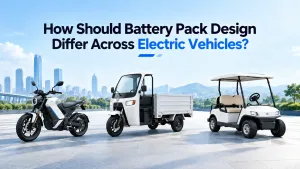
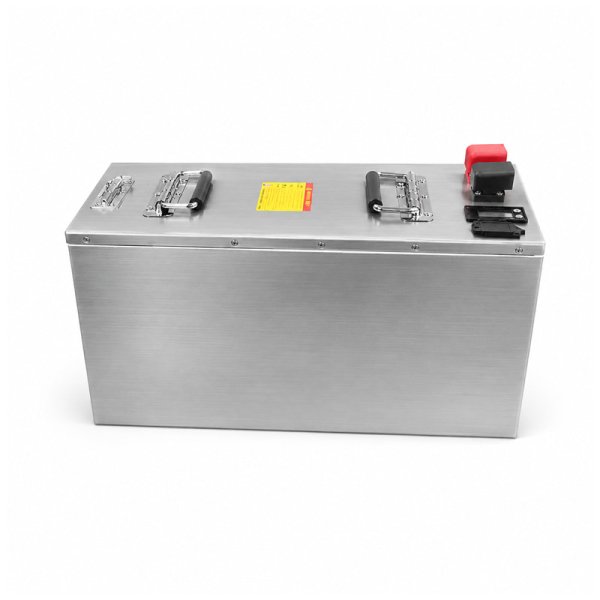
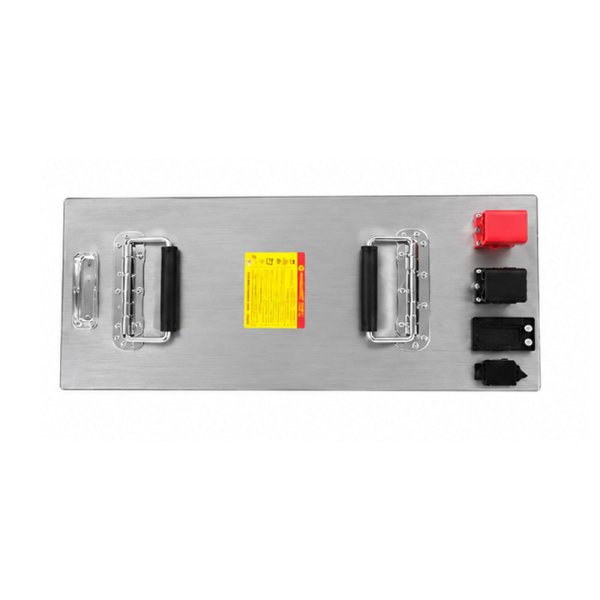
Commercial battery programs rarely fail because procurement forgot to compare nominal specifications. They fail when the approved sample cannot be reproduced at scale, cells change without notice, BMS logic does not match the vehicle, traceability stops at the carton label, or compliance documents do not match the shipped pack.
For OEM sourcing managers, fleet procurement, importers, system integrators, supplier-quality engineers, and technical teams, lithium ion battery manufacturers should be judged by controlled engineering and repeatable production. The real question is not “Who can build a battery?” but “Who can preserve the approved system from RFQ through pilot validation and mass production?”
In this comprehensive guide, B2B buyers can evaluate lithium ion battery manufacturers for commercial electric motorcycles, tricycles, forklifts, golf carts, and other motive-power projects without reducing qualification to price or brochure claims.
What Should B2B Buyers Expect From a Lithium Battery Manufacturer?
Professional lithium ion battery manufacturers should operate as engineering and manufacturing partners, not merely pack assemblers. They should convert a duty cycle into cell selection, pack architecture, mechanical constraints, current capability, thermal margins, BMS logic, communication, validation, and production controls.
For teams managing several vehicle classes, this power battery solutions for commercial motive-power projects show why application context matters. A delivery motorcycle, cargo tricycle, warehouse forklift, and golf-cart fleet impose different stresses even when procurement language sounds similar. This mass-production lithium battery pack quality-control guide shows expected records from pilot through repeatable output.
A qualified lithium battery manufacturer for commercial vehicles should ask about routes, payload, gradients, stop-start intensity, shift length, temperature, vibration, ingress exposure, charging windows, replacement strategy, and controller interfaces. This is where lithium ion battery manufacturers demonstrate whether they understand commercial uptime rather than nameplate capacity.
For motorcycle programs, the commercial motorcycle battery procurement framework connects route demand, fleet standardization, BMS behavior, and lifecycle planning. The same rule applies across motive-power platforms: lithium ion battery manufacturers must understand the work the vehicle performs.
How Is a Manufacturer Different From a Trading Supplier?

A trading company may provide useful sourcing and logistics, but the qualification question is different. Buyers working directly with lithium ion battery manufacturers should be able to audit the organization controlling engineering release, incoming inspection, BMS programming, assembly, testing, traceability, nonconformance, and production changes.
The distinction becomes critical when a field problem appears. Can the supplier identify the cell lot, BMS revision, connector batch, test record, and assembly date for an affected serial number? Can engineering reproduce the fault and issue corrective action? If every answer depends on an unnamed third-party factory, visibility is weaker.
A B2B lithium battery supplier can still add value, but procurement should know who owns the process. When evaluating lithium ion battery manufacturers, request the factory address, production flow, quality responsibilities, critical subcontracted processes, engineering ownership, and escalation path. A lithium battery manufacturer with OEM ODM service should explain what is controlled in-house and what is outsourced.
Which Motive-Power Applications Should the Factory Already Understand?

Application competence should appear in engineering questions, not logos on a presentation. Lithium ion battery manufacturers serving commercial motive power should understand how operating profiles change battery risk.
Commercial electric motorcycles and mopeds create high route frequency, repeated acceleration, limited installation volume, weather exposure, and pressure for rapid service. A lithium ion battery supplier for electric motorcycle fleets should discuss route energy, peak current, pack handling, connector wear, enclosure durability, diagnostics, and fleet standardization.
Cargo tricycles add payload variability, hill starts, rough roads, frequent stops, and high daily throughput. Forklifts introduce multi-shift utilization, counterbalance constraints, high current demand, warehouse interfaces, and downtime sensitivity. A lithium battery supplier for forklift fleets should understand duty cycle, compartment geometry, required mass, communication, opportunity charging, and service access. Golf-cart fleets emphasize repeated daily use, gradients, seasonal utilization, and low-maintenance operation.
A LiFePO4 battery manufacturer for industrial vehicles should show application-specific validation logic rather than treating these platforms as interchangeable. Among lithium ion battery manufacturers, the strongest evidence is a documented path from vehicle duty to pack acceptance criteria.
What Engineering Data Should Be Reviewed Before Quotation?
Before quotation, lithium ion battery manufacturers need a disciplined RFQ. Buyers who send only voltage, capacity, dimensions, and target price invite assumptions that later become engineering changes.
| RFQ Area | What the Buyer Should Provide |
|---|---|
| Application and duty cycle | Vehicle type, payload range, route or work cycle, gradients, stop frequency, working hours, shifts, annual utilization. |
| Electrical demand | Continuous current, peak current and duration, controller limits, regeneration if applicable, auxiliary loads. |
| Mechanical integration | Available envelope, mounting points, retention, connector position, cable exit, handling and service clearances. |
| Environment | Temperature, rain or dust exposure, vibration, washdown, indoor/outdoor operation, storage conditions. |
| Communication | CAN or RS485 protocol, message map, wake/sleep logic, SOC reporting, diagnostics, interlocks. |
| Commercial program | Pilot quantity, forecast volume, target SOP, warranty expectations, spare strategy, packaging, destination markets. |
A custom lithium battery manufacturer for OEM should challenge incomplete inputs rather than quietly fill gaps. Likewise, a lithium ion battery manufacturer for OEM projects should document quotation assumptions. Experienced lithium ion battery manufacturers use those assumptions as a controlled boundary between agreed requirements and later changes.
How Should Buyers Audit Cell Sourcing and Batch Traceability?
Cell sourcing is a direct test of manufacturing discipline. Lithium ion battery manufacturers should identify approved cell models, qualification criteria, incoming inspection, storage controls, matching rules, and how cell lots connect to finished-pack serial numbers.

Buyers should ask: Which cell sources are approved? What happens if the preferred cell is unavailable? How can a field failure be traced to the exact lot? Reliable lithium ion battery manufacturers should answer with records, not general assurances.
Credible lithium ion battery manufacturers do not rely on “same specification” substitutions. Alternate cells should be prequalified or introduced through formal change control, because differences in impedance, capacity distribution, thermal behavior, dimensions, or aging can alter fleet performance. This matters especially in high-utilization fleets, where small inconsistencies become visible across hundreds of vehicles.
Strong lithium ion battery manufacturers maintain genealogy linking finished packs to cell lots, critical components, BMS firmware, production date, line records, and end-of-line results. That makes containment narrower and warranty investigation faster.
What BMS and Communication Capabilities Matter for OEM Projects?
For commercial platforms, the BMS is part of the vehicle interface. Lithium ion battery manufacturers should be able to configure protection thresholds, current limits, balancing behavior, temperature logic, SOC estimation, sleep/wake strategy, fault logging, and communication without treating firmware as a black box.
CAN and RS485 matter when the battery exchanges status, alarms, current limits, temperature, or SOC data with a controller, display, telematics platform, or service tool. The question is not whether “CAN is available,” but whether message definitions, timing, failure states, revisions, and diagnostics are controlled.
A lithium ion battery manufacturer for OEM projects should maintain firmware revision records and parameter baselines for each platform. Mature lithium ion battery manufacturers require approval when changes can affect drivability, charging, protection, diagnostics, or compliance. Silent firmware drift can create inconsistent field behavior while the pack appears mechanically identical.
Which Production and Quality Controls Should Be Verified?
A good prototype proves feasibility; mass production proves the factory. Buyers should inspect how lithium ion battery manufacturers control incoming materials, cell matching, welding or busbar connections, torque, insulation, sealing, BMS programming, labeling, functional testing, aging, final inspection, and nonconformance.
The key is linkage between control and evidence. “100% testing” is weak unless the test items, limits, equipment, calibration status, data retention, and serial-number linkage are defined. High-quality lithium ion battery manufacturers can show the records behind the claim.
Before scale-up, procurement and SQE teams should review a pilot lot under the intended process. The approved configuration should include drawings, BOM revision, cell model, BMS hardware and firmware, connector and fuse specifications, enclosure materials, critical dimensions, test limits, labels, and packaging. Later changes should pass notification, risk review, validation, and approval.
For buyers comparing lithium ion battery manufacturers, configuration control, EOL testing, CAPA, and traceability are often more predictive of fleet stability than a polished sample.
Which Certifications and Transport Documents Should Match the Exact Pack?
Compliance evidence must correspond to the battery configuration being purchased. Lithium ion battery manufacturers should not present a generic certificate portfolio as proof that every custom pack is covered.
Buyers should verify which exact model, cell, BMS, enclosure, capacity, and configuration are referenced by relevant reports. UN 38.3 transport evidence is commonly required for lithium battery transport, while market- or application-specific projects may also require IEC, UL, CE-related, EMC, or regional documentation depending on destination and use.
Serious lithium ion battery manufacturers should explain what changes can require compliance review. A different cell, BMS board, pack architecture, enclosure, or protection setting may affect the technical basis for existing evidence. Well-controlled lithium ion battery manufacturers maintain a compliance matrix by model and revision rather than assuming one document covers an entire family.
For importers and OEMs, lithium ion battery manufacturers should also align test summaries, dangerous-goods information, labels, packaging instructions, model identification, drawings, and shipped product. Exact-model evidence helps prevent customs or launch delays.
Frequently Asked Questions About lithium ion battery manufacturers
Q: Is a lithium battery manufacturer the same as a lithium ion battery supplier?
A: Not always. Lithium ion battery manufacturers control pack engineering and production, while a supplier may trade or source externally. Buyers should verify who owns design release, testing, traceability, and change control.
Q: What information should an OEM send before requesting a battery quotation?
A: Send duty cycle, payload, current demand, space, mounting, connector, CAN or RS485 needs, environment, charging window, pilot volume, annual forecast, target SOP, warranty, and destination-market requirements.
Q: How can buyers verify a lithium battery manufacturer's production capacity?
A: Ask for line capacity, actual utilization, shift pattern, bottleneck processes, test-equipment throughput, staffing, pilot-to-ramp plans, and recent output records. Capacity should be proven against your forecast, not brochure claims.
Q: Can one manufacturer support multiple commercial vehicle battery platforms?
A: Yes, if engineering and production controls are platform-specific. Lithium ion battery manufacturers should show separate duty-cycle assumptions, interfaces, validation plans, firmware baselines, and acceptance criteria for each vehicle family.
Q: What should a bulk lithium battery supply agreement define before mass production?
A: Define the approved BOM, drawings, firmware, test limits, traceability, change control, forecast, MOQ, lead time, acceptance rules, warranty evidence, defect response, CAPA, packaging, documentation, and revision approval.
Conclusion
For B2B buyers, the strongest lithium ion battery manufacturers are not defined by the widest catalog or fastest quotation. They are defined by how well they convert a commercial duty cycle into a controlled product, preserve that configuration through mass production, and produce evidence when something changes.
OEM and fleet programs should qualify lithium ion battery manufacturers through application engineering, transparent cell sourcing, BMS integration, serial traceability, pilot validation, production controls, exact-model compliance, and formal change management. This is particularly important for electric motorcycles, tricycles, forklifts, golf carts, and other motive-power systems where downtime becomes operating cost.
A custom lithium battery manufacturer for OEM programs should make the technical baseline easier to control, not harder to understand. When lithium ion battery manufacturers can show who designed the pack, which cells were used, which firmware was loaded, which tests were passed, and which changes were approved, procurement gains a defensible path to stable fleet operation and repeatable scale.
For an OEM or fleet project, submit duty-cycle and interface data with forecast volume to request an engineering review and quotation.