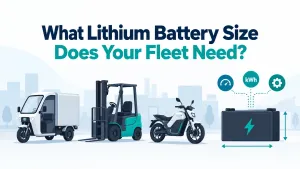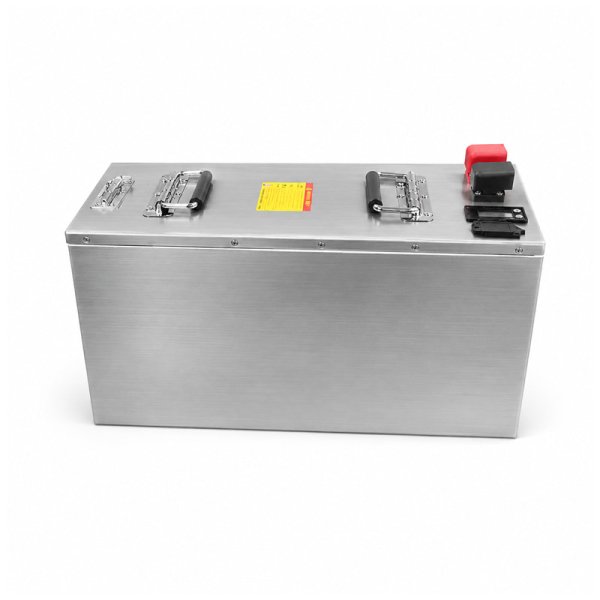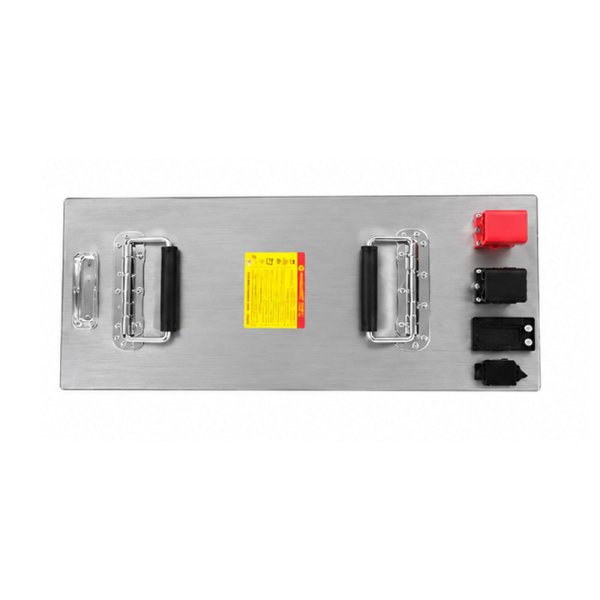
Commercial electric tricycles and motorcycles need more than a high capacity figure. Their battery systems must deliver repeatable power under frequent starts, cargo loads, vibration, temperature changes, and daily charging. A vehicle can still create downtime and warranty claims when its cells, BMS, enclosure, connector, charger, and mounting system are not engineered as one power system.
For many of these applications, a LiFePO4 battery pack offers an effective balance of thermal stability, service-life potential, and predictable operation. It does not provide the highest energy per kilogram among mainstream lithium-ion chemistries, but it is often selected when durability and lifecycle value matter more than the smallest possible pack.
LiFePO4 is not automatically correct for every vehicle. Engineers must compare range, available space, vehicle mass, continuous and peak current, charging time, ambient temperature, daily cycles, and service requirements. The chemistry decision must be supported by suitable cells, electrical protection, mechanical structure, thermal paths, and validation.
Manufacturers evaluating commercial mobility projects can review FEBATT’s electric motorcycle battery solutions and its custom lithium battery pack development process before preparing a technical request. These resources help buyers understand how standard products and project-specific engineering can support electric motorcycles, electric tricycles, and other powered vehicles.
What Makes LiFePO4 Chemistry Well Suited to Commercial Mobility?
LiFePO4 uses an olivine phosphate cathode structure. Strong bonding within that structure contributes to comparatively stable thermal behavior and a lower tendency to release oxygen under abuse than many layered-oxide cathodes. In a complete LiFePO4 battery pack, this chemistry can provide useful engineering margin for vehicles operating long hours or in demanding climates.
The chemistry also supports a relatively flat operating-voltage plateau and long cycle potential when voltage, temperature, current, and depth of discharge are controlled. However, the label alone does not prove finished-pack quality. Cell consistency, conductor sizing, welds, insulation, fuses, BMS calibration, enclosure strength, ingress protection, vibration resistance, and charger compatibility remain essential.
What Are the LiFePO4 Safety Advantages Over NMC in Pack Design?
The phrase lifepo4 safety advantages over nmc generally refers to the greater chemical and thermal stability of LFP cathodes compared with many nickel-manganese-cobalt formulations. NMC usually offers higher energy density, while LiFePO4 often trades some compactness for stability and cycle-life potential.
The relevant question is not whether one chemistry is universally safe. A well-designed NMC pack may be appropriate, while a poorly built LiFePO4 battery pack can still fail. Buyers must evaluate overcurrent, overcharge, short circuit, mechanical impact, vibration, water exposure, connector heating, and high-temperature behavior at finished-pack and vehicle levels. The selected LiFePO4 battery pack must still be validated under the intended vehicle loads and fault conditions.
The practical lifepo4 safety advantages over nmc require correctly selected protection thresholds, current interruption, representative temperature sensing, insulation, robust structure, and validation. Request the actual test plan and reports for the proposed model rather than relying on a generic chemistry statement.
Chemistry selection should follow the vehicle requirement
| Decision factor | LiFePO4 | NMC | Lead-acid |
|---|---|---|---|
| Energy density | Moderate; may require more volume or mass | Generally higher; useful for compact or weight-sensitive designs | Low; large and heavy for equivalent usable energy |
| Thermal behavior | Comparatively stable chemistry, but pack protection remains essential | More demanding thermal and abuse-control requirements | No thermal-runaway mechanism, but acid, gas, and high-current risks remain |
| Cycle potential | Often strong when conditions and end-of-life criteria are defined | Highly dependent on formulation and operating window | Usually more sensitive to deep discharge and partial-charge misuse |
| Best-fit logic | Durability, predictable fleet use, and safety margin | Maximum range or energy in limited space | Lowest initial price or established legacy systems |
How Should Buyers Interpret a Claim of LiFePO4 Cycle Life 3000 Cycles?
A specification using the phrase lifepo4 cycle life 3000 cycles is incomplete unless the test conditions are stated. Results depend on depth of discharge, charge and discharge rate, temperature, voltage limits, balancing strategy, and the capacity-retention threshold used to define end of life.
Confirm whether the result applies to a cell, module, or finished LiFePO4 battery pack, and whether end of life means 80% of initial capacity or another limit. Cycle count is not calendar life: fleets accumulate equivalent full cycles at different rates and operate under different loads.
When a supplier advertises lifepo4 cycle life 3000 cycles, request the protocol, sample quantity, C-rate, temperature, depth of discharge, and retention curve. Use those conditions to model the real vehicle duty cycle rather than treating one number as a guaranteed outcome.
Minimum information required with a cycle-life claim
| Item to confirm | Why it matters |
|---|---|
| Cell or finished-pack result | Pack-level heat, current distribution, and BMS limits can change actual performance |
| Depth of discharge and voltage window | A narrower operating window can materially extend cycle life |
| Charge/discharge rate | Higher current generally increases heat and electrochemical stress |
| Test temperature | Elevated or low temperatures may alter aging behavior |
| End-of-life threshold | 3,000 cycles to 80% capacity is different from 3,000 cycles to another limit |
| Duty-cycle correlation | Laboratory cycles must be related to real vehicle routes and loads |
Why Does Thermal Design Still Matter With LiFePO4?
A LiFePO4 battery pack is not immune to heat-related degradation. Cells, busbars, cables, connectors, contactors, and fuses generate heat under current. High ambient temperature, cargo load, steep gradients, frequent acceleration, restricted airflow, and solar exposure can increase thermal stress.
Good design starts with the real continuous current, peak duration, regenerative current, charge current, enclosure conductivity, cell spacing, and temperature-sensor locations. BMS limits must match the measured thermal response rather than a generic default. Thermal limits for the LiFePO4 battery pack should be based on measured pack data.
A lifepo4 light ev battery pack should be validated at the hottest expected condition, under repeated high-current events and charging after operation. Sealing, cooling, mounting position, and sensor-fault behavior must be evaluated together.

How Does the Flat Voltage Plateau Affect Vehicle Performance and SOC Estimation?
Across much of its discharge range, a LiFePO4 battery pack maintains a relatively flat voltage profile. This can support consistent controller input and reduce pronounced performance decline during a working shift, which is useful for loaded tricycles and commercial motorcycles.
The same plateau complicates state-of-charge estimation because voltage changes only slightly across a broad middle range. A dependable BMS normally combines current integration, calibrated capacity, temperature compensation, rest-state correction, and aging adaptation rather than relying on voltage alone.
For a lifepo4 battery pack for electric tricycle fleets, an inaccurate display can interrupt routes even when the cells remain healthy. Buyers should ask how the BMS manages accumulated estimation error, balancing, event records, and communication with the vehicle controller.

What Should a Real Total Cost of Ownership Analysis Include?
The purchase price of a LiFePO4 battery pack is only one commercial cost. Total cost of ownership should include the charger or modification, installation, maintenance, replacement frequency, energy losses, spare inventory, downtime, labor, warranty administration, and end-of-life handling.
A practical formula is: initial system cost plus replacements, maintenance, charging losses, and downtime, minus residual value. Inputs should use the fleet’s actual depth of discharge, operating days, electricity price, route energy, and downtime cost. Usable energy matters more than nameplate capacity alone. The LiFePO4 battery pack comparison should use the same vehicle duty cycle and acceptance criteria as every alternative.
A lifepo4 light ev battery pack can reduce lifecycle cost when its service interval and low routine maintenance offset the initial price. This outcome must be calculated with documented assumptions; it should not be presented as an automatic percentage saving.

How Does LiFePO4 Support Sustainability and Responsible Procurement?
LiFePO4 cathode chemistry does not use nickel or cobalt, but the complete battery still contains lithium-bearing materials, copper, aluminum, electrolyte, plastics, electronics, and structural components. Responsible sourcing and end-of-life management therefore remain necessary.
The strongest sustainability value of a LiFePO4 battery pack is often a longer useful service interval, which can reduce replacements and waste per vehicle-year. Buyers should request lot traceability, service-part availability, transport documentation, and a practical recovery route rather than relying on broad claims such as green or heavy-metal-free.
How Can Engineers Manage the Lower Energy Density of LiFePO4?
Compared with many NMC designs, LiFePO4 generally needs more mass or volume for the same nominal energy. This affects motorcycle packaging and handling, while tricycle projects must consider payload, axle loading, ground clearance, and center of gravity.
A lifepo4 battery pack for electric tricycle use should be sized from route energy, peak power, gradient, payload, ambient temperature, and aging reserve. Increasing ampere-hours without analysis adds cost and mass; undersizing raises current per cell, heat, and voltage drop.
Engineers can optimize cell size, series-parallel configuration, structural mass, mounting integration, usable state-of-charge window, and vehicle efficiency. A slightly larger LiFePO4 battery pack may be justified when it reduces current stress and protects route reserve.
Which Cell Format Is Better: Prismatic or Pouch?
Prismatic cells use a rigid enclosure and may simplify rectangular pack assembly, while pouch cells can offer packaging and weight flexibility but require controlled compression, swelling allowance, edge protection, and thermal interfaces.
Neither format is automatically superior for every LiFePO4 battery pack. Selection depends on qualified cell supply, current capability, module architecture, thermal path, vibration, serviceability, production controls, and the vehicle’s available space. Request drawings and validation evidence for the chosen mounting orientation.
How Does LiFePO4 Perform Under Frequent Partial State of Charge?
Commercial vehicles often receive short opportunity charges between routes. LiFePO4 generally tolerates partial state-of-charge operation better than flooded lead-acid systems that can suffer sulfation when repeatedly left undercharged.
Partial charging still requires a compatible charger and accurate energy accounting. A lifepo4 light ev battery pack should not be deliberately discharged to protection as routine practice. Fleet procedures should define recharge thresholds and follow model-specific instructions for balancing, calibration, storage, and data review.
What Should a B2B Buyer Specify for a Tricycle or Motorcycle Pack?
A quotation based only on voltage and ampere-hours is not technically reliable. Before requesting a lifepo4 battery pack for electric tricycle or motorcycle production, provide the vehicle application, motor and controller data, payload, route, gradients, daily distance, ambient range, and expected operating hours.
Define nominal and maximum voltage, continuous and peak current, peak duration, regenerative current, charger, communication interface, low-voltage behavior, three-dimensional envelope, mounting, connector position, mass limit, ingress target, and vibration environment. Connected projects should also define messages, fault codes, logging, and access permissions.
The supplier should return a controlled specification, drawing, BMS protection table, validation plan, sample schedule, production test plan, and change-control process. A LiFePO4 battery pack should enter mass production only after bench testing, vehicle integration, pilot operation, and closure of corrective actions.
B2B battery request checklist
| Category | Information to provide or confirm |
|---|---|
| Vehicle | Application, motor/controller, payload, route, gradient, daily distance, operating hours |
| Electrical | Voltage, capacity target, continuous/peak current, charger, regenerative current, communications |
| Mechanical | Maximum dimensions, mounting, connector position, enclosure, mass, ingress and vibration needs |
| Environment | Operating and storage temperature, water/dust exposure, cleaning, altitude if relevant |
| Commercial | Annual volume, sample quantity, target schedule, warranty expectations, destination market |
| Validation | Bench tests, vehicle tests, pilot fleet, acceptance criteria, documentation and change control |
How Should Design Priorities Change by Vehicle Application?
A LiFePO4 battery pack should be defined around the vehicle’s duty cycle, not copied from another platform with the same nominal voltage. Current demand, space, mounting, exposure, operating hours, charging opportunities, and service access can change the correct cell arrangement and protection strategy.
For an electric motorcycle, a LiFePO4 battery pack may need a compact enclosure, low mass, high short-duration current, secure mounting, and careful connector placement. A commercial tricycle usually adds payload, gradient, longer operating hours, greater daily energy throughput, and stronger vibration or weather requirements.
For forklifts and golf carts, a LiFePO4 battery pack may prioritize shift availability, opportunity charging, ballast or axle-loading requirements, communication with the vehicle, and service diagnostics. An RV auxiliary system has a different load profile and must be coordinated with the onboard charger, inverter, low-temperature strategy, and installation environment.
A LiFePO4 battery pack is therefore a platform-specific engineered product. Standard models can shorten development when their limits match the application, but mechanical fit alone is not evidence of electrical, thermal, or functional compatibility.
How Does FEBATT Support Custom LiFePO4 Projects?
FEBATT supports power-battery applications including electric motorcycles, electric tricycles, forklifts, golf carts, RV auxiliary systems, and other powered vehicles. The appropriate LiFePO4 battery pack configuration depends on the customer’s platform rather than one catalogue specification.
A structured project moves from requirement review to electrical architecture, cell and BMS selection, mechanical design, prototype production, bench validation, vehicle integration, and pilot production. Deviations found during testing should be corrected and revalidated before approval.
A lifepo4 battery pack for electric tricycle projects may prioritize daily throughput, cargo-load current, vibration, and weather resistance, while a motorcycle may emphasize packaging, mass, and acceleration current. FEBATT can review voltage, capacity, dimensions, connectors, enclosure, BMS protection, and communication needs for the exact application.
FAQ About Lifepo4 Battery Pack
1.How many years can a LiFePO4 motorcycle battery last?
There is no universal number. Service depends on cycle frequency, depth of discharge, temperature, current, charging, storage, and the end-of-life threshold. Compare cycle data under stated conditions and translate it into expected annual energy throughput. A matched LiFePO4 battery pack can provide a long service interval, but calendar life should not be promised without operating assumptions.
2.Is LiFePO4 safer than NMC?
LiFePO4 generally has greater cathode thermal stability than many NMC formulations. The lifepo4 safety advantages over nmc do not remove the need for a quality BMS, fuses, insulation, enclosure, thermal design, and finished-pack validation.
3.Can a lead-acid battery be replaced directly with LiFePO4?
Not automatically. Confirm voltage, charger profile, continuous and peak current, controller behavior, polarity, dimensions, mounting, communication, and low-temperature charging limits. Install a LiFePO4 battery pack only after compatibility is verified.
4.Why can LiFePO4 be heavier than NMC for the same energy?
LiFePO4 generally has lower gravimetric and volumetric energy density, so more cell mass or volume may be needed. Compare usable energy, cycle life, thermal design, enclosure mass, and replacement interval, not cell energy density alone.
5.Does LiFePO4 have a memory effect?
LiFePO4 does not have the classic memory effect associated with older nickel-based chemistries. Partial charging is acceptable with a compatible charger and BMS, while calibration, balancing, storage, and low-voltage instructions should still be followed.
6.Can LiFePO4 be charged in cold conditions?
Charging limits depend on the cells and pack design. Charging below the approved temperature can damage lithium-ion cells, so the BMS should prevent or limit it. Some projects use controlled heating; always follow the model-specific specification.
7.Does lifepo4 cycle life 3000 cycles guarantee 3,000 days of use?
No. The phrase lifepo4 cycle life 3000 cycles is meaningful only with defined conditions. Equivalent full cycles can accumulate through partial discharges, and calendar service varies with temperature, current, depth of discharge, charging, and the end-of-life threshold.
Conclusion
LiFePO4 is important for electric tricycles and motorcycles because it can combine thermal stability, long cycle potential, stable voltage delivery, and manageable lifecycle cost. These strengths are valuable to fleets that prioritize uptime and replacement planning.
A reliable LiFePO4 battery pack still requires qualified cells, an application-specific BMS, correct protection and conductor sizing, a durable enclosure, controlled thermal behavior, compatible charging, and evidence from bench and vehicle tests.
Define the duty cycle first, compare chemistries honestly, and validate the complete power system before production. When vehicle requirements align with its strengths, a LiFePO4 battery pack can provide a robust foundation for commercial motorcycles, tricycles, and other powered vehicles.