Choosing the right forklift battery is not only a purchasing decision. For warehouses, logistics centers, factories, and material-handling fleets, the battery affects daily uptime, charging schedules, operator efficiency, equipment safety, maintenance planning, and long-term operating cost. That is why fleet managers need a practical method for understanding how to choose a 64V 105Ah forklift battery before placing a bulk order.
A 64V 105Ah forklift battery stores about 6.72kWh of nominal energy, but voltage and Ah alone do not prove that a pack will fit a forklift or cover a shift. Before requesting a quote, confirm the forklift model, compartment dimensions, required battery weight or counterbalance, continuous and peak current, connector, charger voltage/current, CAN or RS485 requirements, temperature and daily duty cycle.
This guide explains how to choose a 64V 105Ah forklift battery from a B2B fleet perspective. It covers battery specifications, LiFePO4 vs lead-acid, compatibility checks, BMS protection, charging, safety documents, supplier selection, customization, lifespan, ROI, and final buying advice. For buyers comparing more industrial power options, FEBATT’s forklift battery solutions can help review compatible voltage and capacity choices.
What Is a 64V 105Ah Forklift Battery?
A 64V 105Ah forklift battery is an industrial battery pack designed to power compatible electric forklifts and material-handling vehicles. The “64V” value refers to the nominal voltage platform, while “105Ah” refers to the battery capacity. Together, these values help estimate stored energy and potential runtime.
The basic energy calculation is:
64V × 105Ah = 6,720Wh, or about 6.72kWh.

This number gives buyers a starting point, but it does not guarantee a fixed runtime. Actual working time depends on the forklift’s average power consumption, lifting frequency, travel distance, load weight, floor condition, temperature, battery age, and charging habits.
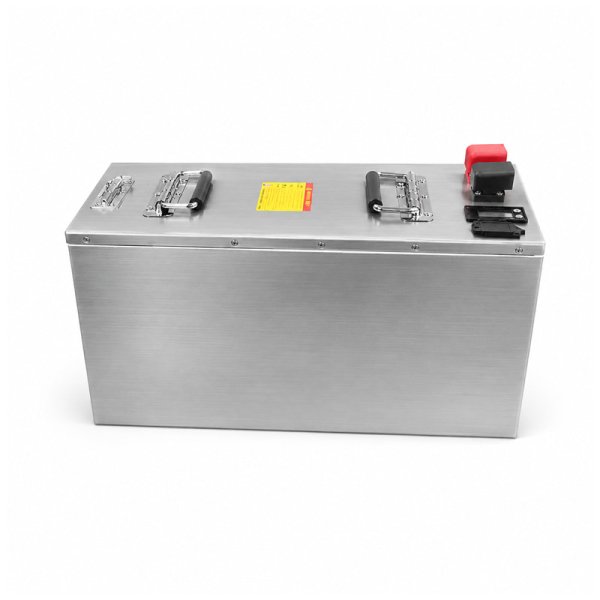
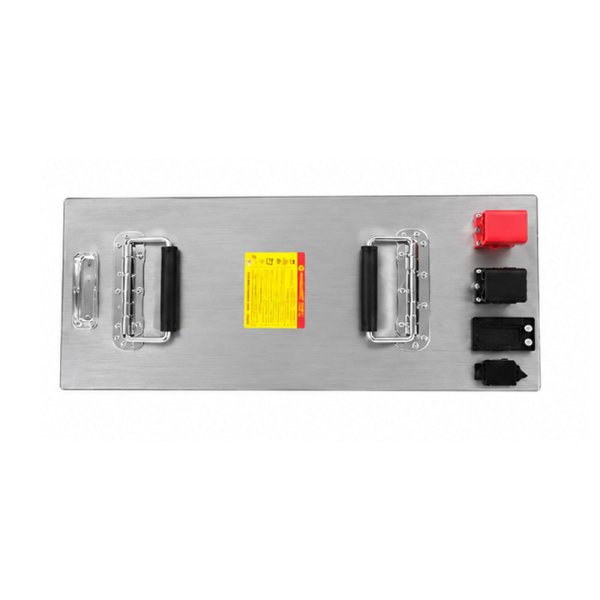
A 64V 105Ah forklift battery is typically selected when the forklift requires more voltage than a 48V system but does not need the size, weight, or cost of a much larger high-capacity pack. For a specific product reference, the 64V 105Ah Forklift Battery can be reviewed for application fit, LiFePO4 chemistry, BMS design, and compatibility details. This product reference is useful for buyers comparing real specifications while learning how to choose a 64V 105Ah forklift battery for fleet use.
Why Should You Choose a 64V 105Ah Forklift Battery?
The main reason to choose a 64V 105Ah forklift battery is to support suitable electric forklifts with a balanced combination of voltage, energy, size, and efficiency. The 64V platform can provide stable power for traction motors, lifting systems, steering assistance, and onboard control systems when the battery is correctly matched to the forklift.
For B2B fleets, this battery capacity can be practical for predictable work cycles, medium-duty handling, indoor warehouse use, and operations with planned charging windows. It can also help reduce unnecessary oversizing when a larger battery is not required.
A 64V 105Ah forklift battery may support:
- Electric forklifts with 64V system requirements.
- Narrow-aisle warehouse vehicles.
- Reach trucks and order pickers where compatible.
- Industrial vehicles with moderate daily duty cycles.
- Fleets using planned or opportunity charging.
- Operations that need lower maintenance than lead-acid.
When learning how to choose a 64V 105Ah forklift battery, the key point is simple: the battery must fit the application. A battery with the right voltage may still be unsuitable if the dimensions, weight, current output, charger, connector, or BMS communication do not match the forklift.
How Do You Know If a 64V 105Ah Battery Fits Your Forklift?
Compatibility is the most important step before purchase. A forklift battery is part of the entire vehicle power system, not a standalone accessory. Buyers should verify physical, electrical, and operational fit before approving samples or volume orders. This is one of the most important parts of how to choose a 64V 105Ah forklift battery correctly.
| Check item | What to confirm |
|---|---|
| Voltage | Forklift supports a 64V battery system |
| Energy | 64V × 105Ah = 6.72kWh nominal energy |
| Dimensions | Battery fits the compartment safely |
| Weight | Battery meets counterweight requirements |
| Connector | Connector type and polarity match |
| Charger | Charger supports the battery chemistry and voltage |
| BMS | BMS supports discharge, charge, protection, and communication |
| Current output | Continuous and peak current match forklift demand |
| Safety documents | Transport and market documents are available if required |

The battery compartment must be measured carefully. The battery should fit securely without compression, cable bending, or movement during braking, lifting, or turning. Battery weight is also critical because many electric forklifts use the battery as part of the counterbalance system.
If a lithium battery is much lighter than the original lead-acid battery, additional ballast may be required. Ignoring battery weight can affect forklift stability and safe lifting performance. This is why understanding how to choose a 64V 105Ah forklift battery requires checking both energy performance and forklift safety requirements.
What Battery Chemistry Is Best for Your Fleet?
Battery chemistry affects maintenance, charging speed, usable energy, lifespan, safety, and cost. For a 64V 105Ah forklift battery, the main chemistry options are lead-acid, LiFePO4, and sometimes NMC lithium chemistry.
| Factor | Lead-acid battery | LiFePO4 64V 105Ah forklift battery | NMC lithium battery |
|---|---|---|---|
| Initial cost | Usually lower | Usually higher than lead-acid | Varies |
| Maintenance | Watering and regular checks | Low maintenance | Low maintenance |
| Thermal stability | Mature but requires care | Strong thermal stability | Higher energy density, more thermal sensitivity |
| Charging | Slower, often needs cooling time | Faster with compatible charger | Faster with compatible charger |
| Cycle life | Shorter in many industrial uses | Longer under suitable use | Depends on design and use |
| Best fit | Cost-sensitive operations | Safety-focused and productivity-focused fleets | Space-constrained designs |
LiFePO4 is often preferred for industrial forklift fleets because it can provide stable discharge, low maintenance, better charging flexibility, and strong safety characteristics when properly designed. However, buyers should avoid absolute claims. Actual performance depends on cell quality, BMS design, charger compatibility, operating temperature, depth of discharge, and workload.
For most B2B buyers researching how to choose a 64V 105Ah forklift battery, LiFePO4 is usually the strongest option when long-term reliability, safer chemistry, and lower routine maintenance are priorities.
Which Performance Specifications Matter Most?
A professional battery evaluation should go beyond voltage and capacity. Buyers should review the specifications that directly affect forklift operation. Performance data is a key part of how to choose a 64V 105Ah forklift battery because it shows whether the battery can support real work conditions.
Important performance specifications include:
- Nominal voltage.
- Nominal capacity.
- Nominal energy.
- Continuous discharge current.
- Peak discharge current.
- Maximum charging current.
- Charging voltage range.
- Operating temperature range.
- Battery dimensions.
- Battery weight.
- Connector type.
- Communication protocol if required.
- BMS protection functions.
Continuous discharge current affects whether the forklift can operate steadily under normal load. Peak discharge current affects acceleration, lifting heavy pallets, ramp operation, and sudden high-demand moments. Charging current affects how quickly the battery can recover during breaks or shift changes.
When comparing suppliers, do not accept a product page that only lists voltage and capacity. A reliable supplier should provide complete technical data. This is a major part of how to choose a 64V 105Ah forklift battery correctly for fleet use.
How Can a Battery Management System Improve Fleet Performance?
The Battery Management System, or BMS, is one of the most important components in a lithium forklift battery. It monitors and controls voltage, current, temperature, cell balance, charge status, and protection limits.
A quality BMS should provide:
- Overcharge protection.
- Over-discharge protection.
- Overcurrent protection.
- Short-circuit protection.
- Temperature monitoring.
- Cell balancing.
- Charging control.
- Fault diagnosis if supported.
- Communication through CAN, RS485, or other protocols if required.
For fleet managers, the BMS helps reduce unexpected shutdowns, prevent abuse, improve charging control, and protect battery life. In some advanced systems, BMS data can also help with maintenance planning by showing battery status, cycle count, fault history, or state of health.
When deciding how to choose a 64V 105Ah forklift battery, buyers should not treat the BMS as a minor detail. Two batteries may have the same 64V 105Ah label, but very different safety, protection, and fleet-management value depending on the BMS.
Which Safety Certifications Should You Look For?
Safety documents and certifications are important for industrial batteries, especially when products are shipped internationally or used in regulated workplace environments. The required documents may vary by market, customer, transport method, and application, so buyers should request the relevant documents according to the actual project.
Common documents and standards include:
| Document or certification | Why it matters |
|---|---|
| UN38.3 | Supports lithium battery transport safety |
| MSDS | Provides material safety information |
| CE | Useful for applicable market compliance |
| RoHS | Addresses restricted substances |
| IEC 62619 | Relevant for industrial lithium battery safety when required |
| UL 2580 | Relevant for electric vehicle battery safety in certain markets |
| Product inspection report | Supports quality verification before shipment |
| User manual | Helps installation, charging, and safe operation |
UN38.3 is especially important for transport because lithium batteries must meet shipping safety requirements. IEC 62619 and UL 2580 may be relevant depending on market and customer expectations. Buyers should confirm the exact certification package before shipment, not after the order is completed.
A serious supplier should be able to explain which documents are available and which ones apply to the buyer’s market. This is another practical step in how to choose a 64V 105Ah forklift battery for international B2B projects.
What Should You Consider Before Choosing a Battery Supplier?
Choosing the right supplier is as important as choosing the right battery specification. A forklift battery supplier should provide engineering support, technical documentation, quality control, customization, warranty terms, and after-sales response.
Supplier evaluation checklist:
| Supplier factor | What buyers should check |
|---|---|
| Engineering support | Can the supplier confirm voltage, current, size, weight, and charger fit? |
| Manufacturing ability | Does the supplier control production and inspection? |
| Cell quality | Are cells consistent and traceable? |
| BMS design | Does the BMS match forklift current and protection needs? |
| Customization | Can the supplier adjust casing, connector, cable, ballast, or label? |
| Documentation | Are datasheets, safety documents, and manuals available? |
| Warranty | Is the warranty clear, written, and realistic? |
| Support | Can the supplier respond quickly to technical issues? |
| Repeat orders | Can the supplier support stable long-term B2B supply? |
A weak supplier may only quote a price. A strong supplier asks about forklift model, duty cycle, charger, connector, battery compartment, operating temperature, and target market. For B2B procurement, this technical communication reduces mismatch risk. Supplier evaluation should be included whenever buyers study how to choose a 64V 105Ah forklift battery, because technical support can prevent costly compatibility problems after delivery.

Should You Choose a Standard or Custom 64V 105Ah Battery?
Standard batteries are suitable when the forklift compartment, connector, weight, and charger requirements are already common and easy to match. They usually offer shorter lead times, lower development cost, and easier replacement planning.
Custom batteries may be needed when the forklift has unusual space requirements, special connector needs, communication requirements, weight balance requirements, or OEM/ODM branding needs. Customization may include:
- Battery case size.
- Connector type.
- Cable length.
- BMS communication.
- Heating function for cold environments.
- Steel ballast for counterweight
- Label and logo.
- Packaging.
- Mounting structure.
- Custom documentation.
When evaluating how to choose a 64V 105Ah forklift battery, buyers should not choose custom design unless it solves a real compatibility or business need. Customization can increase MOQ, cost, and lead time. Standard solutions are better when they already meet the forklift requirements.
How Can You Evaluate Battery Lifespan and ROI?
The true cost of a forklift battery is not only the purchase price. B2B buyers should evaluate total cost of ownership, including maintenance labor, charging efficiency, downtime, replacement frequency, charger investment, and warranty support.
Key cost factors include:
- Initial battery price.
- Charger cost.
- Installation cost.
- Maintenance labor.
- Energy consumption.
- Downtime cost.
- Battery replacement schedule.
- Warranty coverage.
- Service response.
- Disposal or recycling cost.
A well-designed LiFePO4 64V 105Ah forklift battery can often reduce maintenance and support more flexible charging than lead-acid, but ROI depends on real fleet usage. The strongest financial benefit usually appears in fleets with frequent use, high downtime cost, long operating hours, or expensive maintenance labor.
Avoid fixed ROI promises such as “payback in 18 months” unless they are based on your fleet’s data. The correct way to calculate ROI is to compare the battery’s full operating cost over several years against the previous battery system. A clear ROI check helps buyers understand how to choose a 64V 105Ah forklift battery based on long-term value, not only purchase price.
How Do You Estimate Runtime for a 64V 105Ah Battery?
A 64V 105Ah battery stores about 6.72kWh of nominal energy. Runtime can be estimated by dividing battery energy by average equipment power consumption.
Example runtime calculation:
| Average forklift power demand | Estimated theoretical runtime |
|---|---|
| 1.5kW | About 4.5 hours |
| 2.0kW | About 3.4 hours |
| 2.5kW | About 2.7 hours |
| 3.0kW | About 2.2 hours |
| 4.0kW | About 1.7 hours |
These numbers are theoretical. Real runtime depends on lifting frequency, payload, travel distance, temperature, floor condition, battery health, BMS limits, and safety reserve. Fleet managers should use actual forklift power data or conduct sample testing before bulk purchasing.
This runtime check is essential when learning how to choose a 64V 105Ah forklift battery because the correct battery must support the real working cycle, not only look suitable on paper.
FAQ About Choosing a 64V 105Ah Forklift Battery
1.What is the lifespan of a 64V 105Ah forklift battery?
Lifespan depends on chemistry, cell quality, BMS design, depth of discharge, charging profile, temperature, workload, and storage conditions. A 64V 105Ah forklift battery basically lasts 5 to 10 years. A LiFePO4 64V 105Ah forklift battery can often provide longer practical service life than lead-acid, but exact cycle life should be confirmed from the datasheet and warranty terms.
2.Can a lithium battery directly replace a lead-acid forklift battery?
Sometimes, but it should not be treated as an automatic drop-in replacement. Buyers must check voltage, dimensions, weight, connector, charger, counterbalance requirements, BMS compatibility, and forklift controller limits before replacing a lead-acid battery with lithium.
3.How long does it take to fully charge a 64V 105Ah forklift battery?
Charging time depends on charger current, BMS charging limit, starting state of charge, temperature, and battery chemistry. A 64V 105Ah forklift battery takes between 1.5 and 2 hours to fully charge if it is a modern lithium-ion battery. In contrast, if it is an older lead-acid unit, the charge and cool-down cycle requires 14 to 16 hours. The exact charging time should be confirmed from product and charger specifications.
4.How do I choose the right charger for a 64V 105Ah battery?
Choose a charger that matches the battery voltage, chemistry, charging current limit, connector, and BMS requirements. Do not use a lead-acid charger for a lithium battery unless the supplier confirms compatibility. The charger should support safe charging without exceeding BMS limits.
5.What factors influence the total cost of ownership?
Total cost of ownership includes battery price, charger cost, installation, maintenance labor, energy efficiency, downtime, service life, warranty, support, and replacement frequency. Buyers comparing how to choose a 64V 105Ah forklift battery should focus on long-term operating cost, not only initial purchase price.
Conclusion
Understanding how to choose a 64V 105Ah forklift battery starts with technical compatibility. Confirm that the forklift supports a 64V system, then verify dimensions, battery weight, connector, charger, current output, BMS functions, and safety documents. Do not approve a battery only because the voltage and capacity look correct.
For fleets that need low maintenance, stable operation, and flexible charging, a LiFePO4 64V 105Ah forklift battery can be a strong option when properly matched to the forklift and duty cycle. However, buyers should still request datasheets, warranty terms, certification documents, and sample testing before large orders.
The best 64V 105Ah forklift battery is not simply the cheapest option. It is the one that fits the forklift safely, supports the working schedule, reduces downtime risk, and comes from a supplier capable of stable B2B production, documentation, and technical support.