Replacing an aging AGV battery requires more than matching its catalog capacity. A poorly qualified retrofit can interrupt warehouse dispatch, disable vehicle communications, or alter braking behavior. The safest purchasing sequence is to document the existing fleet, verify vehicle-level compatibility, then approve a limited operational pilot before ordering in volume. The right battery for AGV vehicles must preserve predictable missions—not merely fit the compartment.
When Should Operators Replace a Battery for AGV Vehicles?
Replacement becomes commercially justified when battery-related interruptions begin undermining throughput, maintenance budgets, or available vehicle hours. Frequent mid-shift returns, extended charging queues, unexpected low-state-of-charge alarms, and repeated pack failures are more informative than calendar age alone.
Before purchasing a replacement battery, distinguish actual battery deterioration from other operational problems. Poor contact resistance, charger faults, changed route lengths, and heavier payloads can produce similar symptoms. Examine maintenance logs across representative shifts before selecting a battery for AGV vehicles.

A retrofit decision should answer three questions:
- Capacity: Does the existing fleet complete its assigned missions under normal peak demand?
- Reliability: How often do battery faults interrupt dispatch or require technician intervention?
- Economics: Will a replacement battery for AGV vehicles reduce total disruption after installation, charging changes, training, and maintenance are included?
Lithium conversion can be worthwhile when duty cycles support the investment, but a functioning lead-acid fleet should not be converted on chemistry claims alone.
For a LiFePO4 AGV battery retrofit, buyers should verify the proposed pack’s operating voltage range, usable energy, continuous and peak discharge current, charging limits, BMS communication interface, dimensions, and installed weight. These specifications must be validated against the existing vehicle and its operating requirements before conversion.
What Fleet and Vehicle Records Should Buyers Collect Before Retrofitting?
A credible request for quotation starts with an equipment audit, not a preferred amp-hour rating. Every battery for AGV vehicles must be evaluated against a documented vehicle configuration and a defined working environment.
Before approving a battery for AGV vehicles, build a retrofit dossier for each model or revision:
| Record | What the supplier needs to know |
|---|---|
| Fleet profile | Vehicle count, OEM/model, firmware version, and planned retrofit sequence |
| Duty cycle | Route duration, payload distribution, gradients, starts, stops, and shift pattern |
| Existing battery | Chemistry, usable runtime, operating limits, dimensions, and installed mass |
| Electrical interface | Peak traction demand, regenerative behavior, connectors, fusing, and controller requirements |
| Integration | BMS data expectations, CAN/RS485 messages, fault handling, and charge-station interfaces |
| Environment | Ambient temperature, dust, washdown exposure, vibration, and service access |
Ask operations and maintenance teams to identify the busiest route, not just the average route. An underspecified battery for AGV vehicles may pass an unloaded workshop test yet fail during repeated acceleration or loaded lifting.
Where records are missing, log representative current profiles and faults before requesting a battery for AGV vehicles.
How Should a Replacement Battery for AGV Vehicles Work With Legacy Controls?
Electrical compatibility reaches beyond nominal voltage. The replacement pack must remain within the traction controller’s approved voltage range throughout discharge, while supporting short-duration current peaks and safe shutdown behavior.
For a lead-acid-to-lithium conversion, buyers should confirm these interfaces together:
- Power delivery: Continuous and peak current, acceleration transients, lift loads, contactor sequencing, and any regenerative energy returned during braking.
- Controller behavior: Undervoltage thresholds, startup checks, precharge requirements, and the response to sudden BMS protection events.
- Data exchange: CAN or RS485 physical connection, message definitions, alarm codes, state-of-charge reporting, and watchdog behavior.
- Charging infrastructure: Charging profile, connector or contact arrangement, allowable temperature, interlocks, and communication handshakes.
An existing charger is not automatically compatible with a lithium battery for AGV vehicles. Charging equipment must be approved for the new chemistry and BMS operating limits; changing a connector does not solve an incompatible charging profile.
If the AGV controller cannot interpret a new battery’s warning, it may continue dispatching until a protective shutdown stops the vehicle in a traffic lane. The AGV battery integration case illustrates why RS485 communication, connectors, charging equipment, and pack packaging are reviewed together, rather than purchased independently. The same integration discipline applies when assessing a battery for AGV vehicles during retrofit.
What Mechanical and Weight Changes Can Affect AGV Battery Retrofitting?
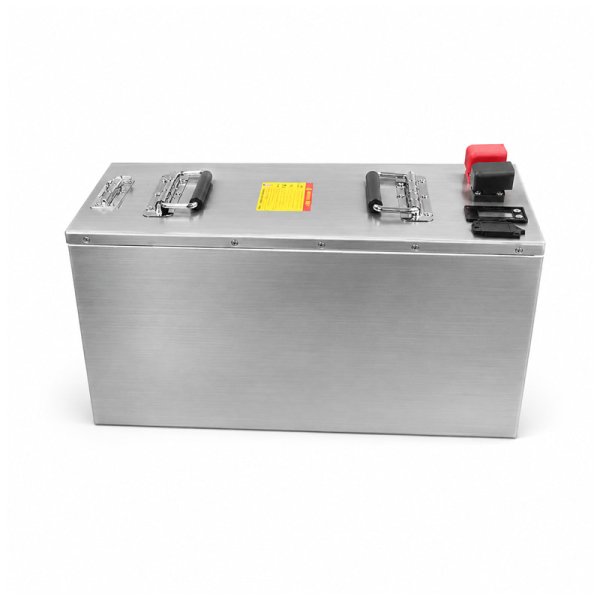
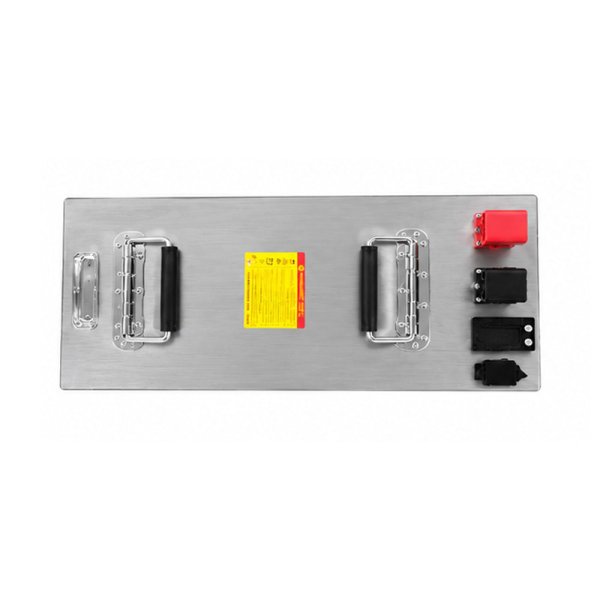
A replacement battery for AGV vehicles must fit the available compartment while preserving the machine’s mechanical integrity. The relevant measurements include connector protrusion, cable bend radius, retention points, ventilation or thermal clearances, and access for future servicing—not just pack length, width, and height.
Mass is another risk when specifying a battery for AGV vehicles. Some legacy AGVs use the original lead-acid battery as part of their designed weight distribution. Installing a lighter lithium battery for AGV vehicles can shift the center of gravity or change drive-wheel traction, stability, and braking response.

Require the AGV OEM or qualified integrator to review:
- Axle loading, stability, traction, and stopping performance with rated payloads.
- Mounting strength and restraint under vibration, shocks, and emergency stops.
- Cable routing, enclosure protection, access panels, and service clearance.
Do not compensate for missing ballast or alter structural mounts without an engineered assessment. The correct battery for AGV vehicles is one that preserves the machine’s validated operating envelope after installation.
Can Different AGV Models Share One Replacement Battery Specification?
Standardization may simplify inventory, supplier management, training, and spares. Nevertheless, one battery for AGV vehicles is not necessarily suitable for every vehicle in a mixed fleet, even when the original packs appear similar.
To standardize a battery for AGV vehicles, group equipment by integration requirements, not nominal rating. Compare compartment geometry, load profile, controller operating limits, data protocol, charging method, and required mass. Two vehicles can share a common pack only when all critical interfaces are compatible or an approved adapter and configuration resolve the differences.
A practical fleet strategy may use one common cell chemistry and supplier platform with several mechanical or BMS variants.
Before approving a standardized battery for AGV vehicles, request a cross-model compatibility matrix showing supported vehicles, deviations, required modifications, and responsible approvers. Suppliers should also explain whether replacement units remain interchangeable after future firmware updates.

For buyers comparing custom integration options, this power battery solutions for industrial fleets provide a starting point for discussing application-specific pack design and system interfaces. A common battery for AGV vehicles should be validated as a fleet specification—not assumed from a catalog description.
What Safety Evidence Should Buyers Require Before Lithium Conversion?
A proposed battery for AGV vehicles needs documented protection behavior, traceable test evidence, and an installation risk assessment.
When qualifying a battery for AGV vehicles, request evidence covering short circuits, overcurrent, temperature, insulation where applicable, mechanical restraint, and fault communication. Verify what happens when the BMS disconnects during driving, lifting, or automatic recovery.
The relevant standards depend on the application and market. IEC 62619:2022 explicitly addresses lithium batteries for industrial applications, including AGVs. ISO 3691-4:2023 covers safety requirements for driverless industrial trucks and their systems, but does not itself certify the battery’s safety. Buyers must determine applicable local obligations and obtain OEM or integrator approval for changes affecting vehicle safety functions.
A supplier offering a battery for AGV vehicles should specify which documents apply to the proposed configuration and provide test reports or declarations that can be checked—not generic certification logos. Confirm emergency-stop behavior, charging interlocks, maintenance isolation, and technician instructions before pilot installation.
How Should Operators Validate a Replacement AGV Battery Before Fleet Rollout?
The decisive test for a battery for AGV vehicles is sustained performance in the intended operation.
Qualify each battery for AGV vehicles through staged acceptance:
Stage 1 — Bench and integration checks. Verify electrical limits, BMS-controller messages, connector pinouts, fault responses, and charger compatibility. Document the hardware and firmware revisions under test.
Stage 2 — Controlled vehicle trial. Fit the battery for AGV vehicles to one representative machine, then test full-load acceleration, lifting, braking, docking, low-charge warnings, and emergency-stop recovery with the approved safety procedures.
Stage 3 — Operational pilot. Run the vehicle through real shifts, including the most demanding routes. Compare battery-attributable stops, completed missions, charging dwell, usable operating hours, and maintenance interventions against the pre-retrofit baseline.
Stage 4 — Release decision. Obtain sign-off from engineering, maintenance, safety, and operations before standardizing the battery for AGV vehicles across additional units.
| Acceptance gate | Evidence required before release |
|---|---|
| Integration | No unresolved controller, communication, or charger faults |
| Mechanical | Approved fit, restraint, stability, and loaded stopping behavior |
| Operations | Agreed mission-completion and availability targets met under representative load |
| Quality | Traceable test records, approved revisions, and defined warranty response |
The procurement agreement should identify test ownership, acceptable deviations, spare-parts availability, and field failure procedures. This guide to lithium battery testing for industrial vehicles explains how documented inspection and validation evidence supports fleet purchasing decisions.
A successful pilot qualifies a specific battery for AGV vehicles in a specific configuration. Changes to firmware, charger type, payload, or duty cycle may require renewed assessment rather than automatic approval.
Frequently Asked Questions About Battery for AGV Vehicles
Q: Can I replace a lead-acid battery in an AGV with lithium?
A: Potentially. A LiFePO4 battery may replace a lead-acid pack when the AGV OEM or qualified integrator approves the conversion. Verify controller compatibility, charging requirements, weight distribution, safety functions, and loaded-route performance before deployment. Verify controller behavior, charging, weight distribution, safety functions, and real-route performance.
Q: Does a replacement battery for AGV vehicles need the same voltage?
A: It must operate within the AGV controller’s approved voltage range, including charging and discharge extremes. Matching nominal voltage alone does not guarantee a safe, functional retrofit.
Q: Can an existing AGV charger work with a lithium battery?
A: Only if its charging profile, current limits, interfaces, and protective functions are approved for the specific lithium pack and BMS. Otherwise, use a compatible charger or validated upgrade.
Q: Does battery weight affect an automated guided vehicle?
A: Yes. Battery mass and placement can affect traction, center of gravity, braking, and stability, particularly on loaded or inclined routes. Have the vehicle integrator validate any significant change.
Q: Can multiple AGV models use the same replacement battery?
A: Sometimes. Models must share compatible dimensions, load demands, electrical limits, communication, and charging requirements. A common platform may still need different mounts or BMS settings.
Plan Your Fleet Retrofit With FEBATT
A battery for AGV vehicles should be specified from operating evidence, not marketing claims. Share your AGV model list, duty-cycle logs, compartment drawings, controller and charger details, and rollout schedule with FEBATT. Request a compatibility review and sample-validation plan before committing to fleet-wide replacement. The goal when qualifying a battery for AGV vehicles is straightforward: remove existing downtime without creating new operational risks.