An AGV fleet can meet its daily transport target yet lose productivity when batteries age early. For warehouse operators, AGV battery cycle life is not simply the largest number on a supplier’s datasheet. The real concern is whether the battery can continue supporting dependable missions as it ages, without causing costly downtime.
Lithium iron phosphate (LiFePO4) is often better suited than flooded lead-acid to intensive fleets through lower maintenance and approved partial charging. Yet impressive ratings cannot guarantee a successful shift. To protect AGV battery cycle life, OEMs must match battery performance to the work robots actually do.
Why Doesn't a High Cycle Count Guarantee Fleet Reliability?
A rating of 4,000 cycles is useful only alongside its test conditions. What was the depth of discharge (DOD), temperature, current and remaining-capacity threshold? Was the test cell-level or pack-level? Suppliers may quote different AGV battery cycle life figures under incomparable conditions.
This guide to factors affecting lithium battery cycle life explains these distinctions. Buyers need to know whether aging packs can complete loaded routes in year three. Real-world AGV battery cycle life should therefore be evaluated against a defined service requirement, not a brochure headline.
How Do Repeated Starts Affect AGV Battery Cycle Life?
Every loaded start, incline, or lifting task draws a short current pulse. As cells age, resistance may rise; the same event can then cause greater voltage sag or unwanted BMS shutdowns. An energized robot can still fail its mission.
Ask suppliers for measured one-second and five-second pulse-current limits, permitted repetition rates, and voltage response at low state of charge. Compare new packs with aged samples where test data exist. These checks reveal whether AGV battery cycle life includes usable power, not just retained capacity. Stable starts protect shift throughput.

Does Opportunity Charging Shorten AGV Battery Cycle Life?
Not necessarily. Short top-ups between warehouse assignments can keep LiFePO4 AGVs moving without the routine maintenance of flooded lead-acid systems. However, fast charging outside a cell’s approved current, temperature or SOC limits can accelerate degradation.
Each partial top-up is not a full cycle. Fleet planners should review equivalent full cycles as well as the frequency of charge events. Ask how the supplier tested AGV battery cycle life under the intended partial-charge pattern. Properly controlled opportunity charging can support availability; an unsuitable charging profile undermines AGV battery cycle life.

How Should OEMs Read AGV Battery Cycle Life Specifications?
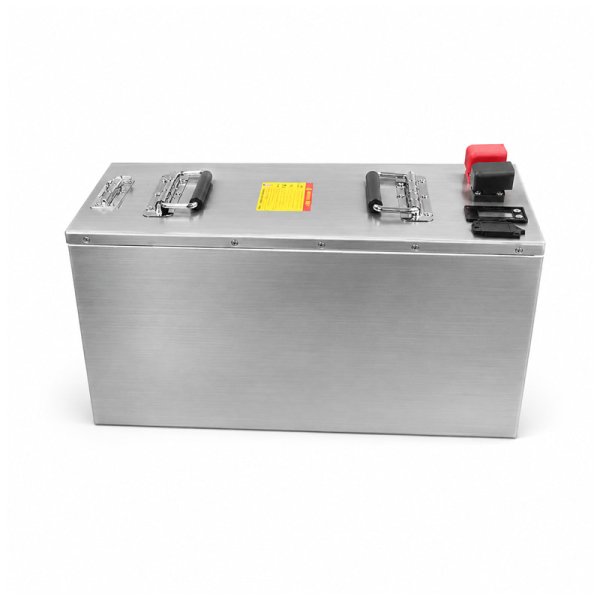
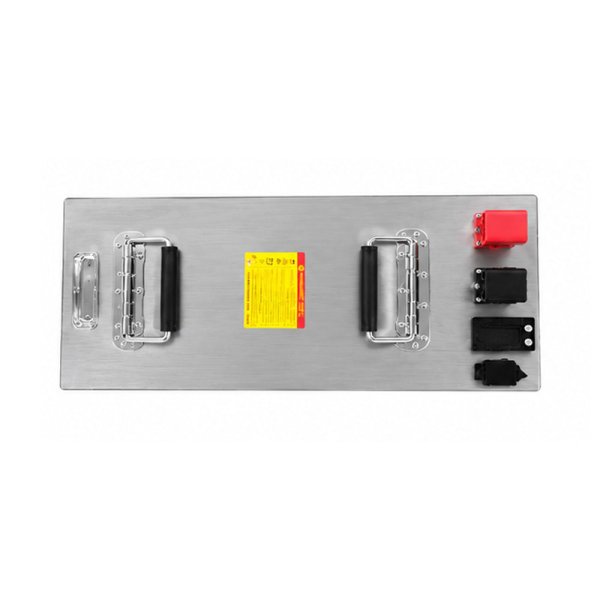
This heavy-duty LiFePO4 pack for logistics robots lists at least 4,000 cell cycles and at least 3,500 system cycles, both at 100% DOD. Its published output ratings are 230A continuous and 250A peak. These are model-specific stated specifications, not independently verified service-life guarantees.

The distinction matters: pack-level AGV battery cycle life can differ from individual cell ratings. Before contracting, request the test temperature, charge/discharge currents, capacity-retention threshold and the allowable duration of peak output. Compare like-for-like data instead of assuming more cycles mean lower costs.
What Should OEM Buyers Include in a Battery Performance RFQ?
Use the robot’s operating schedule, not just a voltage or capacity target, to define AGV battery cycle life requirements:
| Fleet issue | Evidence to request |
|---|---|
| Repeated loaded starts | Pulse-current trace, voltage sag and BMS event log |
| Partial charging across shifts | Aging data at the specified SOC window |
| Hot or cold work areas | Capacity and current limits at operating temperatures |
| Pack-to-pack inconsistency | Cell matching, DCIR spread and sample acceptance criteria |
Define pass/fail limits for remaining usable energy, voltage sag, pulse-current capability, and BMS protection events under the agreed operating conditions. This South Korean AMR project illustrates the practical need to align installation, communication and sample validation before production. These steps help prevent integration mistakes; they do not prove cycle life. Buyers should make AGV battery cycle life a measurable acceptance item rather than a general sales promise.
How Can FEBATT Support More Predictable Fleet Performance?
This power battery solutions include LiFePO4 battery configurations, OEM customization, BMS integration and sample testing for industrial equipment. Share route-current logs, payload, temperature, charging schedule and fleet volume. The correct lithium battery is one that maintains reliable missions at a sustainable replacement cost. For AGV battery cycle life, application-specific validation matters more than buying the largest advertised cycle count.
Frequently Asked Questions About AGV Battery Cycle Life
Q: How long do AGV lithium batteries typically last?
A: No universal interval exists. AGV battery cycle life depends on chemistry, DOD, current, temperature and hours of operation. Translate published ratings into annual use and minimum mission performance.
Q: What is a good cycle life for LiFePO4 AGV batteries?
A: A suitable rating is one verified at comparable conditions. Some FEBATT logistics robot packs publish system ratings in the thousands of cycles, but the useful benchmark is the pack’s capacity and pulse capability at the fleet’s agreed end-of-life threshold. Compare AGV battery cycle life using consistent tests.
Q: Does frequent opportunity charging damage AGV batteries?
A: Not automatically. Approved partial charging may fit multi-shift operations well. Excessive current, low battery temperatures or long periods at high SOC can increase aging. To preserve AGV battery cycle life, match charging limits to the cell and confirm the intended duty cycle during sample testing.
Q: Why do AGV batteries fail before their cycle rating?
A: Aged cells can develop higher resistance and imbalance, causing voltage drops or protective shutdowns even when capacity remains. High load pulses and temperature extremes worsen the problem. AGV battery cycle life claims should therefore be checked against current-delivery requirements, not only a capacity test.
Q: When should a fleet replace its AGV lithium batteries?
A: Replace or service packs when the agreed performance threshold is reached, such as insufficient loaded-route energy, repeated protection faults or unacceptable resistance growth. Use BMS records and periodic verification instead of a fixed calendar date. Tracking AGV battery cycle life alongside actual fleet availability supports planned rather than emergency replacement.