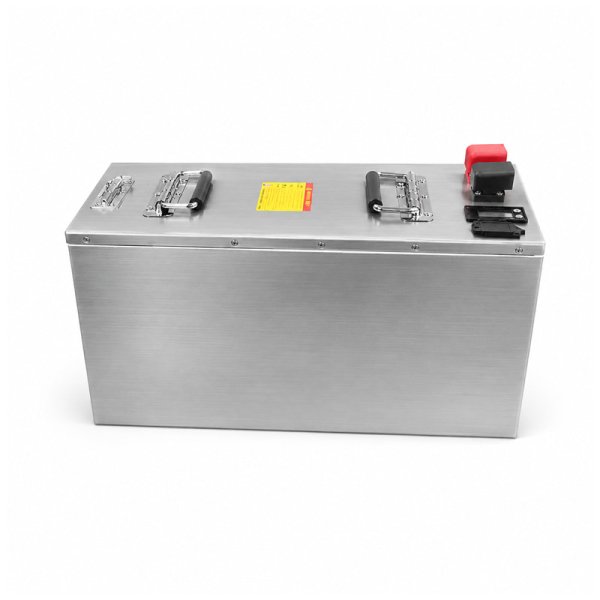
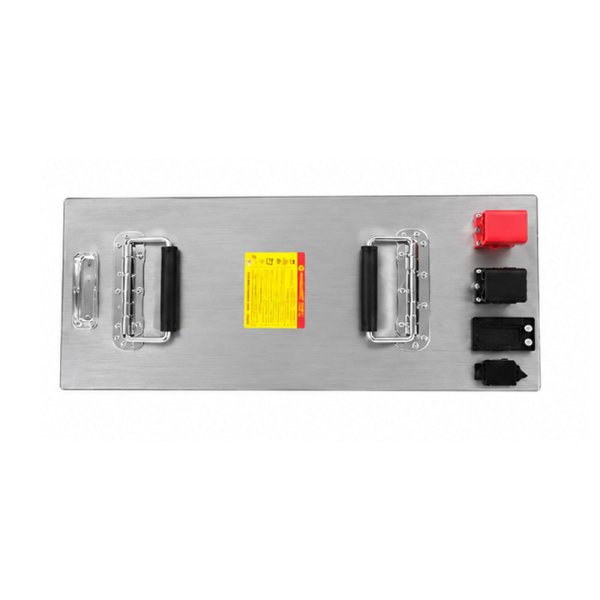
For commercial fleets, battery selection is not simply a question of which chemistry costs less at the time of purchase. It affects vehicle availability, route completion, payload, maintenance labor, replacement planning, charging flexibility, and the total cost of keeping equipment productive. That is why a lithium vs lead acid battery comparison matters most when it is tied to real operating conditions rather than retail price alone.
In a lithium vs lead acid battery comparison, lead-acid remains familiar, widely available, and relatively inexpensive upfront. Lithium iron phosphate, or LiFePO4, generally requires a higher initial investment but can provide a wider usable energy window, lower pack mass, lower routine battery maintenance, more stable voltage delivery, and longer cycle-life potential under defined operating conditions. For high-utilization electric tricycles, golf carts, forklifts, electric motorcycles, RV auxiliary systems, and other power-driven commercial vehicles, those differences can translate into measurable business value.
For OEMs and fleet operators evaluating a complete battery system rather than a standalone pack, FEBATT power battery solutions can be configured around voltage, energy, current, BMS logic, communication, packaging, and operating environment.
Why Does the Lithium vs Lead Acid Battery Comparison Matter for B2B Fleets?
The source article correctly highlights four practical differences in the lithium vs lead acid battery decision: purchase price, weight, service life, and charging behavior. For B2B users, however, the comparison should go further. A battery that is cheaper to buy can become expensive if it causes more replacements, more maintenance, longer charging windows, or reduced vehicle productivity.
A commercial electric vehicle battery ROI analysis should therefore treat the lithium vs lead acid battery choice as a total ownership cost decision over the planned service period. The key questions are: How many productive hours does the battery support? How much energy is usable? How often does the pack need attention? How many replacement events are likely? What installation, downtime, and service costs are involved?
This is also why LiFePO4 vs lead acid for fleets should not be reduced to a universal “lithium is always better” statement. Lithium provides the strongest advantage when the vehicle has high utilization, meaningful payload sensitivity, repeated cycling, limited downtime tolerance, or a need for flexible partial charging. Lead-acid may still be commercially reasonable where utilization is light, the acquisition budget is very constrained, and existing maintenance infrastructure already supports the chemistry.
For a broader financial comparison framework, see FEBATT’s lead acid vs lithium battery fleet upgrade analysis, which focuses on lifecycle cost rather than purchase price alone.
How Do Lithium and Lead-Acid Batteries Differ in Commercial Operation?
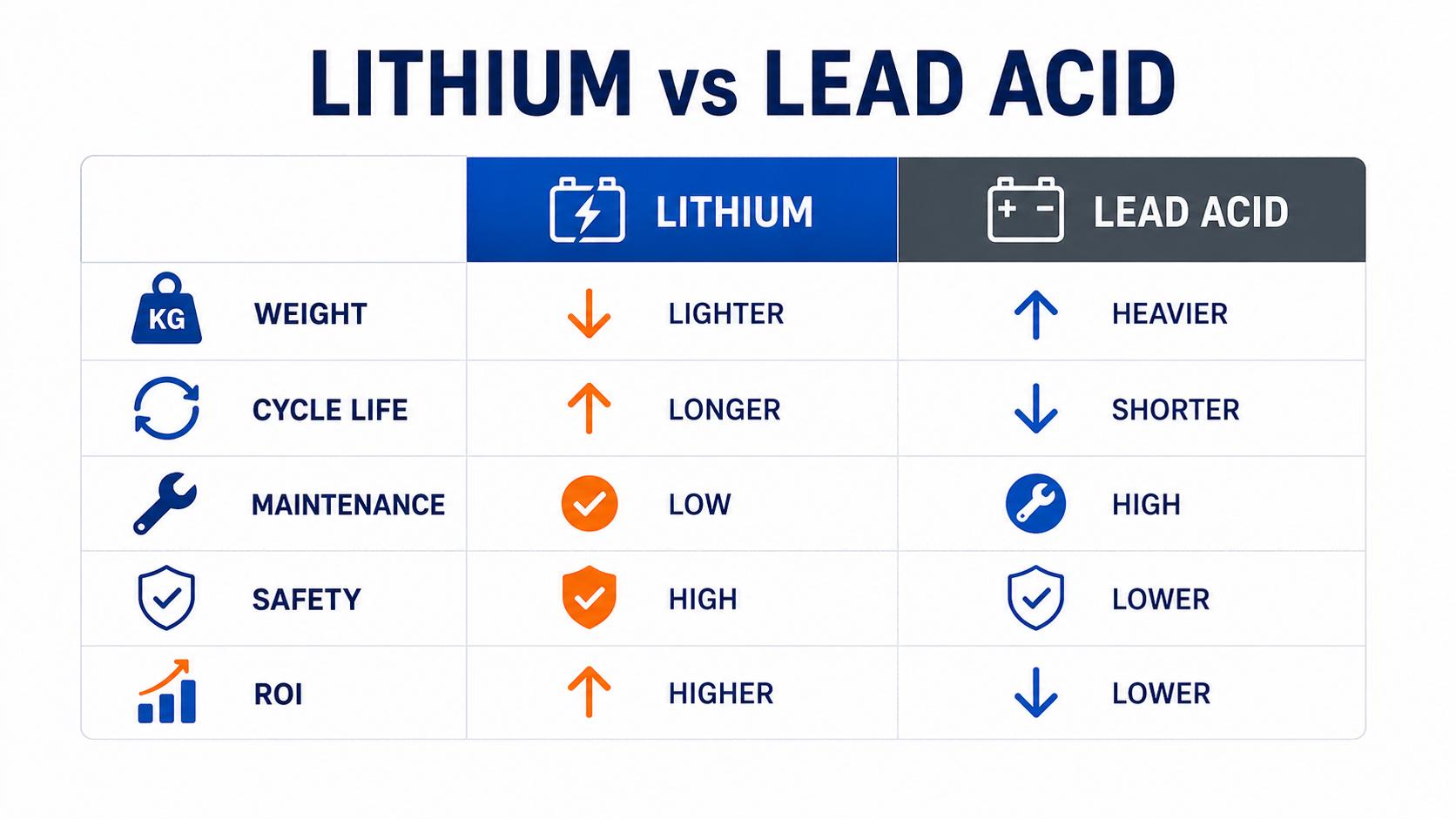
The most useful lithium vs lead acid battery comparison is based on operating tendencies rather than universal numbers. Exact results depend on battery construction, cell model, depth of discharge, charge and discharge rate, temperature, vehicle design, and end-of-life criteria.
| Commercial Factor | Lead-Acid Tendency | LiFePO4 Tendency | B2B Impact |
|---|---|---|---|
| Upfront purchase cost | Usually lower | Usually higher | Lithium requires a stronger lifecycle-cost case |
| Cycle-life potential | More sensitive to deep discharge and chronic partial-state-of-charge operation | Often several-thousand-cycle potential under specified cell conditions | Can reduce replacement frequency in high-utilization fleets |
| Usable energy window | Often operated conservatively to protect cycle life | Can generally use a wider SOC window when approved by the pack design | More usable daily energy from a given nominal pack |
| Pack mass | Relatively heavy for the same stored energy | Higher gravimetric energy density and lower pack mass | Can improve vehicle mass margin where the platform permits |
| Routine battery maintenance | Flooded systems require watering and acid-related maintenance; AGM/gel require less | No watering or acid handling; still requires electrical and mechanical inspection | Reduces chemistry-specific service labor |
| Voltage profile | More noticeable voltage drop as discharge progresses | Relatively flat discharge profile through much of the usable SOC range | Can support more consistent electrical performance |
| Charging flexibility | Generally benefits from complete charge cycles and chemistry-specific procedures | Can support partial or opportunity charging when the pack and charger are designed for it | Useful for multi-shift or short-break operations |
In the lithium vs lead acid battery comparison, the lithium advantage is therefore not that every LiFePO4 pack has the same cycle count or that every lead-acid battery fails after a fixed number of months. The advantage is that a properly sized LiFePO4 system can maintain more usable energy and lower routine service demand across demanding commercial duty cycles.
What Drives Commercial Electric Vehicle Battery ROI?
Commercial electric vehicle battery ROI in a lithium vs lead acid battery project should be calculated as a total-cost model, not as a simple purchase-price comparison. A practical formula includes battery acquisition cost, charger or charging-system changes, installation, replacement events, maintenance labor, downtime, energy consumption, freight, recycling or disposal, and the planned ownership period.
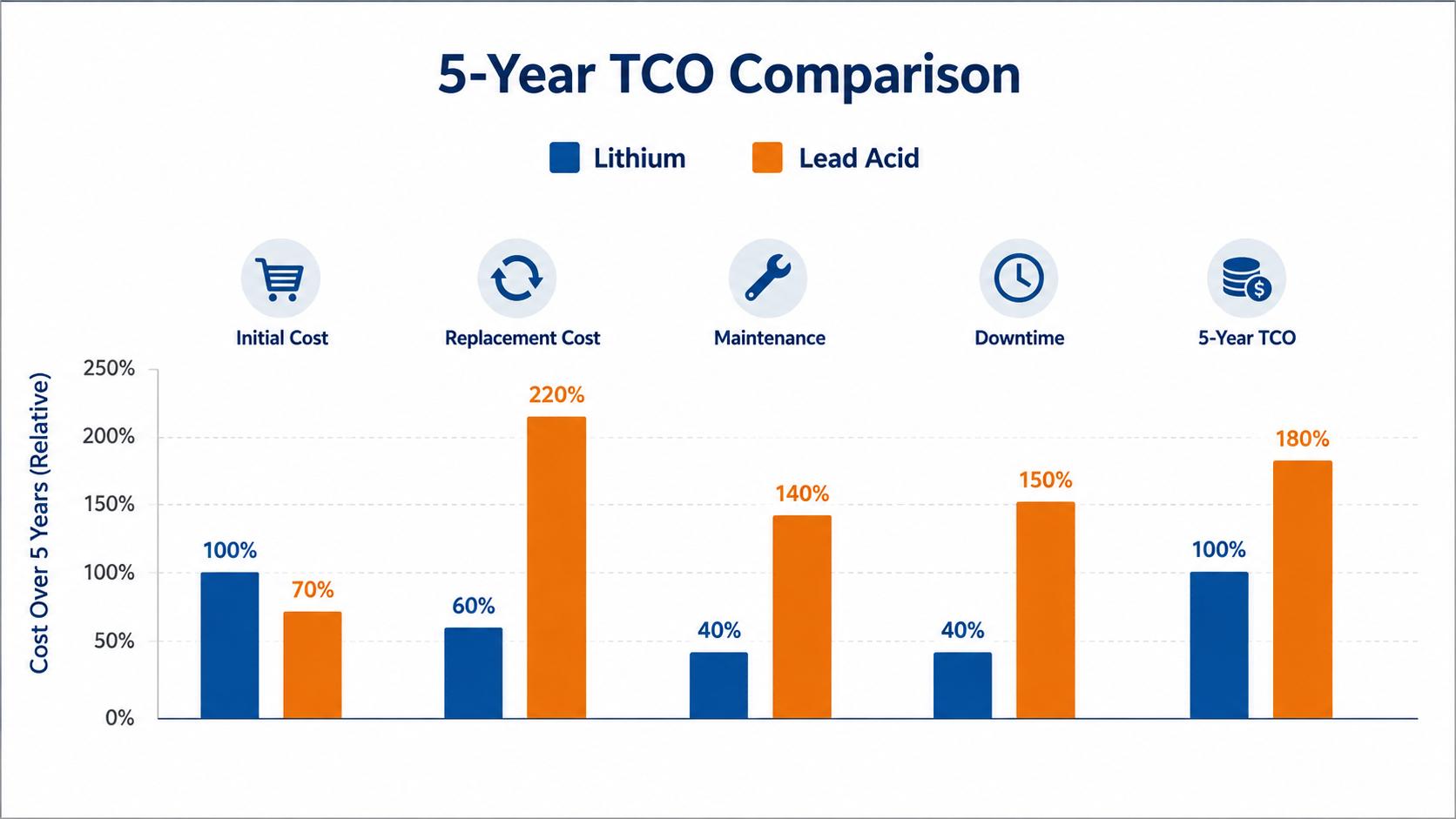
In a lithium vs lead acid battery procurement decision, lead-acid can be attractive when a fleet needs the lowest possible capital outlay. Lithium often becomes more attractive as utilization increases because fewer replacement events, reduced watering and acid maintenance, greater charging flexibility, and a wider usable energy window can offset the higher purchase price. The exact crossover point varies by fleet, so a universal 12-month or 24-month payback claim is not credible without the operating assumptions.
For forklift battery total cost of ownership, downtime can be particularly important. A warehouse operating one shift per day may tolerate a conventional overnight charging routine. A facility running two or three shifts may place much greater value on opportunity charging, reduced battery handling, and avoiding spare-battery rotation. The economic value comes from the operating model, not chemistry alone.
The same lithium vs lead acid battery principle applies to electric tricycles and golf carts. A low-utilization property cart may not justify an aggressive conversion purely on energy cost. A delivery tricycle running long routes every day can place much higher value on reduced pack mass, wider usable energy, stable output, and fewer replacement interruptions.
FEBATT’s B2B lithium fleet upgrade guide can be used as a supporting framework when building a project-specific TCO model.
How Do Weight and Usable Energy Affect Fleet Productivity?
Energy density is one of the clearest practical differences in a lithium vs lead acid battery evaluation. For the same nominal stored energy, a LiFePO4 pack is generally much lighter than an equivalent lead-acid bank. The exact reduction depends on cell format, enclosure, current capability, protection hardware, and mounting structure, so percentage claims should be based on the actual packs being compared.
For an electric tricycle battery replacement, lower battery mass can increase available vehicle mass margin if the platform’s gross vehicle weight rating and payload definition allow it. That can help a delivery operator carry more useful cargo or reduce the energy required to move the vehicle. The battery still needs to meet structural, vibration, mounting, and current requirements; the lightest pack is not automatically the right pack.
In a lithium vs lead acid battery comparison for utility fleets, a golf cart lithium battery upgrade can also reduce pack mass and eliminate watering from flooded lead-acid systems. For resort transporters, maintenance carts, and security vehicles, the more important commercial benefits may be predictable daily runtime and lower routine battery service rather than maximum range.
Forklifts require special treatment. Battery weight can contribute to vehicle stability and counterbalance, so a lighter lithium pack is not automatically a drop-in advantage. The replacement system must meet the forklift manufacturer’s required battery weight, compartment dimensions, center-of-gravity, retention, and stability requirements. Additional counterweight may be necessary.
Voltage delivery also matters. Lead-acid voltage generally falls more noticeably as discharge progresses. LiFePO4 has a relatively flat voltage profile through much of its usable SOC range, which can help maintain more consistent motor and controller performance. It does not guarantee identical torque or top speed from full charge to empty; actual performance still depends on BMS limits, controller behavior, temperature, and current demand.
How Does Temperature Affect Lithium vs Lead Acid Battery Reliability?
Temperature affects both sides of a lithium vs lead acid battery comparison, but in different ways. Cold conditions reduce available power and energy because internal resistance rises. High temperature accelerates aging reactions and can shorten service life. A useful B2B comparison therefore asks for capacity, resistance, and power data at the project’s actual temperatures instead of relying on universal winter-performance percentages.
LiFePO4 discharge performance can remain useful at sub-zero temperatures, but low-temperature charging requires stricter control. Depending on the selected cell, the BMS may reduce charge current, pause charging, or activate a heating system before higher-current charging begins. This is an important distinction: a lithium pack can be a strong cold-weather fleet solution, but only when the thermal strategy and charging limits are designed around the cell specification.
In the lithium vs lead acid battery comparison, lead-acid batteries also lose capacity in cold environments and can experience slower charge acceptance. In hot climates, both systems require thermal awareness, although the degradation mechanisms differ. For commercial fleets, the correct question is not which chemistry “wins winter” in every case, but which complete battery system maintains the required route, shift, power, and charging performance across the expected temperature range.
What Charging Practices Best Support Long Battery Life?
The source article is correct that a lithium vs lead acid battery fleet should not manage both chemistries identically. However, industrial electric vehicle battery charging should be discussed as part of the complete battery system rather than as a charger-only topic.
Lead-acid batteries generally benefit from avoiding chronic undercharge and from completing the chemistry-appropriate charge process. Repeated deep discharge can reduce cycle life, and flooded systems need maintenance appropriate to electrolyte level, terminals, and ventilation. The exact procedure depends on flooded, AGM, or gel construction.
LiFePO4 does not need to be fully charged after every use. Moderate partial charging can be suitable for commercial fleets, and opportunity charging can help avoid routine deep discharge when the battery and charging system are designed for the required current and temperature. High-current charging at very low or elevated cell temperature should be controlled by the BMS and system limits.
Long-term storage also differs. Lead-acid is generally stored at high state of charge and maintained according to battery-specific guidance to avoid prolonged undercharge. Lithium packs are commonly stored at a moderate SOC specified by the supplier, with periodic checks that account for BMS standby consumption and storage temperature. The exact storage SOC and inspection interval should come from the finished pack specification.
The main lithium vs lead acid battery rule for B2B fleets is simple: use the charging profile, current limits, temperature limits, and storage guidance validated for the exact battery system. That protects life more effectively than applying one universal 20%-90% or 50%-60% rule to every pack.
What Must Be Checked Before Replacing Lead Acid With Lithium?
A lithium vs lead acid battery conversion is not defined by nominal voltage alone. A 48V or 72V label does not guarantee that the new pack is compatible with the vehicle. The engineering review should compare the complete voltage operating window, continuous current, peak current, regenerative current, low-voltage cutoff, charging limits, connector ratings, cable size, physical dimensions, mounting, communication, and environmental requirements.
For electric tricycle battery replacement, verify motor-controller limits, route energy, payload, battery compartment dimensions, vibration, and connector retention. For a golf cart lithium battery upgrade, review charger compatibility, controller voltage limits, mounting, and vehicle balance. For forklifts, add minimum battery weight, compartment classification, retention, and counterbalance requirements to the checklist.
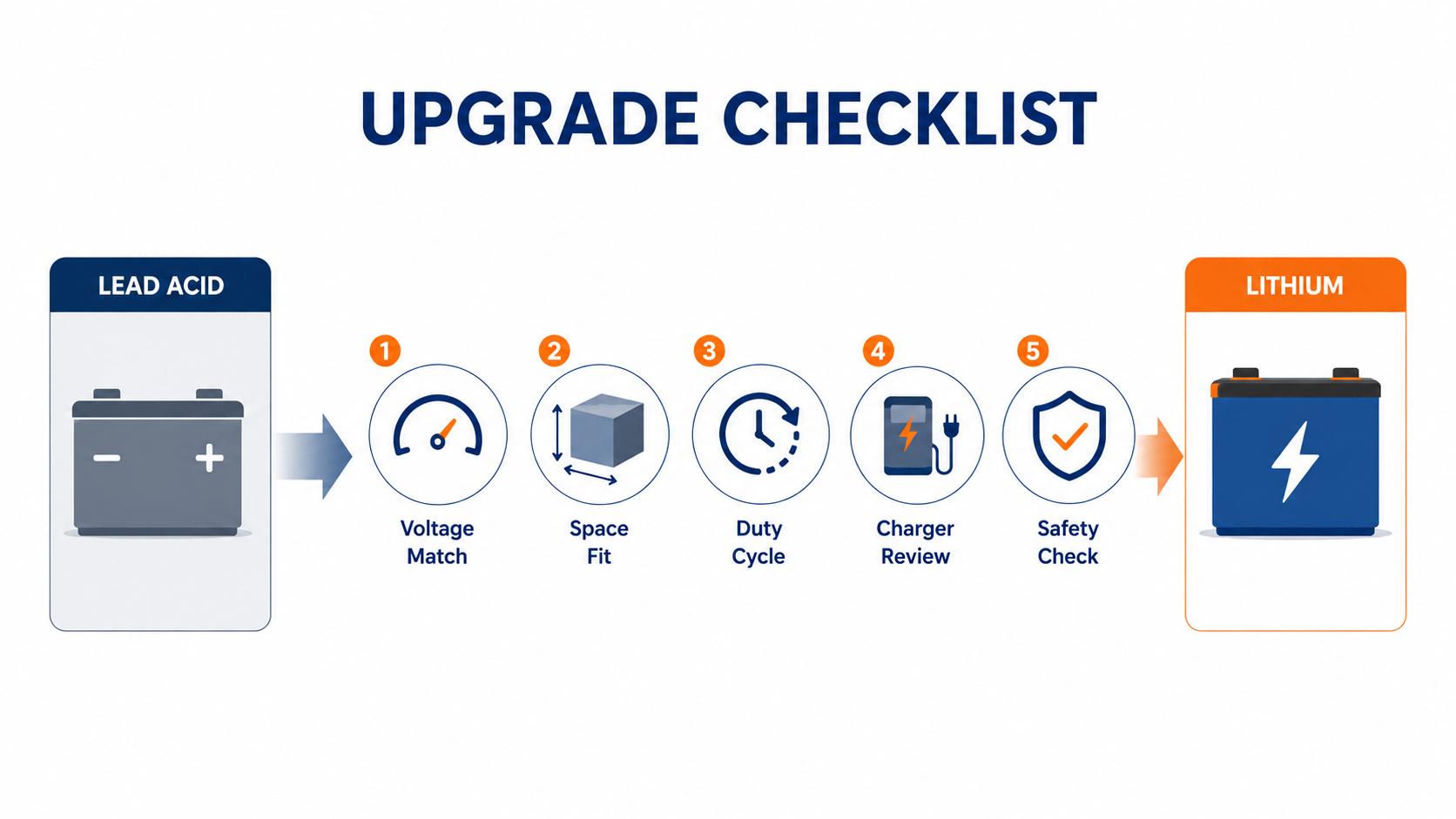
Do not automatically discard an existing charging system simply because it was previously used with lead-acid; instead, confirm whether its voltage limits, current profile, float or equalization behavior, and communication are compatible with the lithium pack. If they are not, a suitable lithium charging solution is required. The point is compatibility verification, not replacing hardware without engineering review.
FEBATT’s lead acid to lithium battery conversion guide provides a more detailed framework for electrical, mechanical, BMS, and charging-system compatibility.
Where Does LiFePO4 Offer the Strongest B2B Advantage?
The strongest lithium vs lead acid battery business case appears where battery limitations interfere with productive work. LiFePO4 is especially compelling in high-utilization fleets that cycle frequently, cannot afford long maintenance windows, benefit from reduced pack mass, or need flexible charging during natural breaks.
Electric Tricycles and Delivery Vehicles
For delivery operations, an electric tricycle battery replacement can improve useful energy, reduce battery mass, and support more consistent electrical output through the route. The pack should be sized for daily energy, reserve, peak acceleration current, cargo load, and temperature rather than simply matching the old Ah number.
Golf Carts and Utility Fleets
A golf cart lithium battery upgrade is attractive for resorts, campuses, maintenance fleets, and security patrols that value predictable runtime and reduced watering. The B2B benefit is often operational simplicity: fewer chemistry-specific service tasks and a wider usable energy window.
Forklifts and Warehouse Equipment
For material handling, forklift battery total cost of ownership depends heavily on utilization. Lithium can support opportunity charging and reduce battery-handling requirements when the complete system is designed for the truck and duty cycle. Battery weight, compartment fit, communications, charger integration, and safety requirements must all be verified.
Electric Motorcycles and RV Auxiliary Systems
Commercial electric motorcycles value compact packaging, high current capability, low mass, and cycle retention. RV auxiliary systems value usable energy, long storage periods, inverter support, and reduced maintenance. In both applications, a correctly engineered lithium pack can provide a stronger lifecycle proposition than lead-acid, but the design should be based on actual load and environmental requirements.
For projects covering several vehicle platforms, FEBATT custom power battery solutions can be matched to the vehicle architecture, operating profile, communication, enclosure, and service requirements.
What Should B2B Buyers Ask a Battery Supplier?
For any lithium vs lead acid battery project, a credible supplier should be able to explain the conditions behind its cycle-life and performance claims. Ask for the selected cell model, cycle-life test conditions, depth of discharge or SOC window, charge and discharge rate, temperature, capacity-retention threshold, and pack-level current limits.
Ask how the BMS handles overvoltage, undervoltage, overcurrent, short circuit, high and low temperature, and cell balancing. For industrial electric vehicle battery charging, confirm the approved charging-current and temperature map rather than assuming every lithium pack supports the same fast-charge rate.
Also request mechanical and integration information: dimensions, mounting, weight, connector type, communication protocol where applicable, environmental protection, vibration requirements, and service access. For forklifts, confirm truck-specific weight requirements. For electric tricycles and motorcycles, confirm controller and peak-current compatibility. For golf carts and utility vehicles, confirm route energy and charger integration.
A supplier should also explain the economic assumptions behind the recommendation. FEBATT’s commercial lithium fleet ROI guide can support that discussion, while the conversion compatibility guide addresses retrofit-specific checks.
Technical Relevant FAQ
1.Is lithium always cheaper than lead-acid over the life of a fleet?
No. Lithium often has the stronger lifecycle case in high-utilization fleets because of cycle-life potential, lower routine battery maintenance, wider usable energy, and charging flexibility. But the result depends on purchase price, utilization, maintenance cost, downtime, electricity, replacement frequency, charger changes, and ownership period. A project-specific TCO model is more credible than a universal payback claim.
2.How much longer can LiFePO4 last than lead-acid?
LiFePO4 is often specified for several thousand cycles under defined cell test conditions, while lead-acid cycle life is generally more sensitive to deep discharge and incomplete charging. The exact ratio cannot be stated universally. Compare the actual product datasheets using the same DoD, C-rate, temperature, and end-of-life criterion.
3.Can lithium batteries be discharged deeper than lead-acid?
Commercial LiFePO4 systems can generally use a wider SOC window than lead-acid systems while maintaining good cycle-life potential. However, repeatedly using the widest possible window can still increase aging stress. Follow the pack supplier’s approved usable SOC range instead of assuming one universal DoD percentage.
4.Is LiFePO4 safer than lead-acid?
The risks are different. LiFePO4 generally has strong thermal stability compared with many nickel-rich lithium-ion chemistries and eliminates sulfuric-acid handling associated with flooded lead-acid. It is not non-combustible and does not eliminate fire risk. A safe commercial pack still requires correct cell selection, BMS protection, enclosure design, wiring, thermal control, and abuse protection.
5.Can a lead-acid battery be replaced directly with lithium?
Sometimes, but a drop-in assumption is not enough. Verify the complete voltage window, current requirements, regenerative current, controller cutoffs, charger compatibility, cables, connectors, dimensions, mounting, BMS communication, temperature range, and application-specific mechanical requirements. Forklifts also require battery-weight and stability checks.
6.What is the best charging strategy for a lithium commercial fleet?
Use the charging-current, SOC, and temperature limits validated for the exact pack. Partial and opportunity charging can work well for LiFePO4 fleets when the battery and charging system are designed for it. Avoid applying a fixed fast-charge rate or SOC rule across different cell models and applications.
Conclusion
For commercial fleets, the lithium vs lead acid battery decision is ultimately a question of productive work over the full ownership period. Lead-acid can still offer a lower entry cost and may suit light-duty operations with existing maintenance infrastructure. LiFePO4 usually creates a stronger business case when fleets cycle frequently, value lower routine battery maintenance, need a wider usable energy window, or benefit from reduced pack mass and flexible charging.
The correct comparison should not rely on claims that lithium always lasts a fixed number of years, charges in a universal amount of time, or produces a guaranteed payback period. It should compare actual battery specifications against the vehicle duty cycle and then calculate acquisition, installation, charging, maintenance, downtime, replacement, and service costs.
For B2B projects involving electric tricycles, golf carts, forklifts, electric motorcycles, RV auxiliary systems, and other power-driven vehicles, FEBATT power battery solutions can be developed around the complete electrical, mechanical, thermal, and operating requirements of the platform. That is where lithium delivers its strongest advantage: not as a generic replacement chemistry, but as an engineered fleet power system designed for higher utilization and lower lifecycle friction.