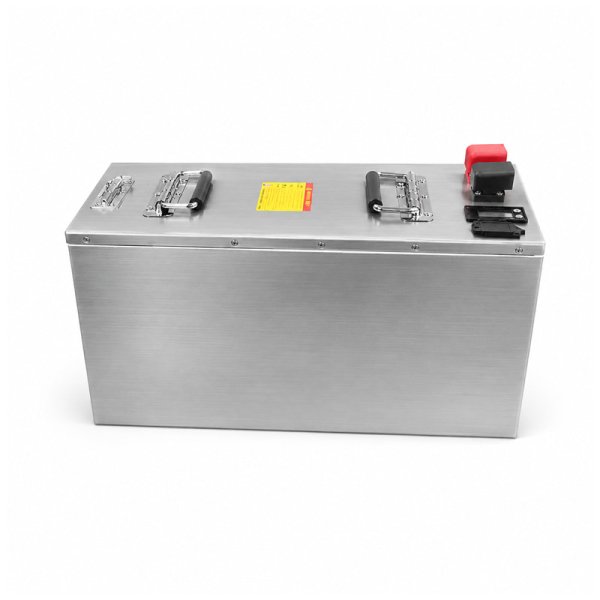
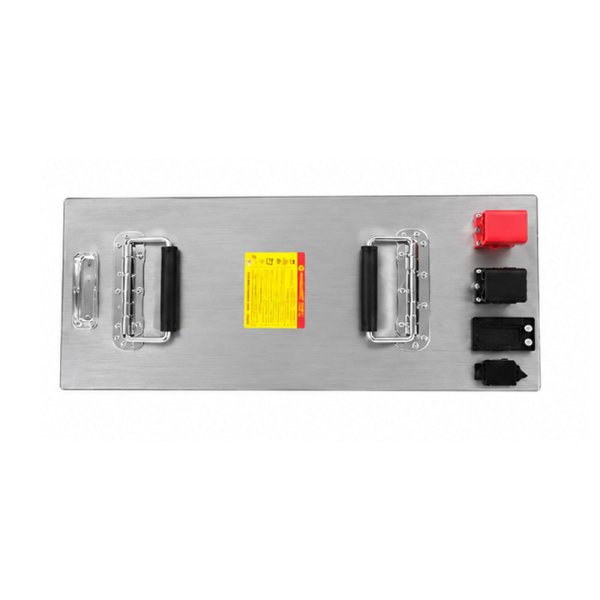
For commercial tricycle fleets, a lead-acid-to-lithium conversion affects more than the battery itself. The conversion changes installed mass, usable energy, voltage behavior under load, charging, diagnostics, maintenance requirements, and sometimes the electrical or mechanical interface of the vehicle.
Procurement teams comparing voltage, capacity, current, BMS protection, dimensions, and integration can review FEBATT’s power battery solutions as a starting framework. The business case is strongest when reduced maintenance and downtime, payload impact, energy throughput, replacement frequency, and conversion work are included in total cost of ownership instead of comparing purchase price alone.
What Hidden Maintenance Costs Come with Lead Acid?
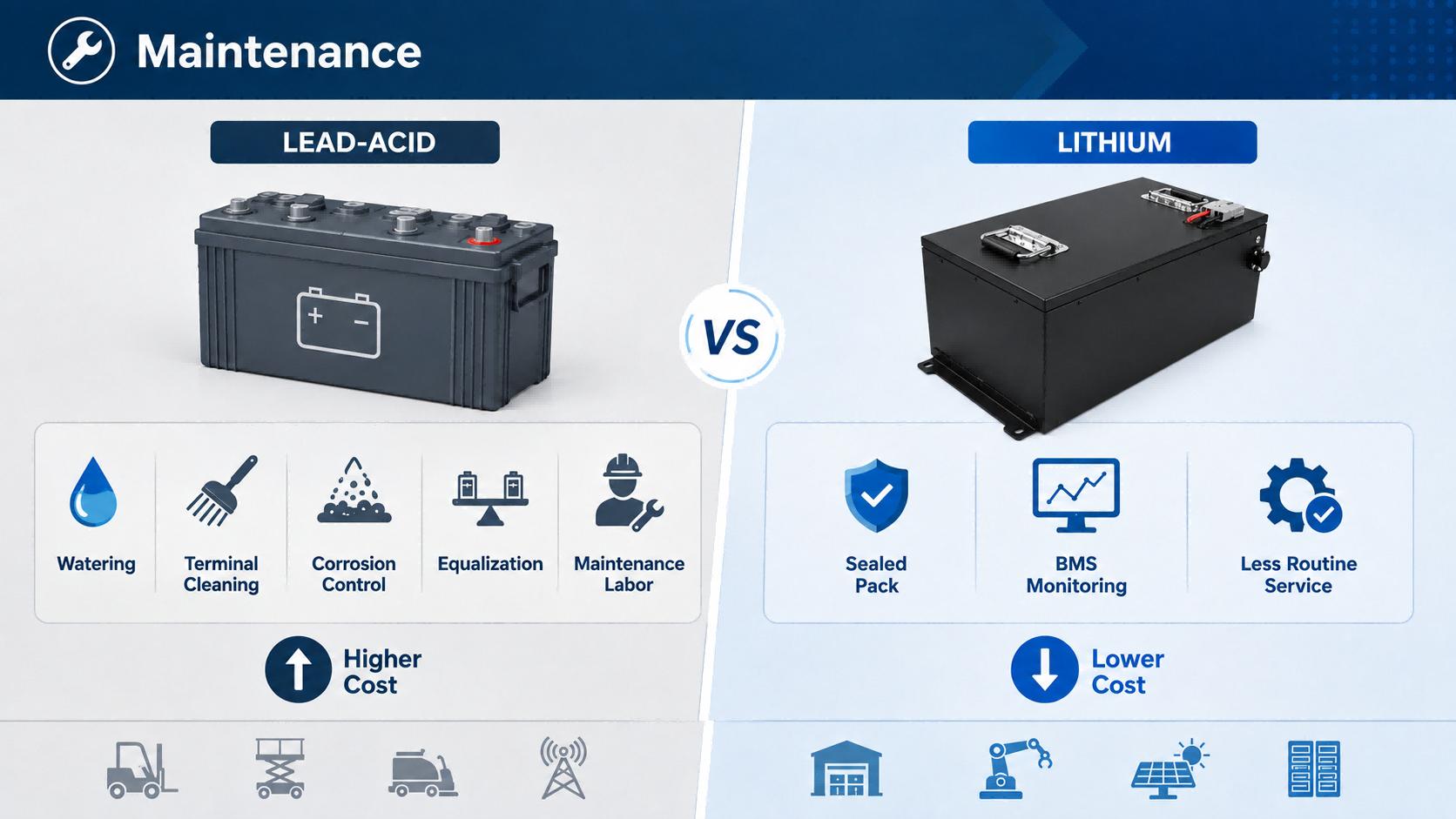
The purchase price of a traction lead acid battery is visible. Its operating burden is less obvious. Depending on battery design, lead-acid fleet maintenance may include electrolyte checks, water replenishment, terminal cleaning, corrosion control, equalization procedures, charger inspection, and monitoring for abnormal heating or undercharging.
Across dozens or hundreds of vehicles, these tasks become a recurring labor cost. Lead-acid performance can also decline gradually. Sulfation, plate deterioration, chronic partial charging, high temperature, or repeated deep discharge can reduce usable capacity, making route margin less predictable.
A LiFePO4 industrial battery pack uses a different maintenance model. It does not require routine water addition, and a properly sealed pack avoids the routine handling associated with flooded sulfuric-acid electrolyte. The BMS can monitor voltage, current, temperature, and fault conditions while technicians focus on connectors, mounting, cables, enclosure condition, and diagnostic data.
For this reason, a traction lead acid battery replacement should be viewed as an operational upgrade, not only a chemistry change. In high-utilization fleets, lower routine maintenance is one of the clearest reasons lithium is usually the better commercial choice.
How Does Battery Weight Affect Tricycle Payload and Efficiency?
Every kilogram carried by a commercial tricycle contributes to gross vehicle mass. A heavy battery therefore consumes part of the mass allowance before cargo, tools, or passengers are added.
Lead-acid systems can become especially heavy when several batteries are connected to create a 48V, 60V, or 72V traction system. A lithium industrial battery pack can often provide the required usable energy with materially lower installed mass, although the actual difference depends on voltage, capacity, discharge capability, enclosure construction, and the lead-acid bank being replaced.
Lower battery mass does not automatically authorize additional payload. Gross-weight limits, axle loads, braking capability, tires, chassis strength, stability, and local rules still apply. However, reducing non-productive battery mass can create more flexibility within those limits.
For industrial battery pack for tricycles, procurement teams should compare complete installed mass rather than cell weight alone. Enclosure, BMS, busbars, cables, connectors, brackets, and protective hardware all contribute to the vehicle-level figure.
Lower mass can also reduce the energy required during repeated acceleration. This combination of lower deadweight and better usable-energy efficiency is another reason lithium is generally more attractive than a traditional traction lead acid battery for intensive tricycle fleets.
Why Can Heavy-Load Tricycles Experience Voltage Sag on Hills?
A loaded tricycle climbing a gradient requires higher torque, and higher torque usually requires higher battery current. Resistance in cells, interconnections, cables, connectors, or terminals creates voltage loss under load.
A traction lead acid battery can show increasingly noticeable voltage sag as discharge rate rises, state of charge falls, temperature changes, or the battery ages. The Peukert effect also means available capacity can decrease as discharge current increases. Drivers may experience slower climbing, weaker acceleration, controller power reduction, or low-voltage cutoff even though unloaded voltage later recovers.
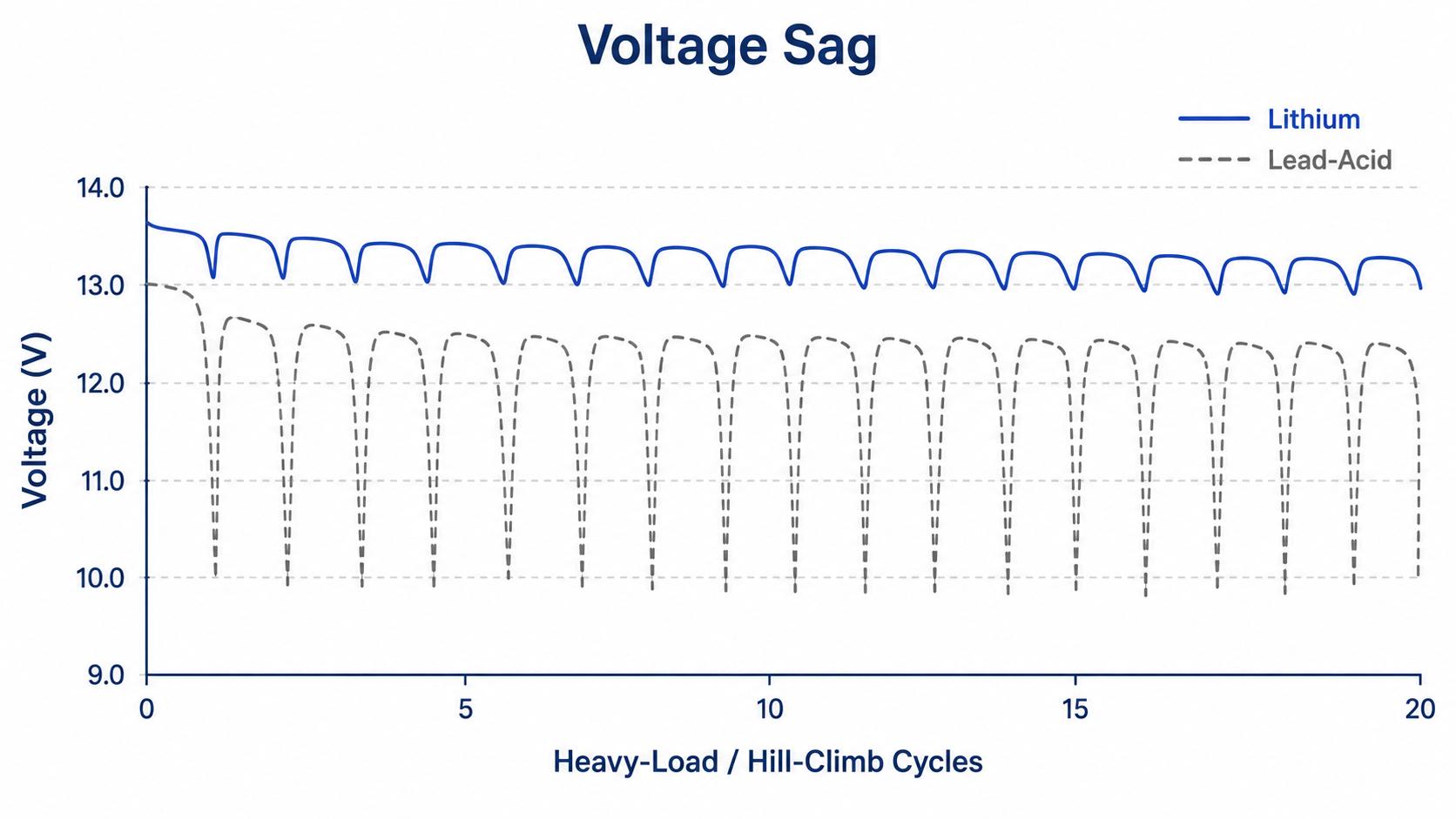
A correctly engineered industrial battery pack can provide a more stable voltage profile when its cells, series-parallel architecture, BMS, busbars, connectors, and cables are matched to actual current demand. LiFePO4 is frequently chosen for commercial traction because it combines good cycling potential with a relatively stable discharge profile.
Lithium is not immune to voltage sag. An undersized pack or BMS can still trigger protection. B2B buyers should provide payload, gradient, controller current, motor power, daily distance, temperature, and acceleration requirements when specifying commercial tricycle battery packs.
For demanding routes, that engineering flexibility usually makes a lithium industrial battery pack a better starting architecture than lead acid.
How Does a 72V Lithium Industrial Battery Pack Support High-Torque Duty?
Power is the product of voltage and current. For the same power requirement, a higher system voltage can reduce current through the electrical path, although system voltage must remain compatible with the controller, motor, charger, DC-DC equipment, and other electronics.
A 72V industrial battery pack intended for cargo duty still needs suitable continuous and peak current capability. Voltage alone does not create performance. The pack must combine cells, BMS limits, busbars, connectors, fuses, and cable sizes that support controller demand without excessive heating or nuisance shutdowns.
Commercial tricycles rarely experience one isolated high-current event. Distribution vehicles may accelerate from dozens of stops, while industrial vehicles may repeatedly start with a loaded bed or climb ramps. The system therefore needs repeatable power rather than a single impressive peak-current number.
A commercial-grade industrial battery pack should be evaluated using pack-level current ratings and the conditions under which those ratings apply. A well-designed lithium system can deliver more consistent usable power through a shift than an aging traction lead acid battery.
Fleet engineers evaluating custom voltage, capacity, and current configurations can use FEBATT’s power battery solution portfolio to frame the specification before confirming the final pack against the vehicle platform.
How Does LiFePO4 Cycle Life Compare with Lead Acid?
Cycle life is one of the most important differences in the lithium versus lead-acid decision. Lead-acid service life is strongly affected by depth of discharge, charge completion, temperature, maintenance quality, discharge rate, and battery construction.
LiFePO4 is widely selected for heavy cycling because a high-quality industrial battery pack can support substantially more cycles under defined operating conditions. Some suppliers publish several-thousand-cycle figures, but buyers should not treat one number as universal. Test depth of discharge, temperature, charge rate, discharge rate, and end-of-life capacity criteria all change the result.
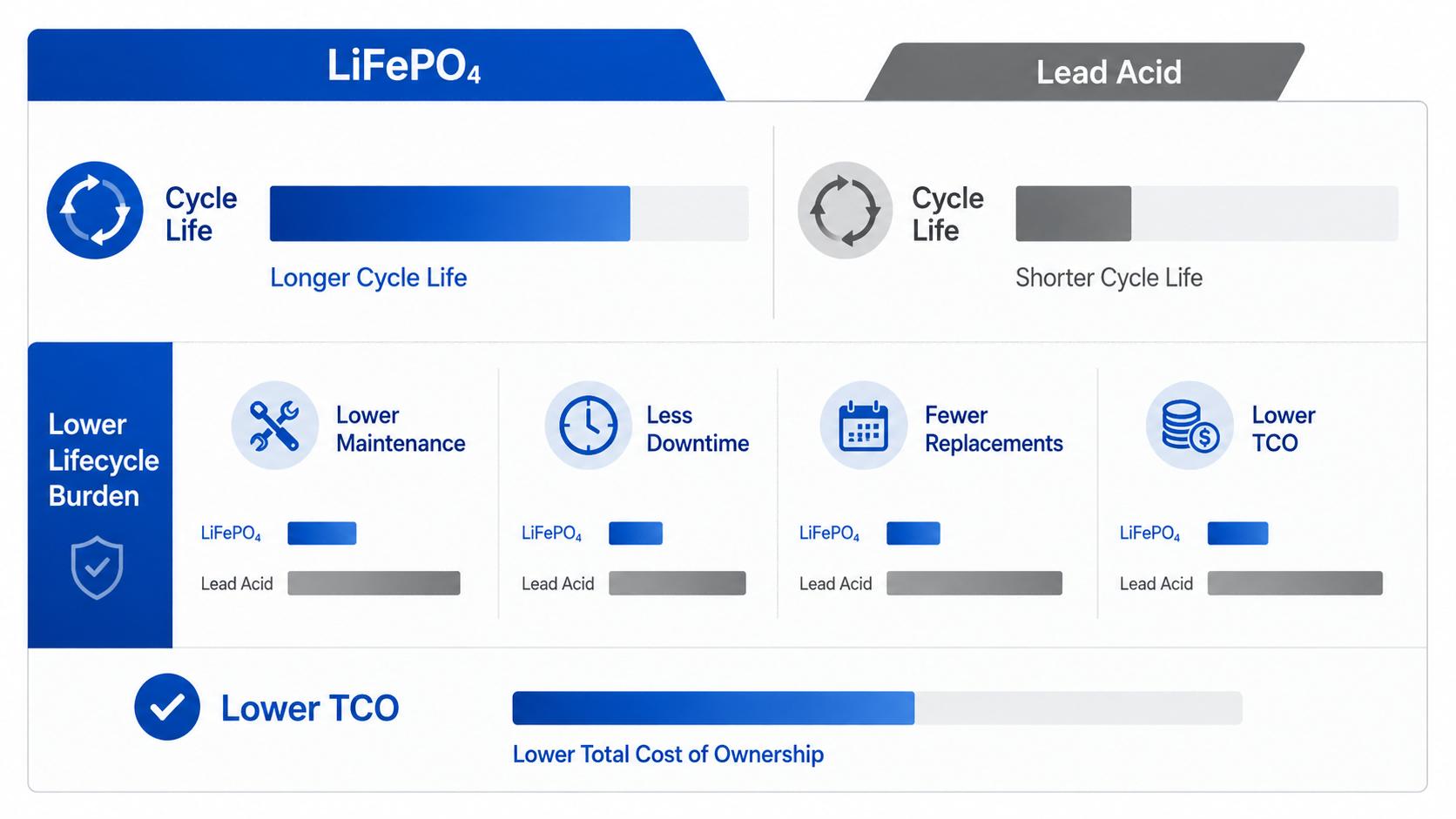
The commercially useful question is not simply how many years a battery lasts. It is how many productive cycles it can deliver under the fleet’s actual route and operating conditions before usable capacity falls below the required threshold.
Repeated traction lead acid battery replacement creates more than hardware cost. Each replacement can involve ordering, handling, installation, vehicle downtime, and end-of-life logistics. A lithium industrial battery pack may have a higher initial price, but its stronger cycling potential can spread that investment across more productive use.
For fleets with frequent daily cycling, lithium is therefore usually the better long-term choice when correctly sized and operated within approved limits.
How Can Lithium Reduce Acid-Spill and Corrosion Risks?
Flooded lead-acid batteries use sulfuric-acid electrolyte. Damage, overfilling, poor handling, or abnormal charging can introduce leakage, corrosion, and gas-management concerns.
A sealed LiFePO4 industrial battery pack does not use sulfuric acid in the same configuration as a flooded traction lead acid battery, so it eliminates the normal sulfuric-acid spill mechanism associated with that battery type. This can simplify maintenance where cleanliness and controlled procedures matter.
Lithium does not eliminate every connector or corrosion risk. Moisture, damaged seals, contamination, or loose terminals can still cause problems. Heavy duty industrial battery pack should therefore be inspected for cable condition, connector retention, mounting security, enclosure damage, ingress evidence, and abnormal BMS events.
Lithium is better than lead acid here because it removes electrolyte watering and acid-spill management while adding electronic monitoring through the BMS.
How Should Fleets Plan Charging for 60V and 72V Lithium Packs?
Charging speed depends on battery capacity, charger power, starting state of charge, approved charge current, temperature, and charging profile. A 60V or 72V label alone does not determine how quickly an industrial battery pack can return to service.
Lithium systems can often support greater charging flexibility than lead acid when the cells, BMS, charger, connectors, cables, and thermal limits are designed for the required rate. Fleets can use overnight charging, planned depot charging, or opportunity charging during scheduled breaks.
A charger designed for a traction lead acid battery should not automatically be reused for lithium. Procurement teams should confirm nominal voltage, maximum charging voltage, recommended current, connector type, communication requirements where applicable, and temperature limits.
The fastest charge rate is not automatically the best strategy. The better approach restores enough usable energy within the operating window without unnecessary thermal or electrical stress. For high-utilization commercial tricycle battery packs, this flexibility is another reason a lithium industrial battery pack can outperform lead acid over the fleet lifecycle.
What Must Be Checked Before a Traction Lead Acid Battery Replacement?
A traction lead acid battery replacement should be treated as a vehicle integration project. Matching the nominal voltage printed on two battery labels is not enough.
Before approving a lithium conversion, B2B buyers should verify:
- Operating voltage:controller maximum voltage, minimum operating voltage, and the lithium pack’s full-charge and low-SOC limits.
- Current capability: motor-controller continuous demand, short-duration peaks, BMS limits, fuse rating, and conductor capacity.
- Low-voltage protection: controller and BMS thresholds must work together without premature shutdown.
- Charger compatibility: the replacement needs a charging profile approved for the lithium chemistry and pack configuration.
- Mechanical fit:dimensions, mounting points, installed mass, vibration support, service clearance, and cable routing.
- Electrical interfaces:connector type, polarity, cable size, DC-DC equipment, dashboard or SOC display, and communication where required.
A nominal 60V or 72V lithium industrial battery pack can therefore be a practical replacement, but it should not be presented as universally plug-and-play. A true drop-in solution has validated electrical, mechanical, and charging compatibility.
This approach is especially important for industrial battery pack for tricycles sold across multiple vehicle platforms. Standardization is valuable only when application limits are understood.
Why Can Lithium Deliver Better Fleet TCO Than Lead Acid?
A traction lead acid battery normally has a lower initial purchase price. For high-utilization fleets, however, acquisition cost is only one part of total cost of ownership.
A meaningful TCO model should include:
- Initial battery and charger investment.
- Expected replacement frequency and replacement criteria.
- Routine maintenance labor.
- Charging-related vehicle downtime.
- Energy consumption and charger efficiency.
- Battery handling and installation labor.
- Payload impact from installed battery mass.
- End-of-life collection, recycling, and replacement logistics.
- Spare battery or spare vehicle requirements where applicable.
A lithium industrial battery pack usually starts with a higher capital cost, but lower routine maintenance, stronger cycling potential, lower installed mass, and more flexible charging can offset that premium over time.
There is no universal saving percentage or guaranteed payback period. The correct model uses the operator’s electricity tariff, labor rate, downtime cost, route utilization, battery pricing, and documented performance.
For high-utilization applications, lithium often provides the stronger lifecycle proposition because it reduces several recurring burdens at once. This is why traction lead acid battery replacement projects should be evaluated on cost per productive vehicle-hour, route, or delivered load rather than on unit price alone.
How Can B2B Distributors Source Custom Lithium Packs for Tricycles?
Distributors often manage vehicle platforms with different voltage systems, battery compartments, motors, controllers, and route requirements. One generic battery specification cannot serve every application reliably.
When requesting custom industrial battery pack for tricycles, distributors should provide:
- Vehicle model and commercial application.
- Existing traction lead acid battery voltage and capacity.
- Battery-compartment dimensions and mounting points.
- Motor rated and peak power.
- Controller continuous and peak current.
- Daily distance and expected energy use.
- Typical and maximum validated payload.
- Gradient and road conditions.
- Charging window and site electrical limits.
- Connector, cable, display, and communication requirements.
- Expected annual order volume and service requirements.
With this information, the manufacturer can evaluate cell configuration, BMS rating, current path, enclosure, ingress needs, charging solution, and mechanical integration.
Heavy duty industrial battery pack should also be evaluated through sample validation, quality-control procedures, traceability, production consistency, and integration support before volume deployment. Physical similarity alone does not make a reliable traction lead acid battery replacement.
FEBATT’s power battery solutions can support early application comparison, while the final industrial battery pack should be confirmed against the actual tricycle platform and duty cycle.
Relevant Technical FAQ
1.How long does an industrial battery pack last in a commercial tricycle?
There is no universal number of years. Service life depends on chemistry, depth of discharge, energy throughput, temperature, charging conditions, current demand, cell quality, BMS limits, and the end-of-life capacity criterion. LiFePO4 generally offers substantially stronger cycling potential than lead acid for frequent commercial use, but buyers should compare supplier cycle data under defined test conditions with the fleet’s real duty cycle.
2.Can a 60V lead-acid system be replaced directly with a 60V lithium pack?
Not automatically. The lithium pack’s maximum, nominal, and minimum voltage may differ from the original battery bank. Controller limits, low-voltage cutoff, BMS current capability, charger profile, fuses, cables, connectors, dimensions, and mounting should all be verified before a traction lead acid battery replacement is approved.
3.Why can a flooded lead-acid tricycle battery gas heavily during charging?
Some gassing can occur in flooded lead-acid batteries during charging. Vigorous gassing, excessive heat, unusual odor, rapid water loss, or other abnormal behavior should trigger shutdown and inspection because possible causes include incorrect charging, battery deterioration, electrolyte issues, or another fault. Technicians should follow the battery and charger manufacturer’s service procedures.
4.How much weight can be saved by switching to lithium?
There is no universal percentage. The reduction depends on the existing lead-acid bank and the lithium industrial battery pack required to provide the necessary usable energy, current capability, enclosure, and protection. Compare complete installed mass for the specific vehicle rather than applying a generic percentage or kilogram-saving claim.
5.What determines the TCO difference between lithium and lead acid?
TCO depends on acquisition cost, replacement frequency, maintenance labor, charging losses, downtime, utilization, battery handling, payload effects, and end-of-life logistics. Lithium can provide lower lifecycle cost in high-utilization commercial fleets because several recurring operating burdens are reduced, but the result should be calculated from fleet-specific data rather than a guaranteed ROI percentage.
6.Is lithium always better than lead acid for a commercial tricycle?
Not in every procurement scenario. Lead acid can remain suitable where acquisition price dominates, utilization is low, existing charging infrastructure is fixed, and added battery mass is acceptable. For high-utilization commercial fleets, however, a properly engineered lithium industrial battery pack is usually the stronger option because it combines lower routine maintenance, lower installed mass, more stable power delivery, stronger cycling potential, and greater charging flexibility.
Conclusion
For commercial tricycle fleets, the battery should be evaluated as part of the complete operating system. Lead acid remains familiar and inexpensive to purchase, but its higher mass, routine maintenance requirements, voltage behavior under heavy load, charging constraints, and replacement burden can become costly as utilization increases.
A properly engineered lithium industrial battery pack addresses several of those limitations at the same time. Lower installed mass can improve payload flexibility. Stable high-current performance can support demanding routes. LiFePO4 can provide stronger cycling potential, while BMS monitoring adds operational control. Lithium also removes routine electrolyte watering and the sulfuric-acid spill concerns associated with flooded lead-acid systems.
The strongest commercial case appears in high-utilization fleets, where every hour of availability and every maintenance intervention has an economic value. In those applications, traction lead acid battery replacement with lithium should be evaluated as a productivity and lifecycle-cost decision rather than a simple battery purchase.
For B2B buyers sourcing commercial tricycle battery packs, the preferred solution is not the battery with the highest nominal capacity or the lowest quotation. It is the industrial battery pack whose voltage, usable energy, current capability, BMS, charging strategy, dimensions, mounting, and environmental protection are matched to the vehicle’s actual workload.
When those requirements are properly defined, lithium is generally the better long-term solution than lead acid for demanding commercial tricycle fleets.