A 48V lithium battery is a practical voltage-class solution for many electric motorcycle projects because it can balance usable power, packaging space, system cost, and integration complexity. It should not be described as the universal standard for every motorcycle. Vehicle mass, target speed, motor power, controller limits, terrain, payload, and daily duty cycle determine whether 48V is appropriate.
For an OEM, distributor, fleet operator, or service organization, selecting a 48V lithium battery requires more than matching the voltage printed on the label. The full operating voltage window, usable energy, continuous and peak current, charging profile, thermal design, enclosure protection, vibration resistance, communication interface, and production consistency all affect real-world performance.
This guide explains how to evaluate a 48V lithium battery and a 48V lithium ion battery without relying on unsupported speed, range, charging-time, or lifespan promises. It also shows how B2B buyers can compare a 48V battery pack during sampling, pilot production, fleet deployment, and long-term supply.
What Does 48V Mean in a Lithium Battery System?
“48V” normally describes a nominal voltage class rather than one fixed voltage at every state of charge. A 48V lithium battery’s actual voltage rises during charging and falls during discharge. Maximum charging voltage, recommended operating range, and low-voltage cutoff depend on cell chemistry, series configuration, BMS settings, and vehicle architecture. Whether marketed as a 48V lithium battery or a 48V lithium ion battery, the full voltage window must be confirmed.
Two products sold as a 48V lithium battery may therefore be electrically different. The charger must match the battery chemistry and series count, the controller must tolerate the fully charged voltage, and its low-voltage cutoff must coordinate with the BMS. Regenerative braking, when used, must remain within the pack’s accepted charging-current and voltage limits.
B2B buyers should request nominal voltage, maximum charging voltage, recommended discharge cutoff, charger profile, continuous current, peak current duration, and protection thresholds. These details are essential when integrating a 48V lithium battery into a new motorcycle or replacing a lead-acid system.
Why Is a 48V Lithium Battery Practical for Electric Motorcycles?
Electrical power is the product of voltage and current: P = V × I. For the same power demand, a higher system voltage can deliver power with lower current than a lower-voltage system. Lower current can reduce resistive losses in cables, connectors, busbars, and switching components when conductor size and system design are appropriate.
For example, an ideal 3 kW load at 48V draws about 62.5A before system losses are included. This calculation does not predict speed or acceleration, but it helps engineers estimate current requirements and select cells, BMS hardware, cables, connectors, fuses, and controllers.
A properly integrated 48V lithium battery can remain compact enough for constrained frames while supporting moderate-power operation. It may also simplify service and charging infrastructure for fleets that standardize around one electrical platform. Voltage alone, however, does not guarantee greater speed, longer range, or higher efficiency.
What Defines a High-Quality 48V Lithium Battery?
A high-quality 48V lithium battery combines consistent cells, reliable electrical connections, a correctly configured BMS, durable mechanical construction, and documented production controls. Nominal voltage and capacity are only starting points.

For a 48V lithium battery, cell selection should match current demand, temperature range, charging pattern, and service-life target. LiFePO4 chemistry is frequently selected for commercial power applications because of its thermal stability and useful cycle-life potential. Even within one chemistry, cell models differ in internal resistance, power capability, low-temperature performance, dimensions, and aging behaviour.
Busbars, welds, terminals, connectors, and cables must carry the specified current without excessive heating or voltage drop. The enclosure must restrain cells, resist vibration, protect against accidental contact, and support safe heat transfer. For volume orders, buyers should also review cell incoming inspection, matching criteria, assembly controls, traceability, end-of-line testing, and firmware control. A 48V lithium battery that varies across batches can create service and fleet-management problems even when the first sample performs well.
How Should OEMs Select the Correct Amp-Hour Rating?
Amp-hours indicate charge capacity, while watt-hours provide a more useful estimate of stored energy. Nominal energy is voltage multiplied by amp-hours. A nominal 48V 30Ah pack is approximately 1,440Wh, while a nominal 48V 45Ah pack is approximately 2,160Wh. Usable energy is lower because the system retains reserve and experiences conversion losses.
Capacity for a 48V lithium battery should be selected from the motorcycle’s measured duty cycle rather than a generic range claim. Engineers should record energy consumption with realistic payload, speed, route, gradient, temperature, tyre pressure, and stop-start operation. Estimated range can then be calculated by dividing usable watt-hours by measured watt-hours per kilometre.
A larger 48V lithium battery can extend operating time, but it also increases mass, volume, charging time, and cost. Additional weight may affect handling, acceleration, suspension loading, and frame design. For managed fleets, the best capacity is often the smallest pack that completes the required shift with an appropriate worst-case reserve.
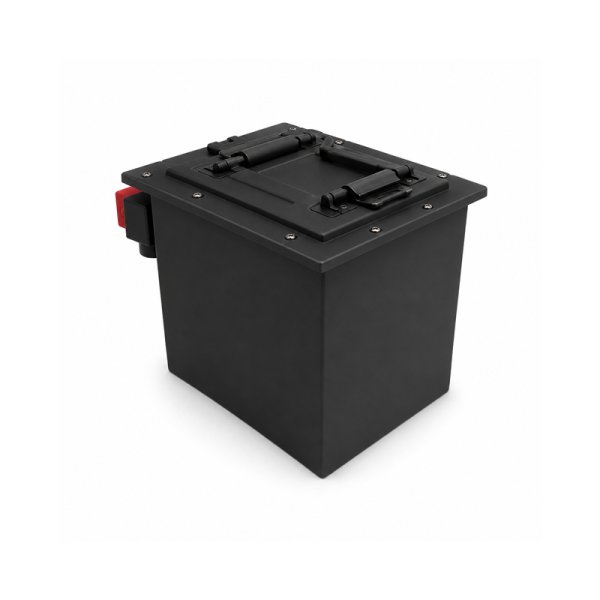
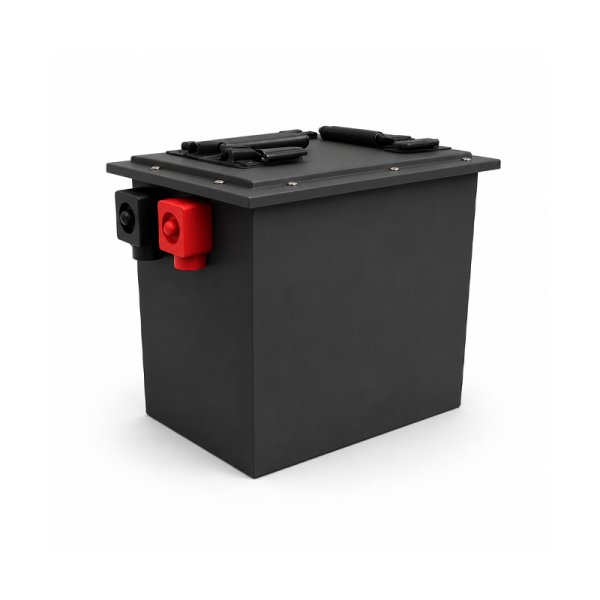
FEBATT offers different nominal capacity options for project matching. Its 48V 30Ah LFP power battery pack can be reviewed for compact energy requirements, while the 48V 45Ah LFP power battery pack represents a higher-energy option. These pages are starting references; final current capability, dimensions, charger requirements, communication functions, and test conditions must be confirmed for each project.

How Does a 48V Battery Pack Support High Discharge Demand?
A 48V lithium battery for an electric motorcycle must handle brief high-current demand during launch, acceleration, hill climbing, and operation with cargo or passengers. The 48V battery pack must support these events without excessive voltage sag, overheating, or repeated BMS shutdowns.
Continuous current and peak current are different specifications. Continuous current describes what a 48V lithium battery can deliver for sustained operation within its thermal limits. Peak current is permitted only for a defined duration and under defined temperature and state-of-charge conditions. A peak-current number without a time limit is incomplete.
Cells, busbars, BMS switching devices, fuses, connectors, cables, and terminals must support the same system target. Engineers should validate repeated acceleration, grade climbing, high-load operation, low-state-of-charge performance, and hot-environment operation. Protection events should remain exceptional; they should not be used as a normal operating strategy for an undersized 48V lithium battery.

Why Is Thermal Management Important for a 48V Lithium Ion Battery?
Heat is generated by internal resistance whenever current flows through cells and connections. High current, repeated acceleration, fast charging, poor ventilation, and high ambient temperature increase heat generation. Excessive temperature accelerates aging, while low temperature can reduce available power and make charging more restrictive.
Thermal management for a 48V lithium battery begins with cell selection and pack layout. Cells should be arranged to avoid concentrated hot spots, and sensors should detect representative and worst-case temperatures rather than only the coolest area. The BMS should apply limits that match the selected cells.
Depending on the architecture, the BMS may communicate an allowable current to a compatible controller or charger, issue a warning, or disconnect the charge or discharge path. Temperature uniformity is important because the hottest cells usually age faster. For fleets operating many hours per day, a 48V lithium battery with validated thermal behaviour is more valuable than a pack assessed only at room temperature and light load. A 48V lithium ion battery should also be checked across the project’s expected ambient-temperature range.
How Can an OEM Verify Electrical and Mechanical Compatibility?
Compatibility for a 48V lithium battery begins with the full electrical window. The controller, charger, DC-DC converter, display, wiring harness, contactor, and accessories must operate safely from the maximum charged voltage down to the intended discharge cutoff. The controller’s current request must remain within the 48V lithium battery’s continuous and peak limits.
The charger must match cell chemistry, series configuration, maximum voltage, and permitted charge current. A lead-acid charger should not be assumed compatible. Connector pinout, polarity, interlock functions, communication, and temperature limits should be checked before vehicle testing.
Mechanical compatibility includes secure restraint during braking, cornering, vibration, and road shock. There should be clearance for terminals, service access, cable bend radius, and ventilation. Some projects need only independent BMS protection, while others require CAN or RS485 for state of charge, temperature, fault reporting, or fleet diagnostics. The actual 48V battery pack should be tested with the production-intent controller, charger, wiring, and mounting hardware.
How Should Outdoor Battery Packs Be Protected from Water, Dust, and Vibration?
Electric motorcycles encounter rain, road splash, dust, humidity, vibration, and repeated temperature changes. Required protection should be based on the operating environment and supported by test documentation. The word “waterproof” is too vague without a stated rating, test method, enclosure condition, and connector configuration.
A durable 48V lithium battery may use sealed enclosure joints, gaskets, protected cable entries, sealed connectors, corrosion-resistant terminals, and controlled pressure equalization. These details must remain effective after assembly and during normal service. An enclosure rating may not apply when a connector is uncapped, a gasket is damaged, or the pack is installed in a different orientation from the tested configuration.
Water resistance does not automatically permit immersion or pressure washing. Buyers should confirm intended exposure, test level, duration, and limitations. They should also review vibration and shock evidence for internal cell restraint, weld integrity, fastener retention, cable support, and terminal protection.
How Does the BMS Protect a 48V Lithium Battery?
The BMS monitors cell voltages, pack current, temperature, and operating state. Typical functions include overcharge, over-discharge, over-current, short-circuit, and temperature protection.
During charging, the BMS measures individual cell voltage because cells do not remain perfectly identical over time. A compatible system may reduce charging current through communication, or the BMS may disconnect the charging path at a protection threshold. Not every BMS actively regulates charger current, so the charger and BMS architecture must be evaluated together.
Cell balancing can reduce voltage differences, but it cannot repair poorly matched or damaged cells. Buyers should request balancing method, balancing current, activation conditions, protection thresholds, recovery behaviour, and communication documentation. For fleets, fault logging can improve diagnostics when service tools can interpret the data from the 48V lithium battery.
What Determines Service Life and Total Cost of Ownership?
There is no single lifespan number for every 48V lithium battery. Cycle life depends on cell design, depth of discharge, average state of charge, temperature, current rate, storage conditions, mechanical stress, and the capacity-retention threshold used to define end of life. Calendar aging continues even when the pack is not cycling.
B2B buyers should compare cycle-life claims only when test conditions are stated. A cycle number without temperature, depth of discharge, charge and discharge rate, and end-of-life threshold is not a complete specification. Laboratory data also do not automatically predict years of field operation because fleets experience variable loads, weather, idle time, partial charging, and vibration.
Good system design can prolong a 48V lithium battery’s useful life. Practical measures include using the approved charger, limiting unnecessary high-temperature exposure, keeping current within design limits, preventing deep over-discharge, maintaining secure connections, and following storage recommendations.
Total cost of ownership should include purchase price, usable energy throughput, charging downtime, replacement labour, spare-pack inventory, service requirements, diagnosis, and vehicle downtime. A low-priced 48V battery pack that causes inconsistent range or frequent shutdowns may cost more over a fleet’s operating life than a validated product.
What Should B2B Buyers Verify Before Placing a Volume Order?
A purchase specification should define nominal and operating voltage, capacity, usable energy target, continuous and peak current, peak duration, charging profile, temperature limits, enclosure protection, dimensions, weight, connector type, mounting points, communication protocol, and required documents.
Samples should be evaluated in the real motorcycle with production-intent motor, controller, charger, wiring, and mounting hardware. Testing should cover load, range, thermal behaviour, charging, low-state-of-charge operation, vibration, environmental exposure, and fault response.
The supplier’s production system matters as much as the prototype. B2B projects benefit from controlled bills of materials, traceability, cell matching, firmware control, inspection records, end-of-line testing, and formal engineering-change control. Changes to cells, BMS hardware, firmware, enclosure, or connectors should be communicated and revalidated.
FEBATT supports power-battery projects for electric motorcycles, electric tricycles, golf carts, forklifts, RV systems, and other powered equipment. For a 48V lithium battery project, a reliable process is to define the duty cycle, confirm interfaces, test samples, run a pilot batch, and approve volume production only after agreed requirements are met.
FAQ About 48V Lithium Battery
1.How Fast Can a 48V Electric Motorcycle Go?
A 48V rating does not determine maximum speed. Speed depends on motor power, controller limits, gearing, wheel size, vehicle mass, payload, aerodynamics, software settings, and the 48V lithium battery’s ability to maintain voltage under load. OEMs should validate speed with the complete vehicle at representative payload and state of charge.
2.How Far Can a 48V 20Ah Battery Travel?
A nominal 48V 20Ah battery stores approximately 960Wh. Range is estimated by dividing usable energy by measured consumption in watt-hours per kilometre. If usable energy were 850Wh and consumption were 35Wh/km on a defined route, the calculated range would be about 24km. This is an engineering example, not a universal promise; speed, payload, gradient, temperature, tyre pressure, and reserve settings can change the result.
3.Can Two 24V Batteries Be Connected in Series to Replace One 48V Battery?
Only when the manufacturer explicitly approves the batteries and their BMS units for series operation. The packs must be compatible in chemistry, capacity, voltage, state of charge, current rating, protection behaviour, and charging method. For an OEM project, one engineered 48V lithium battery is generally easier to integrate, monitor, and service.
4.What Happens If a 48V Battery Gets Wet?
The result depends on enclosure protection, connector sealing, installation, and exposure. A correctly sealed 48V lithium battery may resist rain or road splash, but that does not permit immersion or pressure washing. If water enters the enclosure or reaches unprotected terminals, isolate the battery and follow the supplier’s inspection procedure before charging or returning it to service.
5.How Long Does It Take to Charge a 48V Lithium Battery?
A first estimate is capacity to be replaced divided by charger current. A 30Ah pack charged from empty at a constant 6A would require at least five hours in an ideal calculation. Actual charging takes longer because of losses, current taper, temperature limits, balancing, and charger or BMS restrictions. The approved charging profile for the specific 48V lithium battery should determine the final time.
6.Is a 48V Battery the Same as a 51.2V Battery?
Not necessarily. The labels can represent different nominal classes, chemistries, and series configurations. A 51.2V LFP pack and a product marketed in the 48V class may have different maximum charging voltage and discharge range. They are not interchangeable until the controller, charger, DC-DC converter, accessories, and protection settings have been checked.
7.Is LiFePO4 Always the Best Chemistry for a 48V Motorcycle?
LiFePO4 offers strong thermal stability and useful cycle-life potential, making it attractive for commercial motorcycles and fleets. It is not automatically the best choice for every design. Required energy density, weight, package volume, current capability, low-temperature behaviour, cost, and duty cycle should determine whether a 48V lithium battery using LiFePO4 chemistry is appropriate.
8.What Documents Should a B2B Buyer Request?
Request a controlled specification, voltage and current limits, charging requirements, cell and pack test summaries, protection settings, communication documents, dimensions, weight, connector details, environmental limitations, applicable compliance documents, traceability information, and change-control procedures. The documents should match the exact production 48V battery pack, not a similar sample or generic family.
Conclusion
A 48V lithium battery can be a strong choice for electric motorcycle OEMs and fleets when the voltage class matches the motor, controller, charger, payload, route, and environment. Its value comes from balanced system design, not from voltage alone.
The selection process should combine usable energy, continuous and peak current, thermal behaviour, environmental protection, BMS strategy, mechanical integration, production consistency, and documented validation. Buyers should avoid universal speed, range, charging-time, or lifespan claims that do not state their conditions.
For B2B projects, a 48V lithium ion battery should move through a disciplined sample, vehicle-test, pilot-production, and approval process. By verifying the complete 48V battery pack as part of the vehicle, manufacturers can reduce integration risk, improve fleet availability, and build a more dependable electric motorcycle platform.
Source and Validation Note
Product examples and internal links refer to the current FEBATT pages for the 48V 30Ah LFP power battery pack and 48V 45Ah LFP power battery pack. The calculations in this article use the basic relationships P = V × I and Wh = V × Ah. Range and charging examples are illustrative, not product guarantees.