Battery selection is no longer a routine replacement decision for golf cart manufacturers, distributors, resorts, industrial parks, and fleet operators. The battery affects vehicle range, acceleration, charging schedules, maintenance labor, payload, downtime, and long-term operating cost. That is why the Lead-Acid vs LiFePO4 51.2V 105Ah Battery comparison has become important for B2B buyers planning new vehicles or upgrading established 48V golf cart fleets. Although the phrase compares two battery types at one stated rating, the technically accurate comparison is normally between a conventional 48V lead-acid battery bank and a 51.2V nominal LiFePO4 pack built from sixteen 3.2V cells in series.
For B2B buyers, the Lead-Acid vs LiFePO4 51.2V 105Ah battery decision affects both vehicle availability and operating cost. The Lead-Acid vs LiFePO4 51.2V 105Ah battery comparison should therefore start with the fleet’s actual duty cycle.
Both technologies can power suitable golf carts, but they behave differently in real operation. Lead-acid remains familiar, widely available, and relatively inexpensive at the time of purchase. LiFePO4 offers a flatter discharge curve, lower routine maintenance, faster recharge capability when paired with the correct charger, and a substantially longer potential cycle life. The best choice therefore depends on daily operating hours, charging windows, vehicle compatibility, expected service life, purchasing budget, and the cost of downtime.
How Does a 48V Lead-Acid Battery System Work in a Golf Cart?
A conventional golf cart lead-acid system is commonly assembled from several flooded, AGM, or gel batteries connected in series to produce a nominal system voltage near 48V. During discharge, lead dioxide at the positive plate, sponge lead at the negative plate, and sulfuric acid electrolyte take part in an electrochemical reaction that produces electrical energy. During charging, the reaction is reversed. This operating principle establishes the lead-acid side of the Lead-Acid vs LiFePO4 51.2V 105Ah battery comparison.
Lead-acid technology has supported golf carts for decades because the supply chain is mature and technicians understand its installation and service requirements. Replacement units are readily available, and many older golf carts were designed around the size, mounting arrangement, and weight distribution of a multi-battery lead-acid bank. For low-use vehicles, seasonal carts, or projects with a strict initial purchasing limit, this familiarity can still be commercially valuable. The Lead-Acid vs LiFePO4 51.2V 105Ah battery analysis must still recognize the commercial value of this mature technology. Established service networks still affect the Lead-Acid vs LiFePO4 51.2V 105Ah battery outcome.
However, lead-acid capacity is strongly affected by discharge rate, temperature, state of charge, and depth of discharge. Voltage gradually declines as the battery discharges, so acceleration and climbing performance may weaken before the bank is fully depleted. Flooded batteries also require correct watering, terminal inspection, ventilation, and disciplined charging. Repeated deep discharge, storage in a partially charged condition, or chronic undercharging can shorten service life. These limitations are central to the Lead-Acid vs LiFePO4 51.2V 105Ah battery evaluation for frequently used carts. The Lead-Acid vs LiFePO4 51.2V 105Ah battery comparison becomes more significant as discharge depth and daily workload increase.
How Does a 51.2V 105Ah LiFePO4 Battery Work?
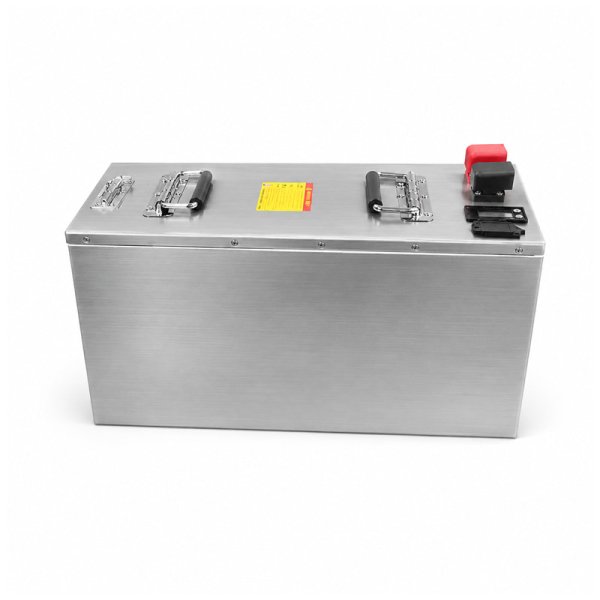
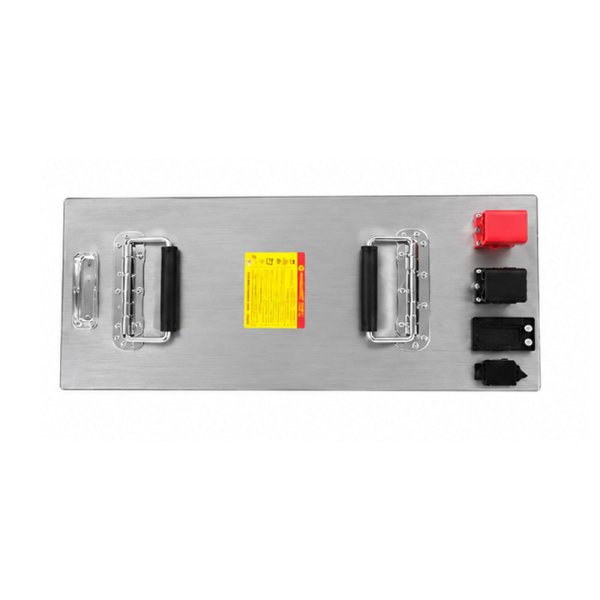
A 51.2V 105Ah LiFePO4 battery normally uses sixteen 3.2V lithium iron phosphate cells connected in series. Lithium ions move between the cathode and anode during charge and discharge. The chemistry maintains a relatively stable working voltage across much of the discharge cycle, which helps the vehicle deliver more consistent power than a lead-acid bank whose voltage falls progressively under use. This stable voltage behavior is a key factor in the Lead-Acid vs LiFePO4 51.2V 105Ah battery performance comparison. That difference directly shapes the Lead-Acid vs LiFePO4 51.2V 105Ah battery result.
A properly engineered pack includes a Battery Management System. The BMS monitors cell voltage, current, and temperature, balances cells where supported, and protects the pack against overcharge, over-discharge, overcurrent, short circuit, and excessive temperature. Depending on the vehicle and fleet requirements, the BMS may also provide CAN or RS485 communication for diagnostics and system integration.
FEBATT’s linked 51.2V 105Ah lithium battery for golf carts is specified as a 16S1P pack with 51.2V nominal voltage, 105Ah nominal capacity, 58.4V charging voltage, up to 50A charging current, 105A discharge current, and 120A instantaneous discharge current. The published configuration also lists a smart BMS with CAN and RS485 communication. These figures should still be checked against the exact vehicle controller, motor, charger, cable, fuse, connector, and installation space before ordering. These specifications provide a practical reference for the Lead-Acid vs LiFePO4 51.2V 105Ah battery assessment. Vehicle matching remains essential in the Lead-Acid vs LiFePO4 51.2V 105Ah battery review.
What Is the Real Energy Difference?
Nominal energy is calculated by multiplying voltage by amp-hour capacity. A 51.2V 105Ah pack therefore contains approximately 5.376kWh of nominal energy. Nominal energy is not identical to usable energy because the BMS cutoff settings, discharge current, temperature, battery age, and manufacturer limits determine how much energy can be delivered in practice. Nominal energy is only the starting point in the Lead-Acid vs LiFePO4 51.2V 105Ah battery comparison. Usable energy makes the Lead-Acid vs LiFePO4 51.2V 105Ah battery evaluation more relevant to actual route planning.
In a Lead-Acid vs LiFePO4 51.2V 105Ah Battery evaluation, amp-hour ratings should not be compared in isolation. Lead-acid batteries are more sensitive to high discharge rates and deep cycling. Commercial operators often avoid using the full nameplate capacity because repeated deep discharge accelerates degradation. LiFePO4 packs are generally designed to provide a larger practical share of their rated energy, although the permitted depth of discharge must be confirmed from the supplier’s specification.

Which Battery Provides Better Vehicle Performance?
The Lead-Acid vs LiFePO4 51.2V 105Ah Battery performance difference is most visible during acceleration, hill climbing, and operation near the lower end of the state-of-charge range. A lithium pack’s flatter voltage profile can support steadier controller input and more consistent vehicle response. A lead-acid bank normally shows greater voltage sag under heavy current, especially when it is partly discharged, cold, aged, or insufficiently charged. Cycle life strongly influences the long-term result of the Lead-Acid vs LiFePO4 51.2V 105Ah battery decision. The Lead-Acid vs LiFePO4 51.2V 105Ah battery comparison should use cycle-life figures measured under stated test conditions.
LiFePO4 can also reduce vehicle mass compared with a complete lead-acid bank, although the actual difference must be calculated from the specific products being replaced. Lower mass may improve efficiency, braking response, payload allowance, and mechanical wear. It can also change vehicle balance, suspension behavior, and traction, so installers should not assume that lighter is automatically compatible without checking the chassis and mounting design.
Which Battery Has a Longer Service Life?
Cycle life is a major advantage in the Lead-Acid vs LiFePO4 51.2V 105Ah Battery decision. Lead-acid batteries may deliver several hundred cycles or more depending on battery type, depth of discharge, temperature, maintenance, and charging quality. A well-maintained bank used at moderate depth of discharge can last longer than a neglected bank that is repeatedly run low and left partially charged.
A quality LiFePO4 pack can commonly deliver thousands of cycles when used within its specified voltage, current, and temperature limits. The original article’s FAQ estimate of 4,000 to 6,000 cycles and approximately 8 to 10 years can be realistic for certain well-designed products and operating profiles, but it is not a universal guarantee. Calendar aging, depth of discharge, charging voltage, heat exposure, cell quality, BMS settings, and daily duty cycle all influence actual life.
Which Battery Charges Faster and Uses Energy More Efficiently?
Charging time depends on battery capacity, accepted charge current, charger output, state of charge, temperature, and BMS limits. The referenced FEBATT pack lists a charging current of up to 50A. In ideal arithmetic, adding 105Ah at 50A would require slightly more than two hours, but real charging time is longer because current may taper, balancing may occur, temperature limits can reduce charge acceptance, and the battery is not always charged from exactly zero to full.
For fleet operations, Lead-Acid vs LiFePO4 51.2V 105Ah Battery charging should be assessed by usable operating hours recovered per charging window. Lithium’s higher charge acceptance can support opportunity charging between shifts or during breaks, provided the charger, BMS, cells, connectors, and wiring are designed for that current. Faster charging should never be achieved by exceeding the manufacturer’s limits. Opportunity charging can materially change the outcome of the Lead-Acid vs LiFePO4 51.2V 105Ah battery fleet analysis. Charging infrastructure can shift the Lead-Acid vs LiFePO4 51.2V 105Ah battery outcome.
Which Battery Requires Less Maintenance?
Maintenance is one of the clearest operational differences. Flooded lead-acid batteries require electrolyte-level inspection, correct distilled-water addition, cleaning, terminal tightening, corrosion control, ventilation, and charging discipline. AGM and gel batteries remove routine watering but still need appropriate charging and inspection. In a large fleet, even simple maintenance tasks consume labor and can create inconsistent results when different operators follow different procedures.
LiFePO4 batteries require minimal routine electrochemical maintenance because there is no watering schedule and no exposed acid electrolyte to service. The BMS automates key protection functions, but the complete system is not maintenance-free in an absolute sense. Fleet technicians should still inspect mounting hardware, cables, connectors, fuses, enclosure condition, communication faults, charger behavior, and stored diagnostic data.

Which Battery Is Safer for Golf Carts and Fleets?
Both battery systems can operate safely when designed, installed, charged, and maintained correctly. Lead-acid batteries use corrosive sulfuric acid and may release gas during charging, especially if overcharged, so ventilation, protective equipment, correct servicing, and ignition control are important. The heavy multi-battery arrangement also requires secure retention and safe lifting practices.
LiFePO4 is valued for thermal and chemical stability compared with several other lithium-ion cathode chemistries. A properly configured BMS adds electrical and temperature protection. Nevertheless, a lithium system still contains substantial stored energy. Incorrect wiring, physical damage, water ingress, undersized protection devices, incompatible chargers, or bypassed BMS controls can create serious hazards.
Which Option Is More Cost-Effective Over Its Full Life?
Lead-acid normally wins the upfront-price comparison. That can be decisive for low-utilization carts, short ownership periods, temporary projects, or buyers whose capital budget is more constrained than their operating budget. However, purchase price alone does not show the true commercial result.
A useful total-cost-of-ownership model includes the battery purchase, charger changes, installation, replacement frequency, technician labor, watering and cleaning, electricity losses, vehicle downtime, spare-battery inventory, disposal or recycling logistics, and any revenue lost when vehicles are unavailable. The Lead-Acid vs LiFePO4 51.2V 105Ah Battery result may change substantially once these costs are added.
LiFePO4 often provides stronger long-term economics in high-use fleets because one pack may remain in service through a period that would require multiple lead-acid replacements. Faster charging and lower maintenance can also increase vehicle availability. The payback period should be calculated from the fleet’s actual route hours, local electricity and labor costs, replacement history, and expected ownership period rather than from a generic marketing claim.
Which Battery Is Better for Golf Cart Fleet Operations?
For intensive use, the Lead-Acid vs LiFePO4 51.2V 105Ah Battery comparison usually favors LiFePO4 because of consistent output, faster charging capability, reduced routine maintenance, and longer potential cycle life. These advantages are especially valuable when carts run more than one shift, climb gradients, carry regular loads, or cannot remain offline for long absorption charging.
Lead-acid can remain appropriate where carts operate occasionally, technicians already manage the batteries correctly, overnight charging is always available, and the business prioritizes the lowest initial cost. Fleet managers should avoid applying one conclusion to every vehicle. A mixed fleet may justify lithium for high-utilization units and lead-acid for low-utilization backup carts.
Can a 51.2V LiFePO4 Pack Replace a 48V Lead-Acid Bank?
A 51.2V nominal LiFePO4 pack is commonly designed as a replacement for a 48V lead-acid golf cart system, but the conversion is not automatically plug-and-play. The nominal voltage labels differ because the chemistries use different cell voltages. Compatibility depends on the full operating voltage range, not the nominal number alone.
Before conversion, confirm the charger’s output profile and maximum voltage, motor controller input range, continuous and peak current, regenerative braking voltage, cable and fuse ratings, connector type and polarity, mounting dimensions, pack weight, state-of-charge display, key-switch or wake circuit, and communication requirements. The FEBATT 51.2V 105Ah golf buggy battery page can be used as a starting point for replacement discussions, but the vehicle model and controller data should be provided to the supplier for final matching.

What Should B2B Buyers Check Before Ordering?
Start with the vehicle and duty cycle, not the battery label. Record the controller voltage range, motor rating, peak and average current, daily distance, gradients, load, charging time, ambient temperature, installation dimensions, connector, communication protocol, and required protection level. Historical lead-acid replacement frequency and maintenance records are also valuable because they reveal the real operating stress.
For a reliable Lead-Acid vs LiFePO4 51.2V 105Ah Battery comparison, compare supplier data under clearly stated conditions. Request cell model and grade, pack configuration, nominal and maximum voltage, usable capacity, continuous and peak current, charging current, operating temperatures, cycle-life test conditions, BMS functions, communication protocol, enclosure material, ingress protection, vibration testing, transport documentation, certifications, warranty terms, and after-sales process.
A reliable supplier should be able to review the complete Lead-Acid vs LiFePO4 51.2V 105Ah Battery application and identify incompatibilities before production. OEM and fleet buyers may also require customized dimensions, connectors, mounting points, cable lengths, CAN messages, RS485 settings, branding, packaging, or batch traceability. Samples and vehicle testing should be completed before a large order is released.
What Are the Key Differences at a Glance?
| Comparison factor | 48V lead-acid system | 51.2V 105Ah LiFePO4 pack |
|---|---|---|
| Initial cost | Usually lower | Usually higher |
| Voltage during discharge | Declines more noticeably | Relatively stable through much of the cycle |
| Practical usable energy | More restricted by deep-discharge wear | Generally a larger share of rated energy, subject to BMS limits |
| Charging | Bulk, absorption, and often float stages | Chemistry-specific CC/CV charging; opportunity charging may be supported |
| Routine maintenance | Flooded types require watering and cleaning | Minimal routine battery maintenance; system inspections still required |
| Cycle-life potential | Hundreds of cycles or more depending on conditions | Thousands of cycles when correctly designed and operated |
| Weight | Complete bank is normally heavier | Usually lighter, but verify the exact pack |
| Electronics | No integrated pack-level BMS | BMS protection and optional communications |
| Best fit | Lower-use or budget-led applications | High-use fleets focused on uptime and lifecycle value |
This summary does not replace model-specific engineering. The final Lead-Acid vs LiFePO4 51.2V 105Ah Battery choice should be based on verified datasheets, vehicle tests, local compliance requirements, and a total-cost calculation.
FAQ About Lead-Acid vs LiFePO4 51.2V 105Ah battery
1.Can a 51.2V 105Ah LiFePO4 battery directly replace a lead-acid battery?
It can generally replace a suitable 48V lead-acid golf cart bank, but it should not be treated as a universal direct swap. The charger profile, controller voltage range, current demand, regenerative braking, connectors, fuses, cables, mounting, state-of-charge display, and BMS communication must be checked. A vehicle-specific compatibility review is required before installation.
2.How long does a 51.2V 105Ah LiFePO4 golf cart battery last?
The original estimate of 8 to 10 years or 4,000 to 6,000 charge cycles can be achievable for certain quality LiFePO4 packs under controlled operating conditions. Actual life depends on depth of discharge, charge rate, temperature, storage state of charge, cell quality, BMS settings, and daily use. Buyers should request the supplier’s cycle-life test conditions and warranty rather than treating one number as guaranteed for every application.
3.How far can a 51.2V 105Ah golf cart battery travel per charge?
The original range estimate of approximately 30 to 50 miles and roughly 4 to 6 hours of operation may be possible in suitable golf carts, but it is not a fixed result. Range changes with vehicle efficiency, passenger or cargo weight, terrain, speed, tire condition, motor and controller efficiency, temperature, accessories, and permitted depth of discharge. Fleet buyers should test the pack on their actual route.
4.Can lead-acid and LiFePO4 batteries use the same charger?
A lead-acid charger should not be assumed compatible. The chemistries have different voltage limits and charging behavior, and some lead-acid chargers use float or equalization functions that are unsuitable for a lithium pack. Use a charger approved for the specific LiFePO4 pack and matched to its 58.4V charging requirement, current limit, BMS behavior, and connector.
5.Which battery is safer for golf cart and fleet applications?
LiFePO4 offers strong thermal stability and removes flooded lead-acid watering, acid handling, and charging-gas concerns. It is often the preferred chemistry for modern fleet upgrades when paired with an effective BMS. However, neither technology is risk-free. Safe operation depends on quality cells, correct electrical protection, compatible charging, secure installation, environmental protection, and trained service procedures.
6.Which battery should businesses choose for large-scale vehicle operations?
For high-utilization fleets, LiFePO4 is usually the stronger long-term option because it can provide longer cycle life, more consistent power, faster charging, higher practical usable capacity, and lower routine maintenance. Lead-acid may still suit lightly used vehicles or projects dominated by initial purchase cost. The decision should be supported by a route-based energy study and total-cost-of-ownership model.
Conclusion
The Lead-Acid vs LiFePO4 51.2V 105Ah Battery comparison does not produce one answer for every buyer. Lead-acid remains practical where upfront cost, established service practices, and low utilization matter most. LiFePO4 is better aligned with fleets that require consistent output, reduced routine maintenance, shorter charging windows, lower mass, and longer potential service life.
In most intensive Lead-Acid vs LiFePO4 51.2V 105Ah Battery applications, a correctly matched lithium pack provides stronger lifecycle value. For golf carts and light electric vehicle operations, a correctly matched 51.2V 105Ah LiFePO4 pack can deliver stronger lifecycle value. The conversion must still be engineered around the vehicle’s voltage range, current demand, charger, regenerative braking, protection devices, mounting, and communication requirements. B2B buyers should confirm all performance claims under documented test conditions and validate samples in the target vehicle before bulk purchasing.
A supplier that can provide accurate technical data, customization, production quality control, certification support, and application engineering will reduce project risk. By evaluating Lead-Acid vs LiFePO4 51.2V 105Ah Battery options through real duty-cycle data and total ownership cost, businesses can select a battery system that improves uptime without compromising compatibility or safety.