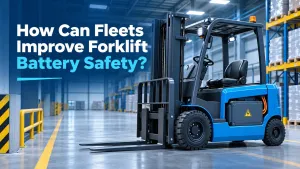
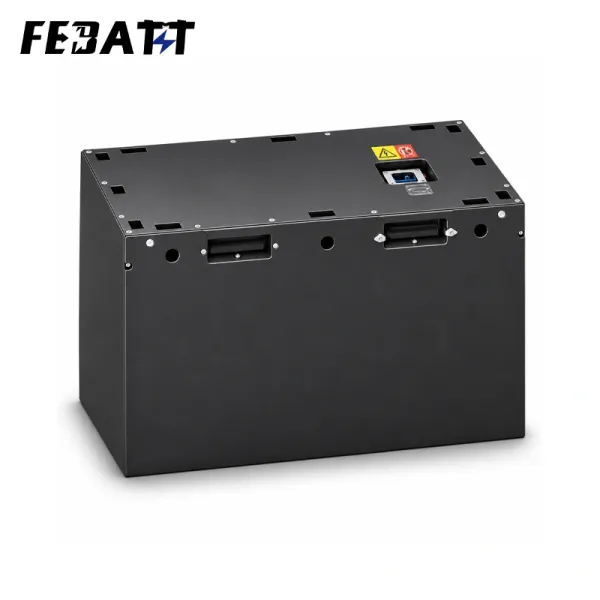
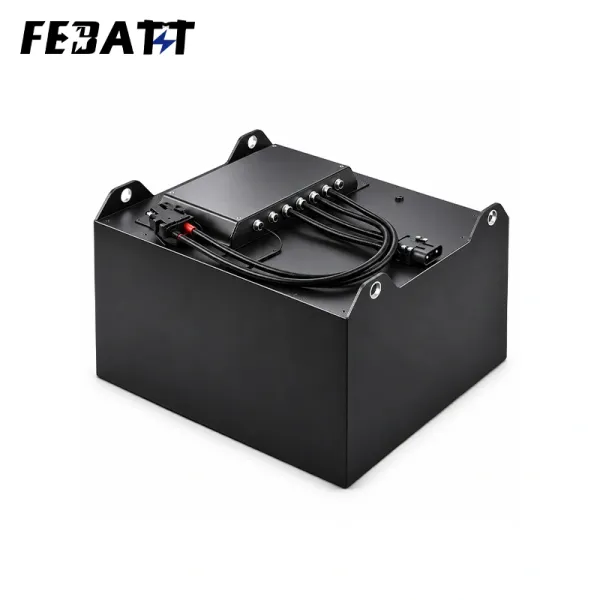
For warehouse fleets, forklift battery weight is not merely a shipping specification. On many electric lift trucks, battery mass contributes to the vehicle’s designed balance. A lithium pack that fits the compartment but falls below the manufacturer’s approved weight can therefore create a safety and procurement problem. Before signing a fleet order, buyers should verify the truck’s permitted battery-mass range, the proposed pack’s installed weight, and written approval for any changes.
How Much Does a Forklift Battery Actually Weigh?
Industrial forklift batteries can weigh roughly 800–4,000 lb (360–1,815 kg), according to the equipment supplier Raymond West. That broad forklift battery weight range is a market reference, not a permissible specification for any individual truck. Compact pallet-handling equipment may use substantially lighter packs, while larger counterbalanced machines may require heavier assemblies.

The practical question is not “What is the average forklift battery weight?” but “What mass was this particular truck engineered to carry?” Two electric forklifts with similar lifting capacities may have different approved forklift battery weight ranges because their chassis, wheelbase, mast, attachments, and stability architecture differ.
A purchasing quotation should distinguish three numbers: cell-and-module mass, complete pack mass, and installed system mass. The last may include an enclosure, manufacturer-approved ballast, fastening hardware, and other items specified in the approved design. Confusing those figures obscures forklift battery weight compliance and produces unreliable comparisons.
When checking a replacement battery against the forklift manufacturer’s weight limits, make sure the comparison includes the right components. The battery enclosure, built-in ballast and mounting hardware may contribute to the total weight, provided they are approved as part of the battery assembly. Unrelated truck components should not be counted toward the required battery weight.
For fleet purchases, ask suppliers to confirm the total weight of the proposed battery assembly, including any approved ballast. The specifications should clearly state what is included and define an acceptable weight tolerance to ensure consistency between the approved sample and future production batches.
Why Does Battery Mass Change Forklift Stability?
On electric counterbalance trucks, the battery can form part of the stabilizing mass behind the load. The lifting operation creates a forward overturning moment; the truck’s mass distribution resists it. OSHA’s powered-industrial-truck stability appendix explains how load moment, center of gravity, and the stability triangle govern tip-over risk. Changing a large internal mass can affect the truck’s stability characteristics.
The effect is not limited to lifting a pallet at rest. Braking, cornering, ramps, high stacking, and off-center loads introduce dynamic forces that make forklift battery weight verification more consequential. A mass change that appears inconsequential during unloaded travel may become material during the most demanding warehouse maneuver. Conversely, overcorrecting forklift battery weight can exceed a maximum battery allowance or impose loads that the tray and supporting structure were not designed to carry.
Three fleet situations deserve particular scrutiny:
- Counterbalanced trucks at loading docks: repeated braking, trailer transitions, and heavy pallets expose both longitudinal stability and battery restraint.
- High-rack reach trucks: elevated loads and narrow-aisle maneuvers make model-specific stability assumptions especially important; the battery’s role must be verified rather than presumed identical to a sit-down truck.
- Mixed indoor-outdoor fleets: ramps, attachments, and uneven surfaces change the operating envelope, even when forklift battery weight stays constant.
Crucially, correct forklift battery weight does not authorize higher lifting capacity. The truck’s rated load, load center, mast, and attachment limitations still control. Procurement should treat weight compliance as one necessary condition, never as a substitute for the truck’s capacity plate.
Where Can Buyers Confirm Approved Battery Weight Limits?
Start with the vehicle identification and capacity plate, then cross-check the model-specific operator manual or battery specification from the lift-truck manufacturer. Some plates state minimum and maximum forklift battery weight directly; others require reference to manufacturer documentation. If the relevant forklift battery weight marking is illegible, incomplete, or does not resolve a particular serial-number configuration, ask the OEM or authorized dealer for written confirmation before issuing a purchase order.
OSHA requires nameplates to remain legible and specifies manufacturer approval for modifications affecting safe operation under 29 CFR 1910.178(a)(4) and (a)(6). The approved forklift battery weight must therefore be linked to a real truck configuration, not inferred from another vehicle carrying the same model name.

Capture the following evidence for each truck family:
- Make, model, serial-number range, and clear data-plate photograph.
- Minimum and maximum authorized forklift battery weight, with units and document revision.
- Rated capacity, load center, mast, attachment, and any relevant derating conditions.
- Battery compartment dimensions, support structure, travel stops, and retention design.
- Existing battery’s measured mass and the proposed assembly’s declared installed mass.
Example, not an actual truck specification: suppose the OEM permits 1,200–1,450 kg and a supplier proposes a 1,010 kg lithium assembly. The apparent shortfall is 190 kg. Buyers should flag the quotation for engineering review—not order 190 kg of loose steel. Forklift battery weight is acceptable only when the complete configuration meets the manufacturer’s conditions and any required approvals are documented.
How Should OEMs Engineer Lithium Weight and Ballast?
Lithium chemistry can deliver the required energy with less intrinsic mass than lead-acid. That advantage does not automatically translate into a lighter approved truck installation. OEM teams must define the required installed weight, mass distribution, securement, and service access before finalizing the enclosure. On a retrofit, battery mass is an integration constraint, not simply a target for weight reduction
A properly engineered solution may use an integrated ballast structure, a reinforced enclosure, or a truck-specific mounting design. Forklift battery weight alone is insufficient: two assemblies with equal total mass can have different centers of gravity and different loads on their supports. An acceptable forklift battery weight figure does not excuse unsecured ballast: the assembly must withstand foreseeable braking, lifting, and vibration conditions. The design should also preserve compartment clearances and safe removal procedures.

This is established industry practice rather than a theoretical concern. Toyota’s 5/35 lithium-ion battery range advertises built-in counterweight and adjustable spacers for specified truck fitment. It does not imply that the same approach is approved for every truck. Under OSHA 29 CFR 1910.178(q)(6), additional counterweighting requires the truck manufacturer’s approval.
For bespoke projects, request a documented design review covering forklift battery weight, ballast fixation, center-of-gravity location, tray loading, and approval responsibilities. A custom power battery integration solution can support the pack-design discussion, but the battery supplier’s proposal does not replace lift-truck manufacturer authorization or independent engineering validation where applicable.
How Can Fleet Buyers Audit Weight Across Truck Models?
A fleet can have dozens of similar-looking trucks with different permitted battery masses. Rather than approving one lithium pack for an entire site, classify equipment by manufacturer, model, serial range, mast/attachment configuration, and operating environment. Then build a truck-to-battery approval matrix that gives forklift battery weight its own approval field. The aim is to make forklift battery weight traceable to the exact machine, not to a generic warehouse application.
| Fleet application | Main weight-related exposure | Procurement approval gate |
|---|---|---|
| Sit-down counterbalance truck | Underweight pack changes designed balance | OEM-permitted mass, installed center of gravity, approved restraint |
| Reach truck in narrow aisles | Model-specific mass distribution and elevated-load behavior | Truck-specific range, mast configuration, securement records |
| Electric stacker or pallet truck | Different chassis architecture and compartment load limits | Applicable manual limits; do not assume counterbalance rules |
| Multi-model distribution fleet | Similar envelopes conceal different weight allowances | Serial-level compatibility matrix and controlled part numbers |
For sit-down machines, the fleet replacement checks for counterbalance forklifts provide broader duty-cycle context after the mass requirement is settled. In narrow-aisle operations, the reach truck battery specification guide addresses additional site and equipment interfaces. Neither guide supersedes the vehicle OEM’s limits.
A sensible pilot measures forklift battery weight on the complete installed assembly, verifies retention and clearances, and checks the truck under authorized, representative duty. Record exceptions by asset number. If forklift battery weight varies between production units, define an agreed manufacturing tolerance that remains within the approved range at its extremes. Release only validated truck-and-pack combinations to purchasing.
What Proof Should Buyers Require Before Bulk Orders?
The most costly forklift battery weight error is discovering a mismatch after a container of packs reaches the warehouse. A favorable sample inspection is insufficient if the supplier cannot show that production units will reproduce approved forklift battery weight and mechanical configuration. Procurement, engineering, EHS, and the service organization should sign off on one acceptance package before the purchase order becomes non-cancellable.
Require six auditable deliverables:
- OEM basis: truck data plate, applicable manual, model/serial coverage, and written approvals where required.
- Controlled drawings: complete-pack dimensions, battery mass, center-of-gravity coordinates if required, lifting points, and securing details.
- Ballast dossier: material, placement, retention method, traceable part numbers, and approved configuration.
- Verification report: calibrated weighing records for the sample, inspection method, test results, and acceptance tolerances.
- Pilot sign-off: documented fitment, authorized operating checks, identified exceptions, and accountable approvers.
- Production controls: bill of materials, change notifications, serial traceability, final inspection records, and corrective-action process.
Make the approved battery-weight range a mandatory RFQ acceptance criterion, not an informational field. Specify whether declared forklift battery weight covers the complete installed system and how each delivered unit will be checked. A supplier who cannot substantiate weight, design revision, and truck compatibility should not pass the fleet purchasing gate.
The purchasing decision is ultimately straightforward: approve the battery against the truck, not the truck against the battery. When the proposed battery meets the manufacturer’s documented mass and stability requirements, buyers can pursue lithium upgrades without turning a fleet efficiency project into an avoidable operational risk.
Frequently Asked Questions About Forklift Battery Weight
Q: How much does a forklift battery typically weigh?
A: Industrial forklift batteries often weigh about 800–4,000 lb (360–1,815 kg), but smaller trucks can differ substantially. Confirm the approved forklift battery weight on the specific vehicle’s documentation before purchasing.
Q: Why is forklift battery weight important for stability?
A: On many electric trucks, battery mass contributes to the designed weight distribution. Incorrect forklift battery weight can alter stability margins, especially during lifting, braking, cornering, and ramp travel.
Q: Can a lithium forklift battery be lighter than the original lead-acid battery?
A: Yes. Lithium cells may weigh less, but the complete pack must still meet the truck’s authorized requirements. Compare installed forklift battery weight and obtain approval before changing the configuration.
Q: Can ballast be added to meet forklift battery weight requirements?
A: Only through a properly engineered, approved arrangement. Ballast location, retention, and mounting matter as much as mass. Do not add loose weights or assume a lighter pack is acceptable without OEM authorization.
Preparing an OEM program or a multi-site fleet order? Share the truck model and serial range, data-plate photos, current forklift battery weight, compartment drawings, and handling duty. FEBATT can assess custom pack and enclosure options against your supplied requirements and coordinate the battery-side specification for technical review. Discuss a fleet battery project before locking a bulk quotation.