For warehouse operators, logistics companies, and industrial fleet managers, the forklift battery price on a quotation is only the first visible cost. The larger economic question is how much the battery system costs to keep each truck productive over several years. A cheaper pack can create higher labor, energy, downtime, spare-battery, and infrastructure expenses, while a higher initial investment can reduce recurring fleet costs when the system is matched correctly.
This is why B2B procurement should evaluate forklift battery price together with utilization, charging strategy, maintenance burden, replacement planning, and the cost of unavailable equipment. For multi-shift warehouses, the financial impact of one stopped truck can extend beyond the battery itself because delayed pallet movement affects labor allocation, dock flow, and order throughput.
Lithium technology has changed this calculation. A properly engineered LiFePO4 system can reduce routine maintenance, support opportunity charging, provide stable usable power, and simplify battery handling compared with conventional flooded lead acid. These benefits do not guarantee the same savings for every operation, but they can materially change lifecycle economics in high-utilization fleets.
Buyers can use forklift battery portfolio as a reference when comparing voltage, capacity, dimensions, and application requirements. The correct forklift battery price should always be interpreted in the context of the truck platform and the warehouse duty cycle, not as a stand-alone purchasing number.
What Fleet Costs Matter More Than the Initial Battery Quote?
The most useful starting point is to separate purchase cost from operating cost. The forklift battery price is paid at procurement, but fleet costs accumulate every day the truck is in service. For B2B buyers, the relevant categories include energy consumption, maintenance labor, charging downtime, battery changing, spare inventory, infrastructure, replacement events, and technical support.
A forklift battery price model should therefore answer a practical question: how much does the energy system cost per productive truck-hour? This approach makes it easier to compare two technologies that have different acquisition prices but very different operating profiles.

For example, a lead-acid battery may carry a lower initial forklift battery price, yet routine watering, equalization, cleaning, battery changing, and charging-area management can increase annual operating expense. Lithium usually reduces those recurring tasks, although connectors, cables, enclosure condition, charger operation, and BMS events still require inspection.
Fleet size magnifies small differences. Saving a few minutes of handling on one truck may appear minor, but across dozens of trucks and hundreds of operating days, the labor effect becomes meaningful. The same logic applies to electricity, downtime, and spare-battery inventory.
For buyers comparing chemistry and system safety, this guide to lithium battery safety considerations for commercial vehicles provides additional context on why battery design, protection logic, and application matching matter beyond the quotation itself.
How Do Voltage and Capacity Affect Fleet Capital Efficiency?
Why Can Lithium Reduce Routine Fleet Maintenance Cost?
Routine service is one of the clearest differences between flooded lead acid and lithium. A lead-acid system may require watering, electrolyte-related inspection, cleaning, equalization procedures, terminal care, and more extensive battery-room management. Each activity has a labor cost and introduces variation between shifts and operators.
Lithium removes routine electrolyte watering and reduces much of the maintenance associated with flooded batteries. This does not make the battery inspection-free. A commercial lithium pack still needs periodic checks of external cables, connectors, mounting, enclosure condition, charger behavior, fault logs, and any model-specific service items.

The forklift battery price comparison should therefore account for lower routine maintenance rather than “zero maintenance.” When forklift battery price comparisons include technician time, consumables, cleaning, and battery-handling procedures, the lithium premium may look different from the initial quotation alone.
Maintenance also affects availability. A battery that requires more frequent manual intervention creates more opportunities for a truck to be removed from service. For a multi-shift operation, reducing scheduled and unscheduled interventions can be more valuable than a small difference in purchase price.
This is why forklift battery cost should be modeled from the fleet’s maintenance records. Buyers should quantify annual hours spent on watering, cleaning, inspections, swaps, and charger-related issues before estimating potential savings from a different battery architecture.
How Can Opportunity Charging Reduce Spare-Battery and Downtime Costs?
Opportunity charging can change the number of batteries a fleet needs to own. Instead of relying only on long charging windows or swapping a depleted battery for a fully charged spare, a lithium system can receive energy during breaks, shift changes, or other planned idle periods when the battery and charger are designed for that strategy.
The forklift battery price savings are not automatic. Charger power, site electrical capacity, available break time, battery temperature, and cell charge limits all affect how much useful energy can be restored. But when the operating pattern supports it, opportunity charging can reduce dependence on spare batteries and battery-changing labor.
This matters because spare batteries increase more than the forklift battery price. They also require storage space, maintenance, handling equipment, connectors, charging capacity, and inventory management. A fleet that can operate with fewer spare packs may release capital and warehouse space at the same time.
Downtime should also be valued. If a forklift waits for a battery change, charger availability, or a replacement pack, the economic loss can include operator time and delayed material movement. High-throughput facilities should therefore calculate the cost of unavailable truck-hours rather than treating downtime as a nonfinancial maintenance issue.
A lower fork truck batteries price quotation is not necessarily the better decision if it requires a larger spare-battery pool. B2B buyers should compare the number of batteries, chargers, and handling steps needed to deliver the same productive hours.

How Does Energy Efficiency Affect Long-Term Forklift Battery Cost?
Electricity is a recurring fleet expense, so charging and round-trip efficiency should be part of every forklift battery price review. Lithium systems generally have lower internal resistance and can use charging energy efficiently, while lead-acid charging can involve greater losses through heat and electrochemical side reactions.
Actual efficiency depends on the complete system. Cell chemistry, charger design, cable sizing, battery temperature, state of charge, charging current, and operating conditions all affect results. For this reason, a universal percentage saving should not be applied to every warehouse.
The best analysis compares electricity consumed at the charger with productive energy delivered to the trucks over a representative period. A fleet with many daily charge events will magnify even modest efficiency differences.
Energy cost is also connected to charging strategy. High-power charging can create site-demand implications, while inefficient charging can increase both direct electricity consumption and heat-management requirements. A credible forklift battery cost model should therefore use local electricity tariffs and real charger data whenever possible.
When an electric forklift battery price is higher for lithium, energy savings alone may not justify the premium in a lightly used fleet. In multi-shift operations, however, energy efficiency combines with maintenance and uptime benefits, creating a stronger total-cost case.
Which Battery Specifications Protect Fleet Uptime and Avoid Hidden Cost?
A low forklift battery price is not useful if the pack cannot deliver the required current, fit the truck correctly, or communicate with the vehicle system. Specification mismatch can create nuisance shutdowns, premature replacement, troubleshooting time, and operational disruption.
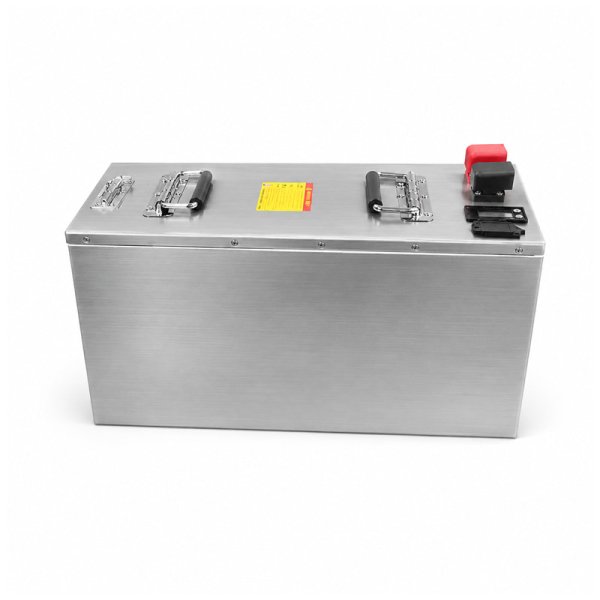
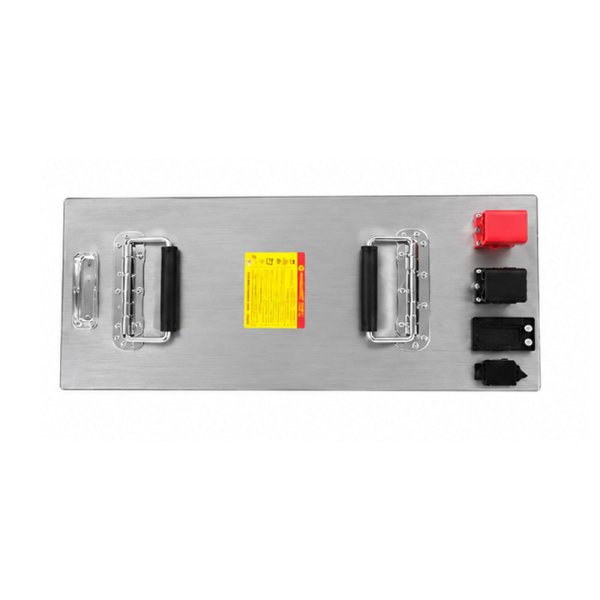
B2B buyers should evaluate the battery as an integrated system. Important parameters include nominal and operating voltage, usable capacity, continuous current, peak current and duration, BMS protection thresholds, charger compatibility, connector type, cable sizing, communication protocol, dimensions, mounting, and required installed mass.
Battery mass deserves special attention in forklift applications. Some trucks rely on battery weight as part of the vehicle’s counterbalance and stability design. A lithium retrofit that is physically lighter may require an approved ballast or vehicle-specific solution. Lower weight is not automatically an advantage if it compromises the truck’s required configuration.
Environmental requirements also affect lifecycle cost. Heat, low temperature, dust, moisture, shock, and vibration can increase failure risk if the enclosure, connectors, BMS, and cells are not designed for the actual environment.
The safest procurement approach is to request evidence that the proposed pack is suitable for the intended application. The forklift battery price should then be evaluated against the cost of reliable service, not against a stripped-down specification that may create expenses later.
How Should Buyers Compare 48V, 64V, and 72V Systems Without Overbuying?
Different voltage platforms exist because forklifts are designed around different electrical architectures. A 72V pack is not inherently better than a 48V or 64V pack. The battery must match the controller, motor, charger, DC-DC equipment, communication, and other vehicle electronics.
Higher voltage can reduce current for the same power level, which may support efficient power delivery in a compatible system. But selecting a higher-voltage battery solely because it sounds more powerful can create incompatibility and unnecessary cost.
For this reason, forklift battery price comparisons should be made within compatible vehicle platforms. Buyers should first establish the approved voltage window and current demand, then compare capacity options that satisfy runtime and charging requirements.
A 105Ah pack will generally contain more stored energy than a 60Ah pack at the same voltage, but the fork truck batteries price does not scale perfectly with amp-hours. Fixed costs such as BMS electronics, contactors, connectors, engineering, testing, and enclosure fabrication mean the relationship is not linear.

For fleet economics, the correct question is not which pack has the lowest electric forklift battery price. It is which compatible configuration provides the required productive hours with the least total capital and operating burden.
How Can Fleet Standardization Reduce Procurement and Service Cost?
Large B2B projects can reduce cost by standardizing battery specifications where the vehicle fleet allows it. Fewer battery variants simplify procurement, spare-parts planning, charger selection, technician training, documentation, and inventory control.
Volume can also improve commercial terms because repeatable configurations reduce engineering and manufacturing complexity. However, buyers should avoid forcing incompatible forklift models into one battery specification merely to obtain a lower forklift battery price.
The strongest standardization strategy groups trucks by compatible voltage, compartment, current demand, and duty cycle. Within each group, buyers can then evaluate common connectors, communication protocols, chargers, displays, and service procedures.
This approach can reduce hidden administrative cost. Fewer part numbers mean fewer purchasing errors, fewer spare components, and easier maintenance documentation. For multinational or multi-site fleets, standardization can also improve consistency in technical support.
When evaluating a fork truck batteries price proposal for dozens or hundreds of units, fleet managers should therefore ask what can be standardized without compromising vehicle compatibility or performance. The cost advantage comes from repeatability, not simply from purchasing the same battery for every truck.
How Should Warranty and Supplier Support Be Included in Fleet Cost?
Warranty should not be treated as a headline number that automatically makes one forklift battery price better than another. Coverage duration matters, but scope, exclusions, operating limits, documentation requirements, and claim procedures can have equal economic importance.
B2B buyers should review what is actually covered: manufacturing defects, BMS components, capacity-retention conditions, or other defined failures. They should also understand whether coverage is limited by time, cycle count, operating conditions, or application-specific requirements.
Technical response capability is another cost variable. When a fleet experiences a battery fault, access to diagnostic support, replacement components, communication documentation, and application engineering can reduce downtime.
A very low forklift battery cost from a supplier with weak technical support may become expensive when a truck remains unavailable while the root cause is investigated. Conversely, responsive service can protect fleet productivity even if the initial quotation is not the lowest.
The warranty and support package should therefore be valued as part of lifecycle risk. Buyers should compare written terms for the actual product and project rather than assume that every commercial forklift battery follows one universal warranty period.
How Can Warehouse Managers Calculate Fleet TCO and Potential Savings?
Total Cost of Ownership converts forklift battery price into a fleet-management metric. The goal is to compare battery systems over the same operating period and the same required level of productive output.
A practical TCO model can include:
- Battery and charger acquisition.
- Installation and commissioning.
- Electricity consumption.
- Routine maintenance labor and materials.
- Battery-changing labor.
- Spare battery inventory.
- Charging-area and handling infrastructure.
- Planned and unplanned replacement events.
- Downtime and lost productive truck-hours.
- End-of-life handling and residual value where applicable.
The calculation should use site-specific data. Electricity invoices, maintenance records, battery-changing time, utilization reports, charger data, and historical replacement information are more useful than generic industry averages.
To estimate a lithium conversion, calculate the additional initial investment and compare it with expected annual savings in energy, maintenance, handling, spare-battery inventory, and downtime. A simple payback calculation can divide the additional investment by annual savings, but it should be treated as a planning estimate rather than a guaranteed result.
The forklift battery price should therefore be only one line in the model. A fleet with low utilization and existing lead-acid infrastructure may find limited economic benefit from immediate conversion. A multi-shift fleet with high maintenance, frequent battery changes, and costly downtime may see a much stronger case.
This is the core B2B principle: the lowest electric forklift battery price does not necessarily produce the lowest cost per productive hour. Procurement should optimize the complete energy workflow.
Conclusion
A forklift battery price is important, but it should not dominate a B2B fleet decision. Warehouse operators make money from productive material handling, not from buying the lowest-priced battery. The relevant economic measure is the cost of delivering reliable truck-hours over the planned ownership period.
Lithium can create a strong lifecycle advantage in demanding fleets because it can reduce routine maintenance, support opportunity charging, improve energy utilization, reduce battery handling, and simplify spare-battery planning. Those benefits should be calculated from real operating data rather than converted into universal savings percentages.
The final battery decision should also protect compatibility and uptime. Voltage, current, BMS, charger, battery mass, compartment fit, connectors, communication, and environmental conditions must match the forklift platform. A low forklift battery cost that creates technical mismatch is not a saving.
For B2B buyers, the strongest procurement strategy is therefore straightforward: evaluate forklift battery price as one component of fleet TCO, quantify recurring costs, standardize where practical, and select the battery system that delivers the lowest sustainable cost per productive forklift-hour.
Add Your Heading Text Here
1.Why can a higher forklift battery price still reduce fleet cost?
A higher forklift battery price can be justified when the system lowers maintenance, energy use, spare-battery needs, handling labor, or downtime. B2B buyers should compare cost per productive truck-hour.
2.How should buyers compare forklift battery cost between lithium and lead acid?
Compare the same duty cycle and include battery, charger, electricity, maintenance, swapping, spare inventory, infrastructure, replacement, and downtime rather than comparing purchase quotations alone.
3.Does a larger battery always produce a higher-value fleet investment?
No. Extra capacity can increase forklift battery price without improving productivity if the fleet does not use it. Select voltage, usable energy, current capability, and charging windows from measured duty-cycle data.
4.Can opportunity charging lower the number of spare forklift batteries?
It can when the battery, charger, site power, and break schedule support partial charging. The potential saving depends on fleet utilization, available charging windows, and required productive truck-hours.
5.What should B2B buyers request before accepting a forklift battery quotation?
Request voltage and current limits, usable capacity, BMS functions, dimensions, installed mass, charger compatibility, interfaces, warranty terms, testing information, and confirmation of application suitability.