A warehouse robot may spend more time leaving its route, waiting for a dock and returning to work than actually charging. For a multi-shift operator, that lost movement matters more than a headline charging speed. AGV wireless charging offers another option: recover energy during predictable production stops, without repeatedly mating exposed electrical contacts. The battery, dock and controls must work together.
Why Is a Faster Charger Not Always the Answer?
Faster charging still requires an AGV to reach an available station. A lift queue or pallet handoff may already offer a usable pause. AGV wireless charging can turn those pauses into energy windows while the robot remains assigned to its normal workflow. Dedicated charging may still be needed.

Higher power can strain site infrastructure and battery limits. Buyers weighing the trade-off can review commercial fleet fast-charging limits separately. The key question is how much usable energy reaches the battery during stops that already exist.
Where Should Wireless Charging Fit the Route?
Good locations are repeatable waiting points: a conveyor handoff, pallet-transfer bay, warehouse lift or fixed quality-control position. For AGV wireless charging, fleet planners should map real dwell-time logs instead of adding pads wherever floor space happens to be available. Shared stops can create queues.

Choose candidate sites using four checks: predictable dwell time, acceptable pad positioning, safe pedestrian and forklift movements, and access to power and maintenance. AGV wireless charging should fit material flow, not force the route to serve the charger. Check relocation costs when layouts change.
How Much Energy Can Short Stops Actually Recover?
Use battery-side energy, not the advertised transmitter rating, when judging AGV wireless charging. An industrial supplier publishes a 3 kW inductive system with up to 93% energy-transfer efficiency and ±30 mm positioning tolerance. These are third-party specifications, not FEBATT performance claims. Actual output varies with alignment and pack limits.
For a transparent AGV wireless charging planning example, assume one warehouse AGV has eight eligible stops per shift, each three minutes long, and the battery receives an average 2.0 kW during active charging. This is a planning assumption, not field data.
| Planning input | Illustrative value |
|---|---|
| Usable stops per shift | 8 |
| Average active time per stop | 3 minutes |
| Assumed average battery-side power | 2.0 kW |
| Estimated replenishment per shift | 8 × 3 ÷ 60 × 2.0 = 0.80 kWh |
When AGV wireless charging restores less than route consumption, planned recharging remains necessary. Verify actual logged energy over complete shifts, including missed docks, charging taper and periods when multiple robots compete for a pad.
Why Choose a LiFePO4 Battery for Frequent Top-Ups?
For industrial AGVs, lithium iron phosphate (LiFePO4) is often a practical choice: it avoids routine watering required by flooded lead-acid packs, has strong thermal stability, and can accept approved partial charges under appropriate BMS controls. This supports AGV wireless charging in multi-shift warehouses where operators cannot routinely remove vehicles for battery service.
Battery chemistry alone cannot guarantee safe wireless charging. Cell charge-current limits, temperature, state of charge and aging must be respected. A larger pack may not solve a poor docking schedule; a smaller pack may become risky if missed charging windows leave insufficient energy for the next job.
What Must the Battery, Receiver and BMS Agree On?
Charging authorization
Inductive equipment transfers energy across a gap, but the onboard receiver still supplies controlled DC power to the battery. In AGV wireless charging, the charger and BMS must agree on current limits, temperature permissions, fault shutdown and how a session ends when the robot moves away. Industrial wireless charging integration guidance identifies BMS communication as a core OEM compatibility requirement.
Useful signals for dispatch
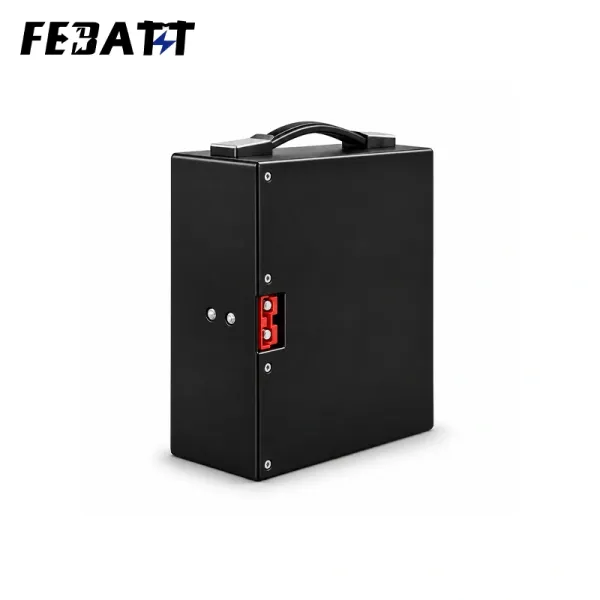
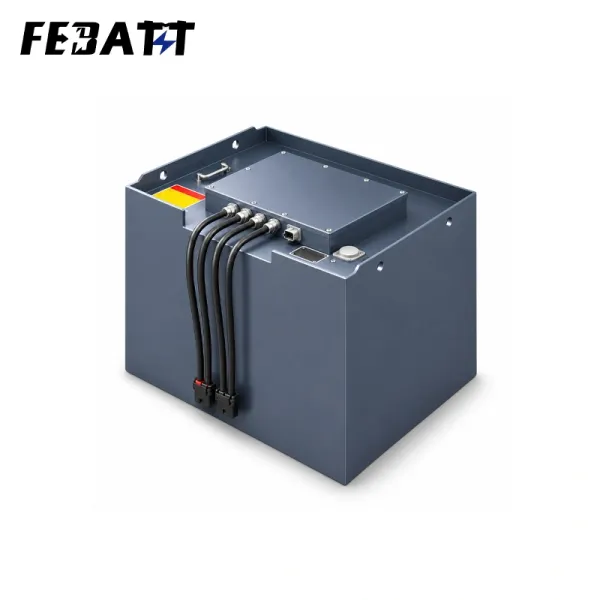
The fleet controller also needs reliable charging status and remaining-energy data before releasing the vehicle. FEBATT’s RS485-enabled LiFePO4 battery pack for AGV robots provides a relevant battery-integration reference, including a published charging temperature range of 0–45°C. This does not establish plug-and-play compatibility with any wireless receiver. For AGV wireless charging, validate the complete charger-to-pack sequence.
What Should Operators Prove Before a Fleet Rollout?
Evaluate the proposed charging system on representative loaded routes, not one bench demonstration. Record delivered kWh, time lost to queueing, docking failures, temperature, BMS alarms and jobs completed per shift. Test partially loaded and fully loaded routes, frequent restarts and low-SOC recovery.

Ask whether AGV wireless charging still performs when the vehicle parks at the edge of the permitted alignment window or when station demand peaks. FEBATT’s warehouse AMR battery integration case illustrates why battery packaging, communication and charging equipment must be validated together before volume production; it is not a claimed wireless-charging field trial.
How Can OEM Buyers Specify a Battery-Ready System?
Before requesting a quote for AGV wireless charging, OEMs should provide route dwell-time data, robot count, battery-side power targets, receiver installation space, charger communication protocols, operating temperature limits and planned production volume. Request a joint acceptance matrix that clearly defines the responsibilities of the battery supplier, wireless charging equipment manufacturer and robot system integrator.
For AGV wireless charging projects, FEBATT can discuss custom LiFePO4 battery configurations, BMS communication, charging-current limits and OEM/ODM integration requirements. However, the wireless transmitter, onboard receiver and associated charging controls must be selected and validated with the charging equipment supplier and system integrator. FEBATT’s published custom power battery and smart-charger solutions should not be interpreted as confirmation that an inductive wireless charging system is included or that compatibility has already been established.
Before production approval, OEMs should verify the complete battery-to-charger integration, including charging authorization, communication protocols, temperature protection, fault handling and interrupted-session recovery. The proposed configuration must be validated using the actual battery, receiver, charging equipment and robot controller.
For fleet buyers, successful AGV wireless charging means fewer avoidable interruptions, predictable energy recovery and reliable battery performance across multiple shifts. Selecting a suitable lithium battery pack is the foundation; integrating it correctly with the charging equipment and warehouse operating schedule determines its practical value.
FAQ: AGV Wireless Charging for B2B Fleets
Q: Is AGV wireless charging suitable for existing warehouse robots?
A: Potentially. A retrofit requires physical room for the receiver, safe power conversion, a compatible battery charge profile and controller permissions. Test one representative vehicle before converting a fleet.
Q: Does AGV wireless charging damage LiFePO4 batteries?
A: Not inherently. Battery aging depends on charging current, temperature, SOC range and total duty cycle. The BMS must enforce the pack’s approved limits during repeated short sessions.
Q: How fast is AGV wireless charging?
A: It depends on charger output, receiver efficiency, docking geometry and the battery’s allowed current. Compare measured battery-side kWh delivered per available stop, not only a charger’s advertised kW.
Q: Is contactless charging better than contact charging for AGVs?
A: Not universally. Contact systems can be cost-effective; inductive systems avoid mechanical charging-contact wear. Decide using site contamination, stopping accuracy, installation costs and measured fleet availability.
Q: What information should OEMs send for an AGV wireless charging quote?
A: Send fleet size, route and dwell-time logs, pack specification, BMS protocol, receiver space, ambient conditions and rollout volume. Ask vendors to agree on integration tests and failure-handling responsibilities.