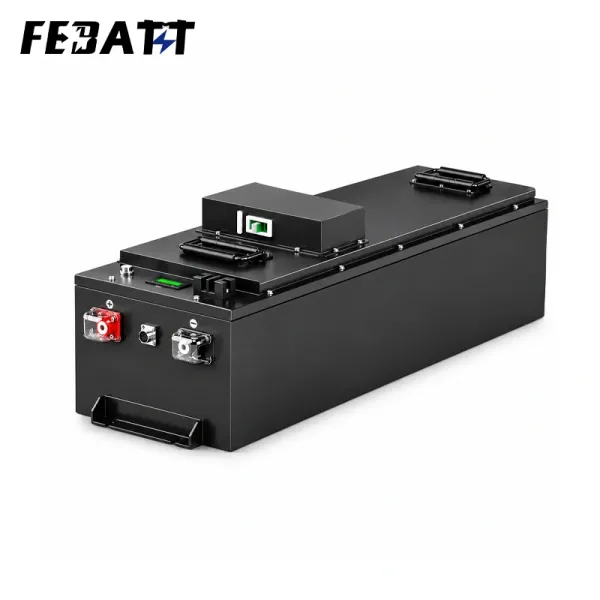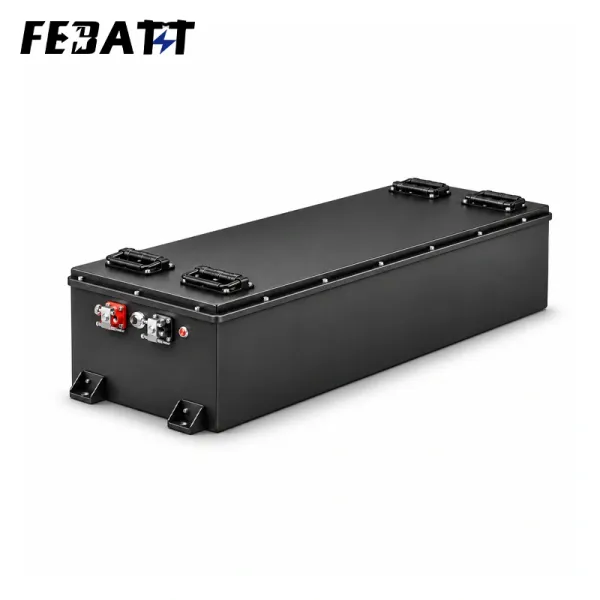
An RXV that loses range or repeatedly returns to the workshop can disrupt a fleet. The replacement route depends first on whether the cart is a conventional lead-acid RXV or a factory ELiTE. The right EZGO RXV lithium battery must match its generation, battery bay, drive system, charging arrangement and duty cycle. A documented EZGO RXV lithium battery fitment record prevents a wrong-kit order and avoidable downtime.
Which RXV Battery System Is Being Replaced?
Distinguish two jobs: converting a conventional RXV to lithium and replacing the factory lithium pack in an ELiTE vehicle.
A conventional electric RXV may still use a bank of lead-acid batteries. This is a conversion project. The supplier must account for the tray, mounting points, cables, charge receptacle and SOC display. An EZGO RXV lithium battery for one tray arrangement may need a different bracket or installation kit for another.
An ELiTE RXV left the factory with a Samsung lithium system, so it needs an EZGO RXV lithium battery replacement compatible with that platform—not a generic conversion pack. Check the enclosure, mounting, communication interface and charger against the installed generation.

Record these details for every cart:
- Model variant: RXV Fleet, Freedom or Freedom 2+2.
- Model year, serial number, PIN and manufacture date.
- Existing battery label, manufacturer and generation, if applicable.
- Photos of the battery bay, tray, mounting points and connectors.
- Charger model, charge port and dashboard or SOC display.
- Any controller, motor, accessory or wiring modifications.
The serial number and PIN matter: E-Z-GO requires vehicle identification and manufacture-date information when ordering components. A registration year alone is insufficient.
For conventional carts, an EZGO RXV lithium battery conversion should be quoted as a complete kit. Keep the EZGO RXV lithium battery specification tied to the photographed tray and vehicle identification. For ELiTE carts, this record lets the EZGO RXV lithium battery supplier identify the correct replacement before quoting, reducing wrong-kit shipments and delays.
How Do ELiTE Generations Affect Fitment?
ELiTE is not one unchanging specification. E-Z-GO introduced Samsung SDI lithium vehicles in 2017 and has since advanced the platform. Buyers must identify the installed generation.
Many aftermarket catalogs group RXV ELiTE Gen 1 around 2017–2021 and Gen 2 from 2022 onward. Treat those years as screening clues, not universal cutoffs; selected 2027 carts now include Gen 3.
There is now a third generation to consider. In September 2026, E-Z-GO announced a third-generation Samsung SDI battery for selected model-year 2027 ELiTE vehicles, including the RXV. E-Z-GO identifies a redesigned tray and cover, enhanced BMS monitoring and integrated thermal-safety features.
| RXV configuration | Buyer verification |
|---|---|
| Conventional RXV | Original lead-acid layout, tray, mounting and conversion hardware |
| ELiTE Gen 1 | Original Samsung pack label, connector arrangement and Gen 1 replacement approval |
| ELiTE Gen 2 | Pack identification, mounting interface, harness and Gen 2 fitment |
| Selected 2027 ELiTE Gen 3 | Vehicle identification and written confirmation for the new-generation arrangement |
For an EZGO RXV lithium battery replacement, ask the supplier to identify the supported generation in writing. Treat EZGO RXV ELiTE battery replacement as a separate fitment category from a conventional conversion. Request the harness or adapter part number, installation instructions and excluded model variants. The proposed EZGO RXV lithium battery must be listed for the specific generation, not simply for the RXV nameplate. If a supplier claims one pack fits every ELiTE RXV, ask for the engineering basis.
What Must the Battery Support in the RXV Drive?
Physical fit is only the first test. The pack must support the motor controller, regenerative braking and accessories.
The RXV uses regenerative motor control. During certain downhill or pedal-up braking events, the motor generates electricity and returns it to the battery. The replacement needs a BMS and electrical design that accept the applicable regenerative charge current. The replacement battery must safely accommodate this returned energy as well as traction loads; discharge capability alone is not enough.

Ask the supplier to document compatibility with the vehicle’s drive system:
- Continuous and peak discharge capability for acceleration, gradients and passenger or cargo loads.
- Permitted charge-current range, including regenerative input.
- BMS protection thresholds and responses to overcurrent, overtemperature and low-temperature charging.
- Required controller, harness or communication interface for the identified RXV.
- Compatibility with the cart’s SOC display and auxiliary 12V accessories.
ELiTE replacements may need generation-specific interfaces for battery communication and display behaviour; conventional conversions can use another arrangement. Nominal ratings alone do not prove EZGO RXV lithium battery compatibility. An E-Z-GO RXV lithium battery must also match the vehicle’s electrical architecture.
Assess the EZGO RXV lithium battery as part of the drive-system package. Request vehicle-level fitment evidence, not just a cell datasheet.
What Should an RXV Replacement Quote Include?
A battery-only price can conceal brackets, harnesses, charger changes and installation. Compare complete quotations.
| Quote item | What to confirm |
|---|---|
| Battery pack | Chemistry, usable capacity, current capability, dimensions and weight |
| BMS | Protection, monitoring, fault reporting and regenerative-charge capability |
| Mounting | Tray fit, brackets, restraints, fasteners and vibration protection |
| Electrical integration | Cables, connectors, fuses or disconnects, model-specific harness |
| Charging | Approved charger, charge profile, charge port and expected charging time |
| Driver information | SOC display, communications interface, alerts and programming |
| Documentation | Wiring diagram, installation guide, operating and service instructions |
| Commercial terms | Warranty scope, capacity retention, support and replacement parts |
A quote for EZGO RXV lithium battery replacement should state whether the pack is a direct replacement for the identified ELiTE generation or a conversion requiring additional components. For a lead-acid conversion, budget for a matched lithium charger unless the supplier confirms the existing charger can be reconfigured. Confirm whether the mounting kit is included. Total golf cart battery replacement costs provide a useful reference for lifecycle budgeting.
Compare lifecycle cost, not pack price alone: labour, charger replacement, downtime and warranty handling matter. Every EZGO RXV lithium battery quote should itemize these system costs.
How Should Fleets Size Capacity for Daily Use?
The largest battery is not automatically best. Size it to the route and work pattern.
Golf-course carts may complete short rounds; resort carts may carry passengers and luggage for long periods; campus patrol carts may travel farther with frequent stops and accessories. Each duty cycle changes the EZGO RXV lithium battery requirement.
Build the specification around measured operating data:
- Daily distance and route: Record distance per shift, gradients, surface conditions and stop-start sections.
- Operating hours: Establish service hours and whether carts must complete back-to-back shifts.
- Vehicle loading: Include passenger count, cargo, accessories and non-standard equipment.
- Charging opportunity: Identify overnight charging, midday breaks and practical opportunity-charging windows.
- Operating reserve: Allow for route variation, seasonal conditions, battery ageing and unexpected use.
Daily energy requirement = measured energy use per shift × shifts per day + operating reserve.
Use fleet measurements or monitor representative carts before fixing the specification.

For each duty profile, size the EZGO RXV lithium battery around usable energy, not a headline capacity. It should provide sufficient energy without imposing unnecessary weight, cost or charging requirements. For rental operators, the discussion of battery requirements for rental golf fleets can help structure the duty-cycle review.
Compare usable capacity, not just amp-hours. Require range assumptions for load, speed, terrain, temperature and accessories; a maximum-range figure is not an EZGO RXV lithium battery fleet operating guarantee.
What Must Dealers Verify Before Bulk Ordering?
One successful installation does not qualify a mixed fleet for bulk replacement. Dealers should validate the supplier and specification before issuing the purchase order.
Segment the fleet by configuration. A site may contain conventional RXVs, several ELiTE generations and modified vehicles. Build a fitment matrix rather than one batch.
Pilot the proposed EZGO RXV lithium battery on a representative vehicle. Check fit, connectors, cable routing, charging, SOC accuracy and regenerative braking under actual fleet loads. Record installation time and modifications.
Qualify the EZGO RXV lithium battery supplier against six criteria, including whether the EZGO RXV lithium battery can be supported consistently across repeat orders:
- Fitment evidence: Written compatibility tied to model, serial range and battery generation.
- Production consistency: Traceable cell and pack batches, defined end-of-line testing and serial records.
- Performance data: Capacity, discharge, charge acceptance and temperature limits supported by test documents.
- Warranty clarity: Coverage for pack, BMS, workmanship, capacity retention and labour, including exclusions.
- Service readiness: Fault diagnosis, replacement parts, response times and technical escalation.
- Supply continuity: Lead times, packaging, transport documents and repeat-order consistency.
For multi-site operators, serviceability matters as much as specification. The supplier should support the approved EZGO RXV lithium battery across repeat orders and define fault handling.
The purchase order should name the approved EZGO RXV lithium battery model, RXV generation, accessories, charger, documents, warranty and acceptance criteria. This prevents a later substitution from silently changing the agreed specification.
Frequently Asked Questions About EZGO RXV Lithium Batteries
Q: Can every EZGO RXV use the same lithium battery?
A: No. Conventional RXV carts and factory ELiTE vehicles need different replacement approaches. Tray design, original battery layout, ELiTE generation, connectors and charging equipment must be checked before an order is placed.
Q: Are RXV ELiTE replacement batteries the same as lithium conversion kits?
A: No. An ELiTE replacement is designed for a factory-lithium vehicle and its generation-specific interfaces. A conversion kit replaces a conventional battery bank and may need new mounting, charging and electrical components.
Q: How Can Buyers Identify Their RXV ELiTE Battery Generation?
A: Check the original pack label, vehicle serial number, PIN and manufacture date, then ask the supplier to cross-reference them. Model year alone is not conclusive, particularly around generation changes and selected 2027 vehicles.
Q: Does an EZGO RXV lithium battery need regenerative braking support?
A: Yes. RXV regenerative braking returns energy to the battery during deceleration. The replacement pack and BMS must safely accept the applicable charge current, with compatibility confirmed for the specific vehicle.
Q: Can the original EZGO RXV charger be reused with lithium?
A: Not automatically. Charger chemistry, charging profile and BMS coordination must match the replacement pack. Reuse the original charger only if the battery supplier confirms that exact charger model is approved.
A reliable replacement begins with vehicle identification. Confirm the RXV configuration, ELiTE generation, drive-system requirements and duty cycle before comparing quotations.
For dealers and fleet operators sourcing an EZGO RXV lithium battery, FEBATT provides custom lithium battery engineering and OEM/ODM supply solutions based on application requirements. Battery compatibility must be verified for each vehicle configuration, particularly factory ELiTE systems with generation-specific communication, charging and electrical interfaces. Any proposed replacement requires documented engineering validation before approval.
Share your vehicle model, manufacture year, existing battery specifications, installation requirements, fleet size and expected order quantity with FEBATT to discuss a suitable battery solution.
Explore custom lithium battery solutions for vehicle applications or contact the team about your fleet project.