Commercial floor-cleaning robots work to fixed schedules. Shopping centres, hospitals and warehouses need predictable cleaning windows. For OEMs, battery selection affects coverage, charging availability and service cost—not just capacity.
A suitable commercial cleaning robot battery must support traction, brushes, vacuum fans, pumps, sensors and controls. For OEMs comparing a lithium battery for cleaning machines, the priority is dependable output across the full route—not a headline capacity figure.
What Makes Commercial Cleaning Robot Loads Different?
A floor scrubber does not draw power at one constant rate. Traction, brush pressure, suction, water delivery, turning and repeated starts create changing loads. A robot cleaning a smooth retail floor may use a different energy profile from one operating on textured warehouse flooring or carrying full solution and recovery tanks.
Published specifications illustrate why OEMs should assess the complete operating profile:
| Commercial machine | Commercial machine Published data | Procurement implication |
|---|---|---|
| Tennant T380AMR | Up to 5 hours with high-capacity lithium-ion versus up to 4 hours with flooded lead-acid; estimated coverage up to 3,106 m² | Battery system choice can affect available cleaning time |
| Kärcher KIRA BR 50 | 4-hour runtime, 5.8-hour charging time and 1,600 W rated input power | Charging windows and combined loads must fit the shift plan |
These model-specific figures are not universal guarantees. See Tennant T380AMR specifications and Kärcher KIRA BR 50 data.
Before specifying a commercial cleaning robot battery, record route length, cleaning mode, floor type, tank load and shift hours. Test with normal accessories and a full tank load. This gives the commercial cleaning robot battery supplier a realistic duty cycle instead of an optimistic runtime target.
Why Is Lithium a Better Choice for Commercial Cleaning Fleets?
For high-utilization equipment, lithium batteries can reduce maintenance, support opportunity charging and lower charging-related downtime. Tennant highlights opportunity charging and reduced watering requirements for its lithium-ion cleaning-machine batteries. Actual service life depends on chemistry, temperature, depth of discharge, charge profile and pack design.
A LiFePO4 battery for cleaning robots is worth evaluating where cycle life and thermal stability matter. NMC may fit tighter weight or space limits. Choose chemistry by energy demand and packaging, not energy density alone. For commercial floor-cleaning applications, OEMs should validate battery performance under representative traction, brush, suction and pump loads, while confirming BMS protection, charging compatibility and operating temperature limits.
When replacing lead-acid packs, compare usable runtime, recharge time, maintenance, replacement intervals and warranty—not only purchase price. Lithium is valuable when it helps machines complete more scheduled work with fewer interruptions.

How Should OEMs Specify a Commercial Cleaning Robot Battery?
Start with energy use and the work schedule, not a voltage number. Measure average and peak current on a representative route, then calculate the energy required for the target operating time. Include traction, brush motors, vacuum, pumps, controller, sensors and communications. Add a reserve based on route variability and the return-to-charge policy. Size the commercial cleaning robot battery for the worst normal route, not the shortest demonstration cycle.
For a robotic floor scrubber battery, the specification should define:
- Working hours per shift and minimum end-of-shift reserve.
- Continuous and peak discharge current, including simultaneous motor starts.
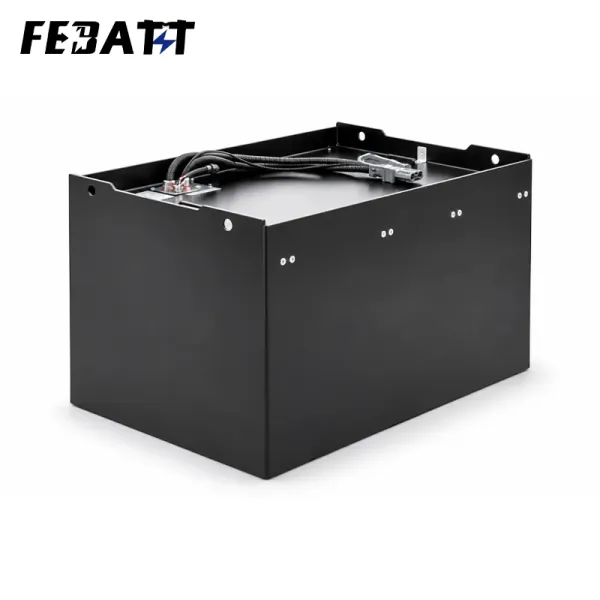
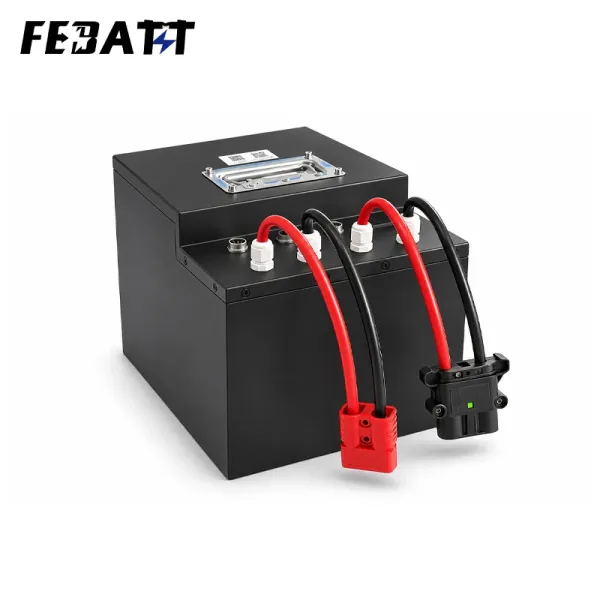
- Battery-bay dimensions, mounting, weight limit and connectors.
- Charger output, charging window and opportunity-charging requirements.
- BMS data and communication, such as CAN, RS485 or SMBus.

A commercial cleaning robot battery must also be tested with the machine controller and charger. Specify the cleaning robot battery pack, charger and controller as one matched system. Record runtime, reserve and fault-response criteria. Verify SOC reporting under changing loads, route-safe low-voltage cutoffs and correct fault interpretation. FEBATT’s LiFePO4 battery guide for mobile robots covers broader integration considerations.
What Environmental and Protection Tests Should Buyers Require?
Commercial scrubbers face water, detergent, debris and vibration. Assess the enclosure, cable exits, connectors and mounting together. Define exposure: splashes, washdown, condensation, chemicals or immersion. An IP rating describes enclosure resistance under defined conditions; it does not prove chemical compatibility, corrosion resistance or vibration durability. The European Commission’s IP-rating guidance distinguishes splashing, water jets and immersion.
For commercial floor-cleaning robots, OEMs should request application-specific evidence of enclosure sealing, connector protection, chemical compatibility and vibration resistance. The commercial cleaning robot battery systems must be evaluated against actual cleaning agents, washdown procedures and operating conditions. Verify cable insulation, connector integrity and protection performance through representative environmental testing before approving a battery configuration for production.
Agree on BMS alarms, communication messages and safe shutdown behaviour with the robot-control team before production.
How Can Fleet Buyers Reduce Total Battery Cost?
Total cost includes the pack, charger changes, maintenance, replacements, warranty, logistics and cleaning downtime. Ask suppliers for cell traceability, pack test results, batch consistency, protection functions and after-sales support.

Before production, test samples on real routes; record runtime, charging, temperature, alarms and capacity. Agree on acceptance criteria. FEBATT’s power battery solution lists designs intended for more than 2,000 cycles, with smart BMS protection, application matching and OEM customization. Ask for the cycle-test conditions for the exact pack.
A reliable commercial cleaning robot battery is not simply the pack with the largest capacity. An industrial cleaning robot battery must fit the cleaning process, service environment and fleet maintenance model. OEMs can review this cleaning robot battery portfolio when comparing application-specific options.
Frequently Asked Questions About the Commercial Cleaning Robot Battery
Q: What information should OEMs provide when sourcing a cleaning robot battery?
A: Share route duration, cleaning mode, average and peak current, battery-bay size, weight limit, charger, connectors, communication and environmental exposure. This lets suppliers quote for the actual machine.
Q: Are lithium batteries better than lead-acid batteries for commercial floor scrubbers?
A: Lithium can reduce routine maintenance and charging interruptions. Compare usable energy, runtime, charge time, warranty and lifecycle cost for the machine.
Q: How can fleet operators estimate floor-scrubber battery runtime?
A: Measure energy use on a representative route with normal brush pressure, suction and tank load. Estimate from average power and required hours, then validate in a full route test.
Q: Can commercial cleaning robots use opportunity charging?
A: Yes, if the cells, BMS, charger and controller support the pattern. Verify charge limits, temperature and communication before scheduling breaks for charging.
Q: What protection tests matter for wet-environment cleaning robots?
A: Match enclosure and connector tests to splashes, jets, washdown or immersion. Check chemical compatibility, cable sealing, vibration and mounting.