A heavy-load AGV moving steel parts, large molds, or machinery across a factory can stop even when its battery still shows adequate charge. The problem may be insufficient peak current, voltage sag, or an unrealistic shift-energy estimate—not simply low capacity. For OEMs and fleet operators, selecting an AGV battery pack means matching usable energy and power delivery to actual transport missions. This power battery solutions support application-matched lithium systems for automated industrial fleets.
What Changes When AGVs Carry Heavy Industrial Loads?
A light warehouse transporter and a vehicle carrying oversized equipment face different duty cycles. A loaded AGV may start against greater inertia, travel up ramps, turn on uneven floors, and operate lifting attachments. These events can produce brief current peaks far above average demand.

An AGV battery pack should therefore be specified from the vehicle’s payload, route, acceleration profile, shift schedule, and auxiliary equipment. For the broader difference between dedicated AGV power systems and general-purpose batteries, see this automated guided vehicle battery comparison. This article focuses specifically on sizing a pack for heavy-load missions.
Why Can an AGV Battery Pack Fail During Loaded Starts?
A battery can store enough energy for a shift but still fail when the vehicle accelerates or climbs. Underrated cells, connectors, or BMS current limits may cause voltage sag, controller alarms, or protective shutdowns. Validate the required current and duration rather than bypassing protection. OEMs should confirm peak-current capability at the lowest expected operating voltage and assess repeated load peaks, not just a single startup event.
| Operating event | What the OEM should measure | Fleet risk |
|---|---|---|
| Loaded start or acceleration | Peak current and duration | Unexpected mission interruption |
| Ramp climbing or lifting | Sustained high-load current | Overheating or power limitation |
| Repeated transport cycles | Average power and temperature rise | Shortened usable runtime |
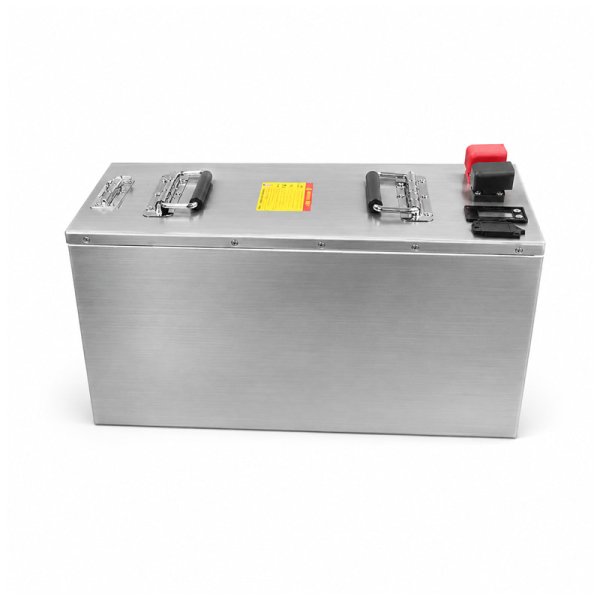
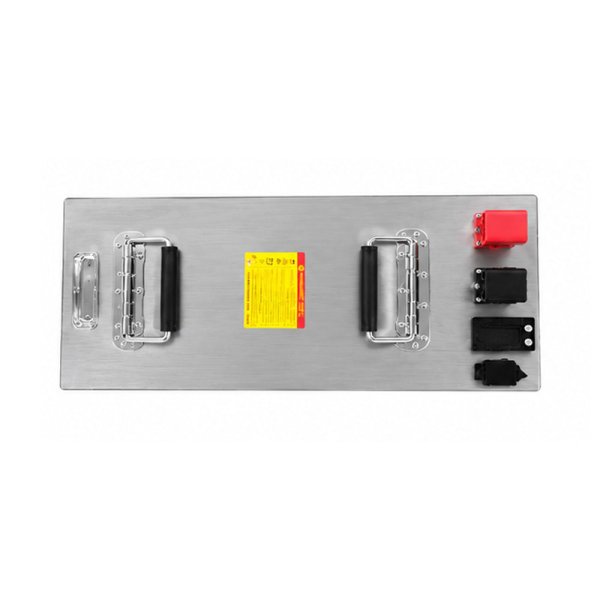
As a real product reference, the 96V 300Ah LiFePO4 pack for logistics AGVs lists 28.8kWh nominal energy, up to 200A continuous discharge, and up to 350A peak discharge, and approximately 228kg pack weight. These are published ratings, not proof that the AGV battery pack suits every heavy-load robot. Buyers still need the permitted peak duration and vehicle-level test results.

How Should OEMs Calculate AGV Battery Pack Capacity?
Start with measured average electrical power over representative loaded routes, rather than motor nameplate power or amp-hours alone. The measured power profile should include traction, lifting equipment, control electronics, and other auxiliary loads across the complete operating cycle.
Required operating energy (kWh) = average battery power (kW) × operating hours.
For example, an AGV averaging 5kW for four hours needs 20kWh of usable energy. If the design assumes an 80% usable-energy fraction, the initial nominal-energy target is 20 ÷ 0.80 = 25kWh, before additional allowances for aging or unusual conditions. The 80% figure is an illustrative planning assumption, not a published FEBATT product rating.
An oversized AGV battery pack can add mass, cost, and packaging difficulty without improving fleet throughput. Compare the calculated energy against vehicle weight limits, scheduled downtime, and the availability of permitted interim charging.
Why Is Lithium Often Suitable for Heavy-Load AGV Fleets?
LiFePO4 can be a practical chemistry for frequent industrial missions: it needs no routine electrolyte watering, offers good thermal stability, and can be designed for repeated cycling. With an appropriately rated BMS, a lithium AGV battery pack can provide useful condition data and reduce manual battery-handling tasks.

However, chemistry does not replace engineering. Continuous output, charging limits, temperature protection, and service access must match the operating plan. Prioritize dependable missions over headline capacity.
What Must OEMs Validate Before Fleet Deployment?
Pack weight and mounting space must be reviewed together with cable routing, vibration, mechanical retention, thermal performance, controller communication, and any automated battery-handling interface. FEBATT’s Korean AMR battery project illustrates why available installation space and RS485 interface requirements can shape a custom design.
For a heavy-load AGV battery pack, ask for tests covering full-payload startup, sustained ramp duty, peak-current duration, low-state-of-charge operation, and repeated loaded missions. Verify connector temperature rise and BMS fault behavior with the actual vehicle controller. IEC 62619:2022 identifies AGVs within its industrial lithium battery application scope; buyers should request evidence applicable to their particular system.
What Should B2B Buyers Include in an AGV Battery Pack RFQ?
Send suppliers an operating profile, not only a target voltage and capacity. Include maximum payload, AGV mass, route gradient, average and peak power, peak duration, target operating hours, required SOC reserve, charging method and available charging windows, installation drawing, operating temperature, BMS protocol, fleet quantity, and validation requirements.
Compare suppliers on documented current capability, fit, sample testing, delivery consistency, and after-sales response. FEBATT can review these requirements for a custom AGV battery pack, but final suitability must be confirmed against the complete vehicle and duty cycle.
Frequently Asked Questions About AGV Battery Packs
Q: How long can an AGV battery pack run with heavy loads?
A: Runtime equals usable energy divided by measured average battery power. Payload, route gradients, stops, temperature, and battery aging can change the result, so verify it in representative shifts.
Q: Why does overcurrent protection activate during startup?
A: Full-load starts, lifting, or climbing may exceed the pack’s allowed peak current or duration. Check the drive-current trace, BMS settings, voltage sag, and connector limits rather than bypassing protection.
Q: Does greater battery capacity always improve fleet performance?
A: No. Additional capacity may extend missions but adds weight, cost, and space requirements. Size usable energy to the route and shift plan, with a justified reserve.
Q: Can heavy-load AGVs use automatic battery swapping?
A: Yes, when the vehicle and swapping equipment are designed together. Confirm locking, alignment, connector life, communications, and safe isolation before deploying a swapping system.
Q: What should OEMs test before ordering AGV battery packs in bulk?
A: Test full-load startup, sustained operation, thermal rise, vibration, communication faults, and low-charge behavior on a production-representative AGV. Agree on acceptance criteria before sample approval.
For demanding factory and warehouse fleets, the right AGV battery pack is a verified match between usable energy, peak power, mechanical integration, and mission availability—not a capacity number selected in isolation.