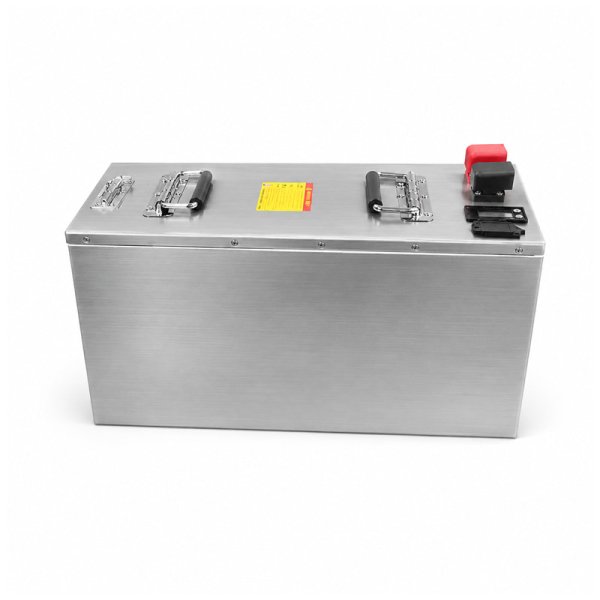
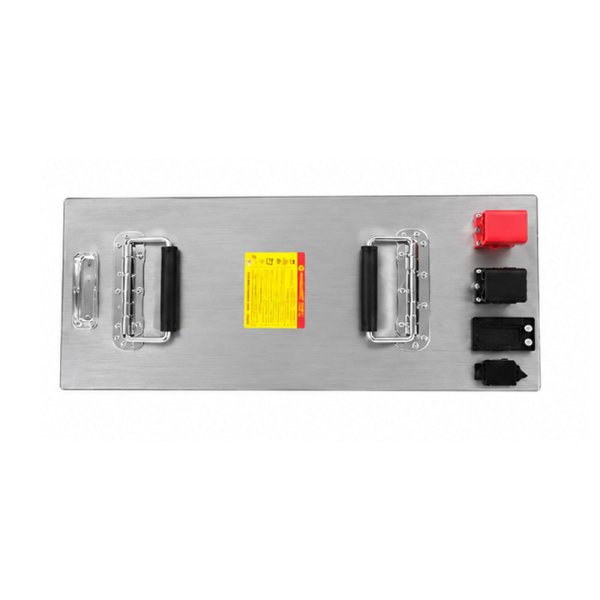
For an electric tricycle fleet, a battery that looks acceptable on a quotation can still fail under payload, repeated starts, gradients, heat, vibration, or long routes. A battery pack testing should answer one commercial question before mass production: can the approved pack complete the real duty cycle without unstable power, excessive heat, or avoidable BMS trips?
This power battery solution supports application-matched lithium packs, OEM/ODM customization, BMS integration, and project testing. For B2B buyers, the goal is not the highest advertised Ah rating. It is a lithium system proven against the vehicle, load, environment, and service plan.
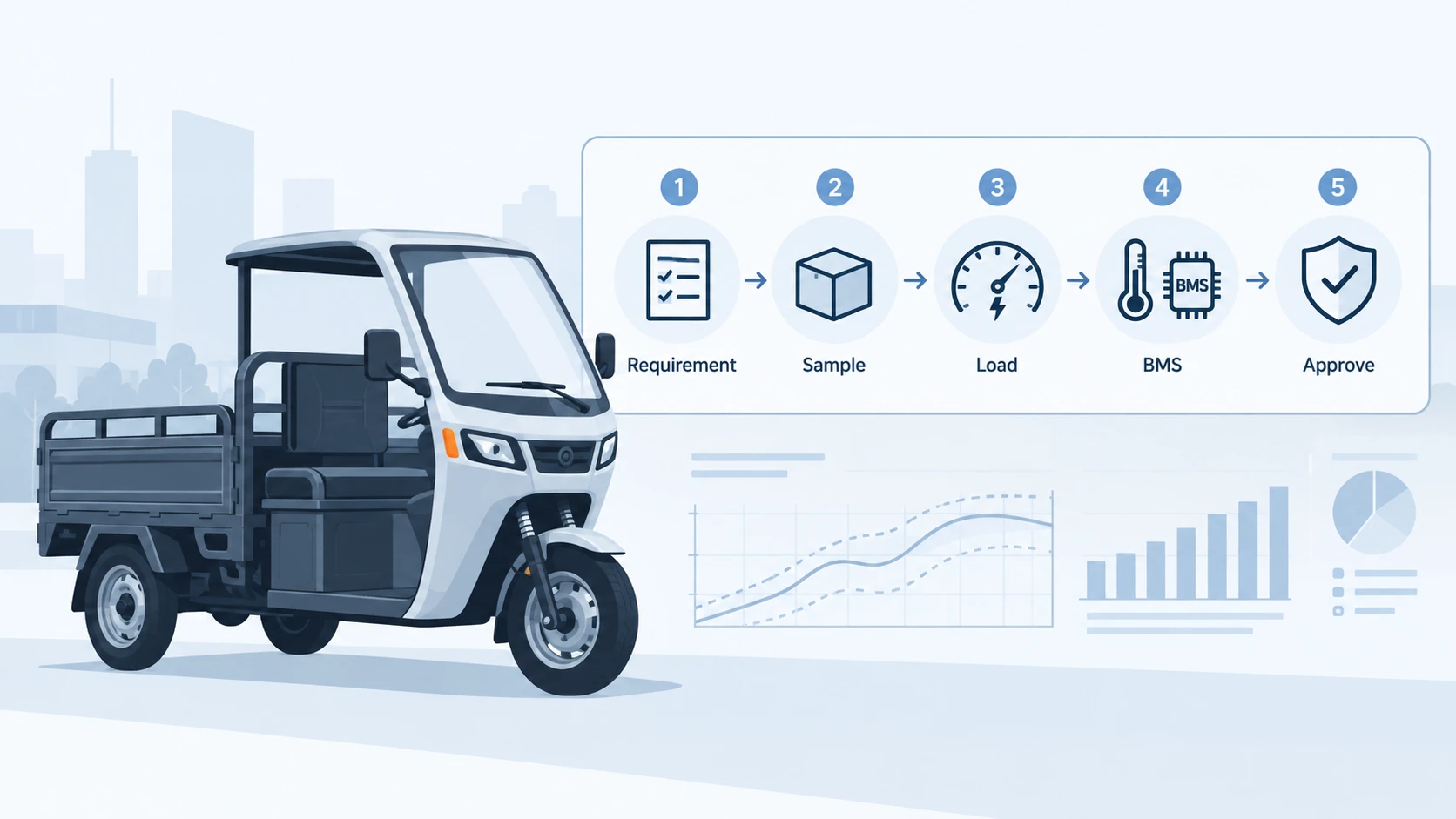
Why Should B2B Buyers Run a Battery Pack Test Before Mass Production?
A supplier sample may have the correct dimensions and nominal capacity but still be poorly matched to fleet work. A battery pack test converts sales claims into measurable acceptance evidence.
For commercial three-wheelers, LiFePO4 is often the first chemistry worth evaluating because it combines long cycling potential, thermal stability, low maintenance, and predictable high-use operation. Buyers comparing chemistry and fleet fit can review this tricycle battery guide for commercial fleets.
Testing should be completed before a volume order is frozen. A weak connector, unsuitable BMS limit, excessive voltage sag, or poor thermal behavior can later become downtime, warranty handling, and replacement cost.
What Should a Battery Pack Test Reproduce From the Real Duty Cycle?
A useful battery pack test should imitate the work the vehicle actually performs, not only a gentle constant-current discharge. For an electric tricycle battery, the profile should reflect payload, stop-start frequency, gradients, vibration, charging windows, and ambient temperature.
This broader lithium battery testing guide explains qualification versus routine production checks, but a three wheeler battery approval still needs application-specific limits.
| Fleet condition | Battery pack test focus | Buyer should review |
|---|---|---|
| Heavy cargo and hill starts | Peak current, voltage sag, temperature rise | Load curves and BMS events |
| Long daily routes | Usable energy and reserve SOC | Capacity and energy records |
| Frequent stops | Repeated peak response | Dynamic-load results |
| Rough roads | Connector, mounting and enclosure integrity | Vibration/post-test inspection |
| Hot or wet operation | Thermal response and sealing | Temperature and ingress evidence |
A battery pack test should also include a representative vehicle or validated load profile.
Which Results Matter Most During Lithium Battery Pack Testing?
During lithium battery pack testing, buyers should focus on results tied directly to fleet failure: usable capacity, continuous current, peak-current duration, voltage sag, temperature rise, and protection behavior.

Current delivery and BMS response
A heavy-load three wheeler battery can draw high current during acceleration and climbing. The battery pack test should show whether cells, busbars, cables, connectors, fuse, and BMS carry that demand without repeated protection trips or excessive heating. Fault logs should also help technicians separate battery issues from controller or wiring faults.
Capacity and thermal consistency
A lithium battery pack test should record capacity under defined temperature, current, cutoff, and rest conditions. Buyers should not accept “rated capacity” without those conditions. Abnormal temperature differences can indicate a weak connection, undersized conductor, inconsistent cells, or unsuitable packaging.
UN 38.3 is important for lithium battery transport, but it does not replace vehicle-level battery pack testing. The UN Manual of Tests and Criteria treats Section 38.3 as transport classification testing, so application validation remains a separate requirement.
Why Is LiFePO4 Often a Better Choice for Commercial Three-Wheelers?
For high-frequency cargo and delivery work, lithium—especially LiFePO4—often provides a stronger operating case than lead-acid because it reduces maintenance and supports frequent cycling with high usable energy.
Across the broader battery market, the IEA reported that average LFP pack prices were more than 40% lower per kWh than NMC alternatives in 2025, although the comparison spans multiple applications and should not be treated as a direct price benchmark for electric-tricycle packs. It also reports latest-generation LFP cells at up to about 205 Wh/kg, compared with about 265 Wh/kg for NMC. NMC therefore retains an energy-density advantage, while LFP can offer a favorable cost, cycling, and thermal-stability balance when compactness is not the main constraint.

A battery pack test is still necessary. Chemistry cannot compensate for poor BMS settings, weak connectors, inadequate enclosure design, or a pack never validated against real load.
How Should Buyers Turn Battery Pack Test Results Into Purchase Criteria?
The final battery packs test should end with a clear pass/fail decision. Procurement and engineering should agree on limits before testing starts.
The approval package should identify the tested configuration, cell source, BMS firmware, sample serial number, test conditions, results, deviations, and corrective actions. It should also state which checks repeat on every production unit and which apply only to qualification samples.
If cells, BMS hardware, firmware, connectors, enclosure materials, or critical assembly processes change, the supplier should define whether the battery pack test must be repeated.
A disciplined battery pack test gives B2B buyers more than a low factory price: evidence that the lithium pack can support payload, uptime targets, and repeatable production before fleet-scale risk begins.
Frequently Asked Questions About Battery Packs
Q: What is battery pack testing?
A: A battery pack testing checks whether a completed pack meets electrical, thermal, protection, mechanical, and application requirements before approval or shipment. For B2B vehicle projects, battery pack testing should use documented conditions and measurable acceptance limits rather than a simple “pass” label.
Q: How do you test a lithium battery pack?
A: To test a lithium battery pack normally combines capacity checks, load testing, temperature monitoring, BMS protection verification, communication checks, and application-level validation. A battery pack test should use defined conditions and pass/fail limits.
Q: What tests are performed on battery packs?
A: Typical battery pack testing includes usable-capacity verification, current-load testing, voltage-sag measurement, thermal monitoring, BMS protection checks, communication validation, and mechanical or environmental tests appropriate to the application.
Q: How do you test battery capacity?
A: Capacity should be measured under a defined charge method, discharge current, temperature, cutoff condition, and rest period. For an electric tricycle battery, buyers should also confirm that usable energy remains sufficient under representative vehicle loads rather than relying only on nominal Ah.
Q: Why should OEMs test battery packs before mass production?
A: Pre-production battery pack testing helps OEMs find integration or performance problems while they are limited to samples. A battery pack test can therefore reduce fleet-wide downtime, warranty claims, rework, and uncontrolled design changes.