Which 24V Truck Battery Is Better: 100Ah, 200Ah or 300Ah?
Choosing the right 24V truck battery is not only about buying the largest capacity available. For truck parking power, sleeper cab comfort, parking air conditioning, and auxiliary electrical loads, the best choice depends on runtime needs, power consumption, charging conditions, installation space, and fleet operating habits.
Why Does 24V Truck Battery Capacity Matter for Parking Power?
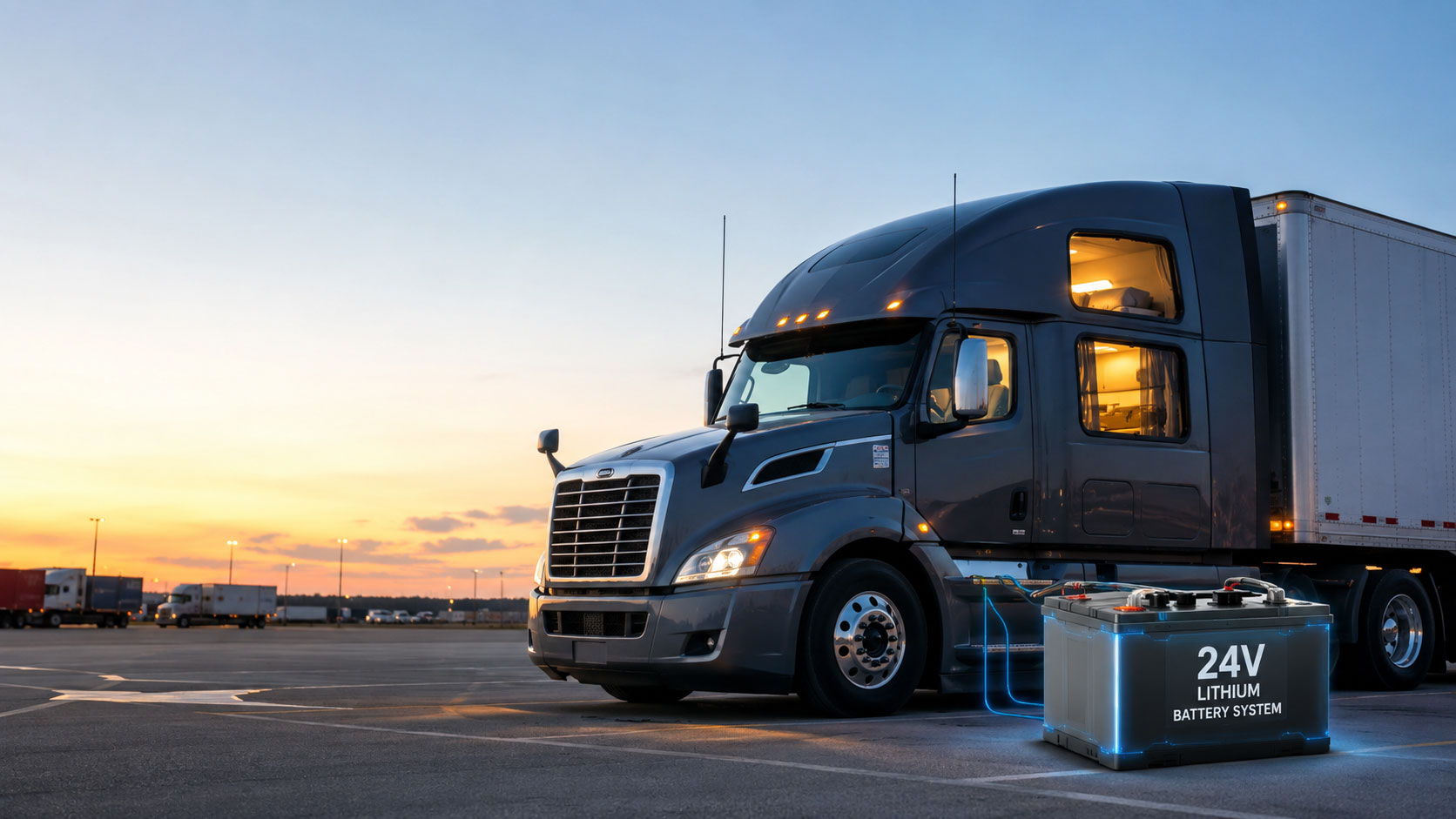
A 24V truck battery is often used to power electrical loads when the main engine is turned off. These loads may include a parking air conditioner, cab fan, refrigerator, lights, phone chargers, communication devices, small inverter loads, and other sleeper cab equipment.
For long-haul drivers and fleet operators, this matters because engine idling is expensive. The U.S. Department of Energy’s Alternative Fuels Data Center notes that many long-haul heavy-duty trucks idle during rest periods, and idle reduction options can help provide climate control, lighting, electronics power, better air quality, and reduced noise.
This is why the capacity of a 24V truck battery should match the real parking load. If the battery is too small, the driver may still need to idle the engine during long rest breaks. If the battery is too large, the fleet may pay for extra capacity that is not always needed.
The goal is not simply to choose 100Ah, 200Ah, or 300Ah. The goal is to choose the right battery size for the truck’s actual working conditions.
What Is the Difference Between a 24V 100Ah, 24V 200Ah and 24V 300Ah Truck Battery?
The main difference is stored energy. For lithium truck battery systems, a nominal 24V battery is usually built around a 25.6V LiFePO4 platform. That means the approximate energy is:
| Battery Capacity | Approx. Energy | Common Use Level |
| 24V 100Ah | About 2.56 kWh | Light auxiliary loads |
| 24V 200Ah | About 5.12 kWh | Medium parking power |
| 24V 300Ah | About 7.68 kWh | Long runtime and parking AC |
A 24V truck battery with 100Ah capacity may be enough for basic cab loads, but it may not be ideal for long hours of air conditioning. A 200Ah battery offers a stronger balance between capacity, cost, size, and runtime. A 300Ah battery is usually more suitable for trucks that need longer overnight power or parking air conditioner support.
In simple terms:
- 100Ah is for light use.
- 200Ah is for balanced use.
- 300Ah is for long parking hours and higher-power loads.

Is a 24V 100Ah Truck Battery Enough for Light Cab Loads?
A 24V 100Ah battery can work well when the truck only needs to support low or moderate loads. This may include LED lighting, phone charging, small fans, communication equipment, and a refrigerator or cooler.
For drivers who only need short rest-period power, a 100Ah 24V truck battery can be a practical option. It is usually smaller, lighter, easier to install, and more cost-effective than higher-capacity models.
However, the limitation is runtime. If the truck needs to run a parking air conditioner for several hours, a 100Ah battery may not be enough. Air conditioning is usually the largest electrical load in a sleeper cab. Even if the parking AC is efficient, it can drain a smaller battery much faster than lights or chargers.
A 24V 100Ah truck battery is better for:
- Short parking periods
- Basic sleeper cab loads
- Refrigerators or coolers
- LED lighting
- Communication equipment
- Small auxiliary devices
- Trucks with limited installation space
It may not be the best choice for:
- Full-night parking air conditioner use
- Hot climate operation
- Long-haul trucks with heavy sleeper cab loads
- Fleet vehicles that need consistent overnight runtime
If the buyer’s main requirement is “basic auxiliary power,” 100Ah may be enough. If the requirement is “comfortable overnight rest without idling,” a larger 24V truck battery is usually safer.
When Is a 24V 200Ah Truck Battery the Better Choice?
A 24V 200Ah battery is often the most balanced option for truck parking applications. It provides more usable energy than 100Ah without becoming as large or expensive as 300Ah.
For many fleets, a 200Ah 24V truck battery can support a mix of common sleeper cab loads, such as lighting, refrigerator, electronics, fans, and moderate air conditioning use. It gives drivers more confidence during rest breaks and reduces the chance of the battery running out too quickly.
This capacity is especially useful when the truck has regular parking periods but does not always need the air conditioner running at maximum power for the entire night.
A 24V 200Ah truck battery is suitable for:
- Medium sleeper cab power demand
- Trucks with refrigerator and lighting loads
- Moderate parking air conditioner use
- Drivers who need longer rest-period power
- Fleet operators looking for a cost-performance balance
- Auxiliary power systems where space and weight still matter
For many B2B buyers, 200Ah is the “safe middle choice.” It can cover more scenarios than 100Ah and may offer better ROI than choosing 300Ah for every truck.
But it still depends on the load. If the truck regularly operates in hot weather and the parking AC needs to run through the night, 200Ah may still be limited. In that case, a 300Ah 24V truck battery is often more reliable.

Why Is a 24V 300Ah Truck Battery Better for Parking Air Conditioning?
A 24V 300Ah battery is designed for higher energy demand. It is usually the better choice when the truck needs to power a parking air conditioner for longer periods, especially during overnight rest.
Parking air conditioning can be demanding because it does not run like a small electronic device. It may start with a higher power draw, cycle on and off, and consume more energy when the outside temperature is high. If the battery capacity is too small, the driver may still need to restart the engine, which defeats the purpose of using a truck parking battery system.
A 300Ah 24V truck battery gives the system more energy reserve. This helps support:
- Longer sleeper cab cooling time
- More stable overnight power
- Reduced engine idling
- Better driver comfort
- More confidence in hot weather
- Higher-power auxiliary loads
- Fleet vehicles with demanding rest-period use
For long-haul trucks, sleeper cabs, and idle-reduction projects, 300Ah is often the strongest option. It is not always necessary for every vehicle, but it makes sense when runtime and comfort are more important than the lowest upfront cost.
If the truck’s main pain point is “the driver needs cooling through the night,” then a 24V 300Ah truck battery should be seriously considered.
The California Air Resources Board explains that battery-electric auxiliary power systems use advanced battery packs to provide heating, cooling, and electrical power to ancillary cab appliances.
How Can You Estimate Runtime Before Choosing a 24V Truck Battery?
Before choosing a 24V truck battery, buyers should estimate the expected runtime. The basic calculation is:
Battery Energy ÷ Load Power = Estimated Runtime
For example, if a 24V 200Ah LiFePO4 battery has about 5.12 kWh of energy and the average load is 500W, the theoretical runtime is about 10 hours. In real use, the actual runtime may be lower because of inverter loss, temperature, battery protection limits, and changing load conditions.
Here is a simple reference:
| Average Load | 24V 100Ah | 24V 200Ah | 24V 300Ah |
| 200W light loads | Long runtime | Very long runtime | Extended runtime |
| 500W mixed loads | Moderate runtime | Good runtime | Long runtime |
| 800W parking AC load | Shorter runtime | Moderate runtime | Better runtime |
| 1000W+ heavy load | Limited use | Load-dependent | Stronger option |
This table should only be used as a general guide. The exact runtime depends on air conditioner efficiency, compressor cycling, inverter efficiency, wiring, battery age, and ambient temperature.
For accurate selection, fleet buyers should list all parking loads first:
- Parking air conditioner wattage
- Refrigerator wattage
- Fan wattage
- Lighting load
- Electronics and charging load
- Inverter load
- Expected parking hours
- Charging time during driving
Once these numbers are clear, choosing the right 24V truck battery becomes much easier.

How Does a Lithium 24V Truck Battery Compare With Lead-Acid?
For truck parking applications, lithium batteries usually perform better than lead-acid batteries. The reason is simple: parking power requires repeated charge and discharge cycles, and lead-acid batteries do not handle deep discharge as well as LiFePO4 batteries.
A lithium 24V truck battery can offer higher usable capacity, better cycle life, lighter weight, faster charging, and more stable voltage output. It can also include an intelligent BMS to protect against overcharge, over-discharge, overcurrent, short circuit, and temperature issues.
Lead-acid batteries may have a lower upfront cost, but they can become expensive over time if they are frequently discharged during long parking hours. They may also deliver weaker runtime as they age, especially under heavy auxiliary loads.
For fleets, the comparison should not only focus on purchase price. It should include:
- Usable capacity
- Cycle life
- Replacement frequency
- Charging efficiency
- Weight
- Maintenance needs
- Driver comfort
- Downtime risk
- Total cost over time
If a truck only needs occasional light power, lead-acid may still be used in some cases. But for serious parking air conditioner use, sleeper cab comfort, and idle reduction, a lithium 24V truck battery is usually the better long-term solution.
What Should Fleets Check Before Buying a 24V Truck Battery?
Fleet buyers should not choose a battery only by the Ah number. A reliable 24V truck battery needs to match the full vehicle power system.
The first point is real load demand. A truck with only lights and a refrigerator does not need the same battery as a truck running a parking air conditioner overnight. The buyer should define the load before selecting capacity.
The second point is charging method. The battery may charge through the alternator, DC-DC charger, external charger, or other system design. If the charging system is too weak, even a large battery may not be fully charged before the next rest period.
The third point is installation space. A 300Ah battery provides more energy, but it also requires more space and proper mounting. Fleets should check battery dimensions, cable routing, ventilation conditions, service access, and vibration resistance.
The fourth point is BMS protection. A professional truck battery should include reliable BMS protection because vehicle environments can be demanding. Overcurrent, short circuit, high temperature, low temperature, and over-discharge protection are all important.
The fifth point is supplier support. For B2B projects, buyers may need customized voltage, capacity, casing, connectors, communication functions, or mounting structure. A supplier that understands truck parking applications can help reduce selection mistakes.
Which 24V Truck Battery Is Best for Different Applications?
The best 24V truck battery depends on the application. There is no single capacity that fits every truck.
For light auxiliary power, 100Ah is usually enough. It works for trucks that only need lights, small electronics, communication devices, or a cooler during shorter parking periods.
For mixed sleeper cab loads, 200Ah is often the best balance. It gives more runtime than 100Ah and can support more realistic rest-period use without making the system too large.
For parking air conditioning and longer overnight power, 300Ah is usually the better choice. It provides stronger energy reserve and reduces the risk of drivers needing to idle the engine for comfort.
A practical selection guide looks like this:
| Application | Recommended Option |
| Basic lighting and electronics | 24V 100Ah |
| Refrigerator, lights, fan, small inverter | 24V 100Ah or 200Ah |
| Mixed sleeper cab loads | 24V 200Ah |
| Moderate parking AC use | 24V 200Ah or 300Ah |
| Overnight parking AC | 24V 300Ah |
| Fleet idle-reduction projects | 24V 200Ah or 300Ah |
| Hot weather, long rest periods | 24V 300Ah |
For most fleets, the decision comes down to one question: how long does the truck need to stay comfortable with the engine off?
If the answer is only a few hours, 100Ah may be enough. If the answer is most of the night, 200Ah or 300Ah is safer. If parking AC is the main load, 300Ah usually gives the best performance margin.

How Can Febatt Help You Choose the Right 24V Truck Battery?
Choosing between 24V 100Ah, 24V 200Ah, and 24V 300Ah is not just a product comparison. It is a system selection decision. The right 24V truck battery should match the truck’s real parking loads, expected runtime, charging method, installation space, and operating environment.
Febatt provides lithium truck battery solutions for parking power, sleeper cab comfort, auxiliary loads, and idle-reduction applications. For fleet operators, distributors, and vehicle system integrators, Febatt can help match battery capacity, BMS protection, charging compatibility, and structural design according to real project requirements.
If your fleet needs a reliable 24V truck battery for parking air conditioning, overnight cab power, or lead-acid replacement, Febatt can support capacity selection from 100Ah to 300Ah and provide customized LiFePO4 battery solutions for demanding truck applications.
Contact Febatt to discuss your truck battery project and choose the right 24V battery capacity for your fleet.