Battery selection affects far more than driving range. For a commercial golf-cart fleet, the battery influences vehicle availability, maintenance labor, charging schedules, passenger service, replacement planning, and total cost of ownership. That is why procurement teams increasingly evaluate LiFePO4 golf cart battery benefits as part of a wider fleet-performance strategy rather than as a simple comparison of purchase prices.
Lithium iron phosphate batteries can provide long cycle life, stable voltage, lower routine maintenance, and faster energy recovery when the pack, charger, controller, and vehicle are correctly matched. However, no benefit should be treated as universal. Actual results depend on the cell model, pack design, depth of discharge, temperature, current demand, charging limits, and warranty conditions. This guide explains the practical LiFePO4 golf cart battery benefits for golf courses, resorts, campuses, factories, airports, hospitality fleets, and OEM vehicle projects while keeping the technical limits clear.
What Is a LiFePO4 Golf Cart Battery?
A LiFePO4 golf cart battery is a rechargeable traction battery that uses lithium iron phosphate as its cathode chemistry. A commercial pack normally combines multiple cells, a Battery Management System (BMS), electrical protection, a metal or engineered polymer enclosure, power connectors, communication wiring, and a matched charging interface.
The chemistry is only one part of the system. Reliable LiFePO4 golf cart battery benefits depend on the quality of the cells, mechanical construction, busbars, insulation, fusing, BMS settings, charger profile, and vehicle integration. A well-designed BMS monitors cell voltage, pack current, and temperature. Depending on its hardware and programming, it may also balance cells, log faults, estimate state of charge, control contactors, and communicate through CAN or RS485.
Golf-cart batteries are sold in several voltage classes, including 24V-class, 36V, 48V-class, 51.2V, and 72V systems. The market label is not enough for system approval. Buyers must compare the complete voltage range, including the maximum charge voltage and discharge cutoff, with the controller, motor, charger, display, and regenerative-braking limits.
Why Are LiFePO4 Golf Cart Battery Benefits Important to Commercial Fleets?
Commercial fleets value predictable availability. A golf cart that cannot complete its route, requires frequent watering, or loses climbing performance during a shift creates labor and service problems that are larger than the battery invoice.
The main LiFePO4 golf cart battery benefits are operational:
- Longer service potential when operated within approved limits
- Stable voltage through much of the discharge cycle
- Lower routine maintenance than flooded lead-acid systems
- Faster charging when the pack and charger support the required current
- Lower installed weight in many vehicle designs
- BMS-based monitoring and protection
- More usable energy from a correctly sized pack
- Better support for partial charging and multi-shift schedules
These advantages can reduce downtime and replacement frequency, but fleet managers should measure them against real route data. Vehicle mass, passenger load, hills, tire pressure, accessory power, average speed, temperature, and driving behavior all affect the result.
How Does Longer Cycle Life Improve Fleet Economics?
Cycle life is one of the most valuable LiFePO4 golf cart battery benefits, but it is also one of the most commonly misused specifications. A cycle rating has little meaning unless the supplier states the depth of discharge, charge and discharge rates, temperature, and end-of-life capacity threshold.
As a product-specific example, Trojan publishes 4,000 cycles at 70% depth of discharge for its OnePack Extended Range battery. FEBATT publishes a 4,500-cycle rating for its 24V-class 105Ah product, but the public specification does not state the complete test conditions. A B2B buyer should therefore request the test report, cell model, retained-capacity endpoint, and pack-level warranty before using the number in a financial model.
A longer cycle life can reduce:
- Replacement purchases over the ownership period
- Technician labor for battery swaps
- Vehicle downtime during replacement
- Freight and disposal handling
- Spare-battery inventory requirements
- Budget volatility across a large fleet
The economic value depends on annual usage. A lightly used private cart and a resort shuttle completing several routes every day will not reach the same cycle count at the same time. Calendar aging also continues when the vehicle is not operating, so years of service should never be calculated from cycles alone.

How Do Stable Voltage and Current Improve Golf Cart Performance?
Stable output is another of the practical LiFePO4 golf cart battery benefits. Lead-acid voltage typically declines more noticeably as the battery discharges, while a correctly engineered LiFePO4 pack maintains a flatter voltage profile through much of its usable state-of-charge range.
For the driver, this can support more consistent acceleration and hill climbing. For the fleet manager, it improves route predictability because a cart is less likely to feel strong at the start of a shift and weak near the end. The result still depends on the controller, motor, gearing, tire size, and BMS current limits.
Continuous and peak current must be reviewed separately. The referenced FEBATT 51.2V 105Ah pack publishes 105A continuous discharge and 120A instantaneous discharge. Those values may be suitable for a particular vehicle, but they must be compared with measured startup current, climbing current, passenger load, accessories, and regenerative braking. A battery with enough energy can still shut down if its BMS current limit is below the vehicle demand.
Why Does Lower Battery Weight Matter?
Weight reduction is one of the most visible LiFePO4 golf cart battery benefits, although the exact difference depends on the lead-acid bank and lithium replacement being compared. Some vehicle manufacturers publish substantial model-specific reductions. Club Car, for example, states that one commercial lithium vehicle configuration is nearly 400 pounds lighter than its comparable lead-acid version. That figure should not be applied to every cart, but it shows why weight must be considered at vehicle level.
Lower battery mass can provide several advantages:
- Less energy required for acceleration
- Improved steering and braking response
- Reduced stress on suspension and tires
- More available payload within the chassis rating
- Easier installation and service handling
- Greater flexibility for OEM packaging
Weight should not be reduced without checking vehicle stability and axle loading. In some industrial vehicles, battery mass contributes to balance. Golf carts generally benefit from lower weight, but the vehicle manufacturer or integrator should approve the final installation.

How Does Faster Charging Improve Fleet Availability?
Faster charging is frequently listed among LiFePO4 golf cart battery benefits, but charging time must be calculated from the specific battery and charger. Capacity alone does not determine charging speed. The approved charging current, starting state of charge, temperature, balancing behavior, charger efficiency, and current taper near full charge all matter.
For a real product example, FEBATT publishes a maximum charging current of 50A for its 51.2V 105Ah pack. A simple capacity-to-current calculation suggests slightly more than two hours for 105Ah divided by 50A, but actual charging takes longer because current may be reduced during part of the session. Club Car publishes model-specific lithium charging times of approximately 2.8 to 3.7 hours for one 3.1kWh vehicle system, depending on charger power.
Lorem ipsum dolor sit amet, consectetur adipiscing elit. Ut elit tellus, luctus nec ullamcorper mattis, pulvinar dapibus leo.
Commercial fleets can use shorter charging periods to support:
- Overnight charging with less idle time
- Midday top-ups during breaks
- Higher vehicle utilization across consecutive shifts
- Smaller spare-vehicle requirements
- Better recovery after unplanned high-energy routes
Opportunity charging must remain within the battery and charger limits. Fast charging at very low temperature, high temperature, or excessive state of charge can increase stress or trigger BMS protection. The approved charge current should come from the pack datasheet, not from a generic lithium-battery assumption.
What Maintenance Savings Can Fleets Expect?
Reduced routine service is one of the clearest LiFePO4 golf cart battery benefits for fleets replacing flooded lead-acid systems. A sealed lithium pack does not require electrolyte watering, acid handling, or equalization charging. This can reduce scheduled labor, operator error, corrosion cleanup, and ventilation concerns associated with flooded batteries.
Lower maintenance does not mean no inspection. A responsible fleet should still check:
- Cable tightness and connector condition
- Fuse and contactor condition
- Enclosure damage or water ingress
- Mounting brackets and vibration points
- Charger operation and fault history
- BMS alerts and temperature records
- Cooling or heating components, where installed
The maintenance advantage is therefore better described as fewer electrochemical service tasks and more data-based inspection. This shift helps technicians focus on the electrical system and vehicle condition instead of routine watering and acid cleanup.
How Does the BMS Support Safety and Battery Life?
BMS protection is central to LiFePO4 golf cart battery benefits. The BMS monitors the battery and can restrict or interrupt operation when voltage, current, or temperature exceeds programmed limits. It does not make an unsuitable installation safe, but it provides an essential protection layer.
The FEBATT 51.2V 105Ah product publishes protection against short circuit, overcharge, over-discharge, overcurrent, and over-temperature, with CAN and RS485 communication. Its charging range is listed as 0°C to 55°C and discharge range as -20°C to 55°C. The FEBATT 24V-class 105Ah product publishes a charging range of 0°C to 45°C and discharge range of -20°C to 60°C.
These differences show why buyers must review the exact model. Low-temperature discharge capability does not automatically mean low-temperature charging is permitted. A heater should not be assumed unless it is explicitly included in the approved specification.

Which Voltage and Capacity Are Best for a Commercial Fleet?
The correct configuration depends on vehicle architecture and route energy. A 24V-class pack is not a direct substitute for a 36V or 48V traction system. Series connection should be used only when the manufacturer confirms that the BMS and pack are designed for it.
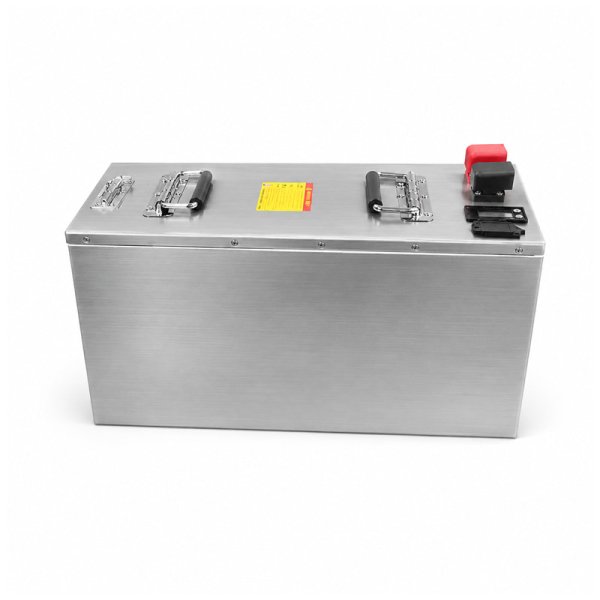
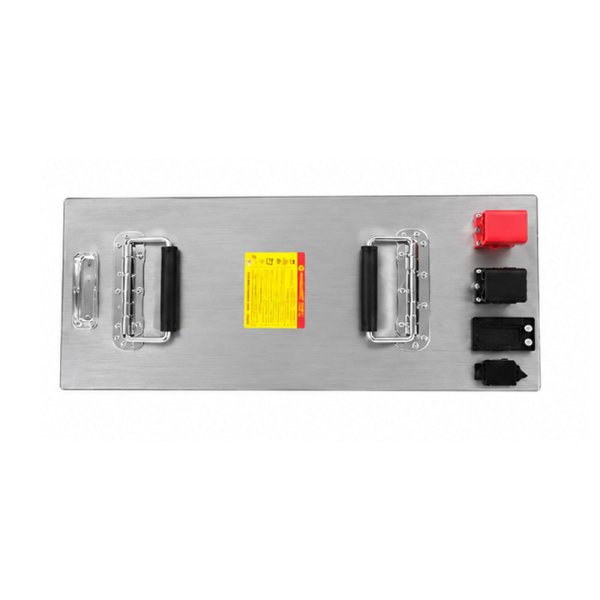
The FEBATT 51.2V 105Ah product is configured as 16S1P and publishes 51.2V nominal voltage, 105Ah capacity, 58.4V charging voltage, 105A continuous discharge, 120A instantaneous discharge, dimensions of 240 x 300 x 460mm, and weight of no more than 54kg. Its nominal energy is 51.2V x 105Ah = 5.376kWh.
FEBATT also lists a 24V-class 105Ah pack with 2.688kWh of energy and 30kg weight. Because 2.688kWh divided by 105Ah equals 25.6V, buyers should confirm whether the finalized electrical datasheet uses a 24V market-class label or a 25.6V nominal rating. This is an important example of why procurement teams should verify calculations rather than copying product names into vehicle specifications.
To estimate required capacity:
Required battery energy = route distance x measured vehicle consumption
Add reserve for gradients, passenger load, temperature, accessories, aging, and schedule variation. Then divide the target watt-hours by the verified nominal voltage to estimate amp-hours. Final approval should come from a loaded route test, not a generic mileage promise.
How Do LiFePO4 Batteries Compare with Lead-Acid Batteries?
A comparison helps convert LiFePO4 golf cart battery benefits into purchasing criteria.
LiFePO4 systems generally offer lower routine maintenance, more stable voltage, lower installed weight, faster approved charging, and longer cycle-life potential. Lead-acid systems often have a lower initial price and may already match legacy chargers and vehicle layouts.
The practical decision depends on the complete system:
- Purchase price and charger cost
- Expected annual cycles
- Replacement labor and downtime
- Electricity consumption
- Usable energy and route reserve
- Vehicle compatibility
- Warranty limits
- Recycling and end-of-life handling
A lithium conversion may provide strong value for high-utilization fleets, but a low-use cart may take longer to recover the higher initial investment. The buyer should compare cost per operating hour or cost per delivered kilowatt-hour rather than battery price alone.
How Can Buyers Calculate Total Cost of Ownership?
| Comparison factor | Flooded lead-acid | LiFePO4 system |
|---|---|---|
| Routine service | Watering, cleaning, and electrolyte checks may be required | No watering; electrical and mechanical inspection still required |
| Voltage behavior | More noticeable voltage decline during discharge | Flatter voltage profile through much of the usable range |
| Charging | Depends on charger and bank size; often longer recovery | Can support shorter charging when pack and charger limits permit |
| Weight | Higher mass for a comparable vehicle energy system | Often lower installed mass; verify vehicle balance and axle loading |
| Lifecycle evaluation | Lower initial price may suit low-use fleets | Higher initial cost can be offset by lower maintenance and fewer replacements |
Total cost of ownership converts LiFePO4 golf cart battery benefits into a business case. A useful calculation includes:
TCO = battery purchase + charger and installation + energy + maintenance + downtime + replacements + logistics – residual value
Then compare the result with operating hours, passenger trips, route kilometers, or delivered energy over the planned ownership period.
For example, a fleet should estimate how many lead-acid replacements would be required during the expected service period, how much technician time is spent on watering and inspection, and how many vehicle-hours are lost to charging or maintenance. The lithium option should include the approved charger, electrical modifications, monitoring, and any installation engineering.
Avoid using a cycle rating without its test conditions. Also avoid assuming that the battery will remain in service for a fixed number of years. A credible model uses a range of outcomes and includes conservative assumptions for temperature, annual utilization, and capacity fade.
What Should B2B Buyers Verify Before Ordering?
Capturing the full LiFePO4 golf cart battery benefits requires a supplier that can support engineering, quality control, and after-sales service. Procurement teams should request:
- Exact cell manufacturer and cell model
- Nominal and maximum battery voltage
- Continuous, peak, and instantaneous current limits
- Approved charger voltage and current
- Charging and discharging temperature ranges
- BMS protection thresholds and communication protocol
- Cycle-test conditions and retained-capacity endpoint
- Pack drawing, dimensions, weight, mounting, and connector details
- 3 test summary and required shipping documents
- Production test records and serial-number traceability
- Warranty years, cycle limits, exclusions, and claim process
- Change-control procedure for cells, BMS, connectors, and firmware
OEM and fleet buyers can review FEBATT’s commercial LiFePO4 golf cart batteries to compare available voltage and capacity classes. For a common 48V-class architecture, the 51.2V 105Ah lithium battery for golf carts provides published electrical and mechanical data for preliminary integration review. For vehicles designed around a lower-voltage platform, the 24V-class 105Ah LiFePO4 golf cart battery can be evaluated after confirming the exact nominal voltage, charger, current demand, and series-connection limitations.
FAQ About LiFePO4 Golf Cart Battery
1.How long do LiFePO4 golf cart batteries typically last?
There is no single guaranteed lifespan. Service life depends on cell quality, depth of discharge, charge and discharge rates, temperature, storage, current demand, and the supplier’s end-of-life definition. Trojan publishes 4,000 cycles at 70% depth of discharge for one specific OnePack model, while FEBATT publishes 4,500 cycles for its 24V-class 105Ah product without full public test conditions. Buyers should request the complete cycle-test report and warranty terms for the selected pack. Ten years may be achievable for some products and duty cycles, but it should not be treated as a universal promise.
2.Can a LiFePO4 battery directly replace a lead-acid golf-cart battery?
It may replace a compatible lead-acid system after a complete engineering review. Confirm the full voltage range, charger profile, controller limits, continuous and peak current, regenerative braking, fuse and cable ratings, connector polarity, dimensions, mounting, display behavior, and BMS communication. A lithium pack should not be called a drop-in replacement solely because the market voltage or case size appears similar.
3.What capacity is best for a commercial golf-cart fleet?
The best capacity is the smallest pack that meets the loaded route, reserve, current, charging-window, weight, and service-life requirements. Calculate route energy from measured Wh/km or Wh/mile, add reserve for hills, payload, temperature, accessories, and aging, and validate the result on the vehicle. A 105Ah pack can be suitable for many projects, but the same capacity can produce different range in different carts.
4.How should businesses calculate total cost of ownership?
Add the battery, charger, installation, energy, maintenance, downtime, replacements, logistics, warranty administration, and end-of-life costs over the planned ownership period. Divide by operating hours, route distance, passenger trips, or delivered energy. The calculation should use verified cycle-test and warranty conditions rather than marketing claims.
5.What factors determine battery lifespan?
The main factors are cell quality, depth of discharge, time spent at very high or low state of charge, charge current, discharge current, battery temperature, storage conditions, vibration, charger compatibility, BMS settings, and manufacturing consistency. Good operating practices cannot compensate for an undersized or incompatible pack, so correct specification and supplier validation come first.
Conclusion
The strongest LiFePO4 golf cart battery benefits are not isolated laboratory claims. They appear in daily operations as more consistent power, fewer routine maintenance tasks, shorter approved charging periods, lower installed weight, and longer service potential. These advantages can improve fleet availability and reduce lifecycle cost when the battery is matched to the vehicle and duty cycle.
B2B buyers should base decisions on verified voltage, energy, current, temperature, cycle-test, BMS, mechanical, and warranty data. By combining route measurements, engineering review, sample testing, and a realistic TCO model, fleet operators and OEMs can capture LiFePO4 golf cart battery benefits without relying on unsupported range or lifespan promises.