For a warehouse fleet, an industrial AGV battery fails its assignment when a stalled vehicle blocks the next pallet move. Repeated starts and variable loads expose weaknesses hidden by catalogue specifications. The right industrial AGV battery must support the actual transport mission, communicate with vehicle controls and fit the maintenance plan. For busy fleets, LiFePO4 can outperform lead-acid in maintenance, partial charging and service life. A delayed vehicle can disrupt an entire sequence of automated handoffs.
Where Do Material-Handling Fleets Lose Battery Time?
One industrial AGV battery specification rarely suits every task. Under-riding vehicles face tight packaging limits; pallet carriers encounter repeated acceleration; tugger AGVs draw sustained traction power; lifting AGVs must manage brief current peaks. Classify routes by payload, stops, gradients and idle windows before requesting quotes. Include the busiest shift, not only average daily throughput.
| Fleet task | Operating pressure | Buyer priority |
|---|---|---|
| Frequent pallet transfers | Stop-start current and queue delays | Power stability and fault visibility |
| Long tugger routes | Sustained traction and fewer idle windows | Usable energy and thermal limits |
| Lifting or compact AGVs | Short peaks or restricted space | Current response and mechanical fit |
This task-based view prevents an industrial AGV battery from being oversized for one vehicle and underpowered for another.
Why Is Lithium Often Better for Busy AGV Fleets?
Unlike flooded lead-acid, an industrial AGV battery using lithium avoids watering and supports approved between-mission top-ups. LiFePO4 offers thermal stability and cycle-life potential; results depend on duty cycle and temperature. With compatible equipment, partial charging can fit between missions rather than require a full shift change.

Packaging, vehicle balance, charging windows, and controller compatibility still matter. For industrial material-handling fleets, this industrial robot battery chemistry comparison explains for you about where LiFePO4 and NMC trade energy density against operating priorities. Buyers should validate these requirements under representative operating conditions before approving a fleet-wide configuration.
How Should Operating Data Define the Battery Requirement?
Log representative loaded routes; check usable energy and sustained/peak current. For illustration, 500 W average draw over eight hours consumes 4.0 kWh before losses and reserves. The industrial AGV battery must be validated against real route data. Compare logged loads from peak production days and the slowest, most demanding routes.

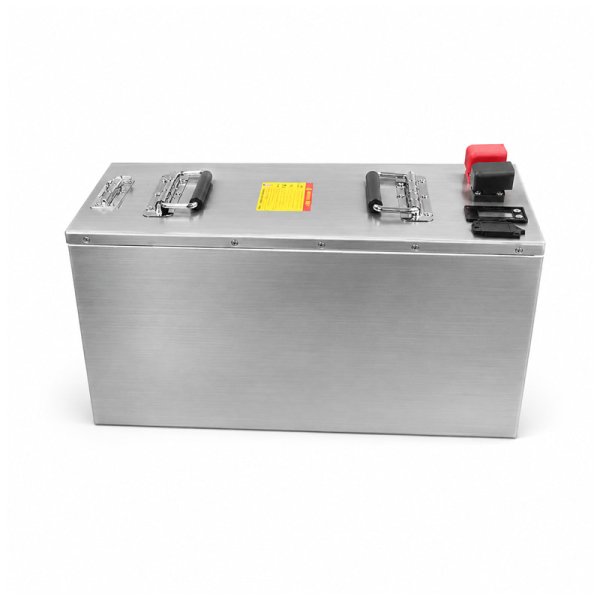
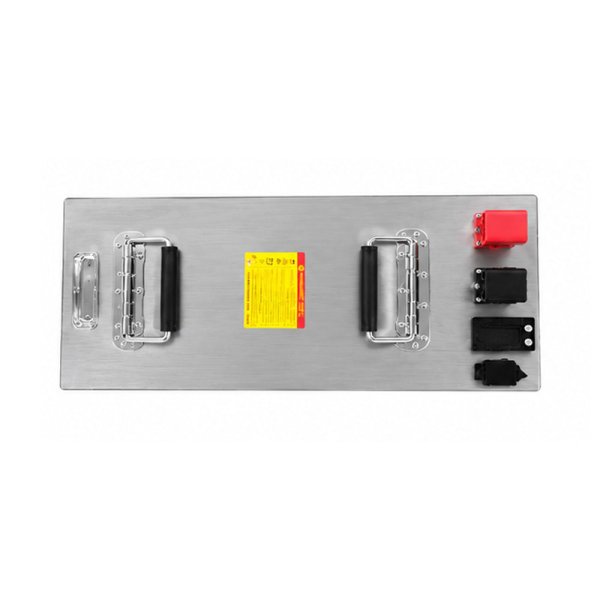
For a concrete product reference, FEBATT lists a 100Ah LiFePO4 battery for AGV robots with CAN/RS485 and up to 100 A continuous discharge. These specifications do not guarantee fleet runtime. Confirm motor demand, mechanical fit and protocol before adopting this industrial AGV battery option.
What Prevents Battery-Related Mission Interruptions?
An industrial AGV battery needs more than protective electronics: the fleet controller must receive useful state-of-charge, temperature, current-limit and fault information. CAN or RS485 compatibility requires matching the actual message protocol, not just the connector. Low-energy warnings should prevent vehicles from blocking aisles. Agree with the integrator on safe-stop logic and the minimum energy needed to finish a task.
In FEBATT’s custom AGV/AMR project case, the buyer specified RS485 communication, a constrained installation envelope and defined interfaces. Test response to communication loss, undervoltage and repeated stops. An industrial AGV battery with clear alarms helps fleet diagnosis.
Which Industrial Conditions Must Be Verified Before Rollout?
Dust, floor vibration, cleaning exposure and temperature shifts can turn a suitable laboratory pack into an unreliable industrial AGV battery. Specify enclosure protection, mounting and separate charge/discharge temperature limits. Protect against charging below the permitted temperature. Test protection responses after repeated floor joints, impacts and exposure to facility cleaning procedures.

IEC 62619:2022 addresses safety requirements for industrial lithium batteries and explicitly includes AGVs among its applications. Check applicable tests and UN 38.3 transport evidence. Safety approval must match the actual pack configuration and destination market.
What Should B2B Buyers Compare Beyond the Unit Price?
Evaluate an industrial AGV battery against availability, labor, spares and integration cost. Lithium may cut watering and changeovers; savings depend on utilization. Before ordering, require route tests, communication logs, drawings and sample acceptance criteria. Cycle ratings are not replacement guarantees. Before approving bulk production, OEM buyers should define measurable acceptance criteria for loaded-route completion, peak-current response, BMS communication, charging compatibility, fault recovery, and mechanical integration. These requirements should be verified on representative AGV units using the intended controller and charging system.
How Can FEBATT Support a Fleet-Ready Configuration?
FEBATT’s power battery solutions cover LiFePO4 configurations, BMS integration and application matching for industrial equipment and AGV/AMR operations. Share route logs, payload, protocol, available space and order volume. A sample-tested industrial AGV battery specification beats a generic quotation.
Frequently Asked Questions About Industrial AGV Batteries
Q: What type of battery is best for industrial AGVs?
A: For repeated missions, a LiFePO4 industrial AGV battery offers low maintenance, thermal stability and cycle-life potential. However, NMC may suit unusually tight space or mass constraints. Choose using verified duty-cycle performance. Consider peak traction demand and available charging windows before approving a common battery for several models.
Q: How long does an AGV lithium battery last?
A: An industrial AGV battery ages with use, temperature, discharge depth and current. Verify cycle-test conditions and monitor real mission completion. State of health is a useful trend, not a substitute for observing daily task capacity.
Q: Can lithium batteries support multi-shift AGV operations?
A: Yes, when an industrial AGV battery matches energy demand, charging windows and BMS limits. Validate daily energy demand; Ah alone does not guarantee availability. Fleet routing software must account for low-energy returns and charging interruptions.
Q: Why switch AGV fleets from lead-acid to LiFePO4?
A: An industrial AGV battery can avoid watering and enable approved partial-charge strategies. Check mass, wiring, controls, chargers and cost before retrofitting.
Q: What should OEMs test before buying AGV batteries in bulk?
A: Test loaded routes, peak current, BMS messages and faults with the industrial AGV battery installed. Verify mountings, temperature limits and production consistency.