When a cart slows on the back nine or returns with too little charge for another booking, staff must swap vehicles, delay departures, or hold reserves. For course operators, golf cart battery range is a scheduling issue—not merely a battery specification.
A properly matched LiFePO4 system can improve golf cart battery range consistency while reducing flooded lead-acid maintenance. The goal is not the largest pack, but a fleet that finishes every assigned round with sufficient reserve.
What Does Golf Cart Battery Range Mean for 18- and 36-Hole Operations?
An 18-hole round is not a fixed distance. Cart paths, clubhouse trips, and return journeys consume energy. Two rounds can mean substantially greater use than one.
For golf cart battery range planning, it may require a quiet weekday for one round; a tournament may demand two with little turnaround.

Club Car states its second-generation Tempo Li-Ion can cover 36+ holes per charge. This is a model-specific claim, not a universal lithium guarantee.
Before planning a golf cart fleet battery project, review how vehicles are assigned. Some carts return to the depot after every round; others are dispatched immediately. A course with short charging windows needs more usable energy available at the start of each shift. Define the busiest realistic day first. Golf cart battery range should cover assigned rounds plus a sensible operational reserve, rather than just the average trip.
Why Does Golf Cart Battery Range Drop During Busy Shifts?
Identical carts can finish with different charge levels. Slopes, passenger loads, frequent stops, soft ground, tire pressure, and accessories change consumption.

Aging lead-acid packs can exhibit voltage sag. Properly engineered LiFePO4 packs maintain a flatter discharge voltage, supporting steadier power delivery, but cannot guarantee identical golf cart battery range on every route.
Measure representative routes rather than trusting maximum-distance claims. Log kWh used, rounds, loads, terrain, and state of charge (SOC). Peak-day measurements make golf cart battery range relevant to actual operations. Record the same vehicle under both light and full passenger loads, and distinguish energy consumed per round from time spent parked or waiting. This helps avoid paying for oversized batteries where the real problem is dispatch scheduling.
Why Is Lithium Better for Reliable Golf Cart Battery Range?
Lithium’s advantage is operational consistency. Unlike flooded lead-acid batteries, properly integrated LiFePO4 packs need no watering or acid handling, simplifying vehicle dispatches.
Stable voltage and potentially faster charging can reduce withheld carts. Actual turnaround depends on charger rating, BMS limits, temperature, and site power.
Evaluate a commercial golf cart battery by usable energy, current capability, and availability—not inflated mileage claims. Reliable golf cart battery range reduces substitutions and disruption.
A well-matched lithium system also reduces the variation caused by unevenly maintained flooded batteries. Crews can spend less time checking electrolyte levels and more time preparing vehicles for the next departure. Lithium is often the stronger operational choice when the battery, controller, and charging equipment are correctly integrated.
How Should Operators Calculate Golf Cart Battery Capacity?
Multiply measured energy per round by rounds before charging. Account for usable SOC and the retained capacity expected near the end of planned service life.
Assume 1.8 kWh per round and two rounds before charging. This is hypothetical, not FEBATT field-test data.
| Planning input | Example |
|---|---|
| Energy per round | 1.8 kWh (assumed) |
| Rounds before charging | 2 |
| Planned usable SOC window | 80% |
| End-of-life capacity allowance | 90% |
| Illustrative minimum nominal energy | 1.8 × 2 ÷ (0.80 × 0.90) = 5.0 kWh |
The 80% SOC window and 90% retained-capacity allowance are planning assumptions; actual limits must come from the pack specifications. The 5.0 kWh result is a starting threshold, not a recommendation. Terrain, heat, and uncertainty may demand more margin. It translates golf cart battery range into a measurable energy requirement.
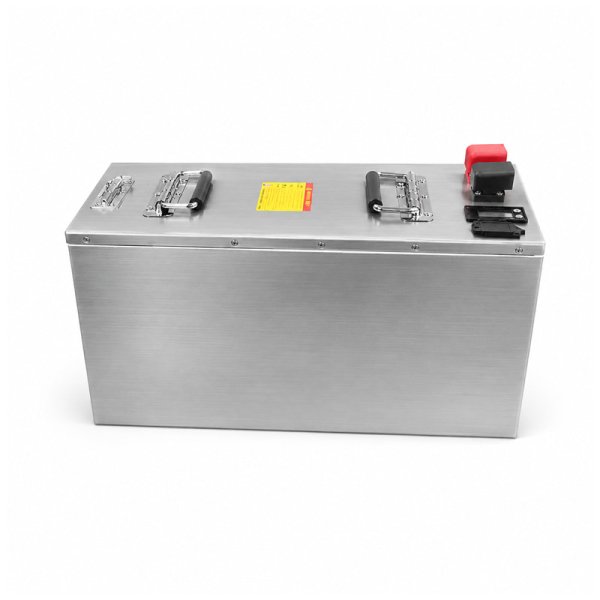
FEBATT lists a 100Ah LFP pack at 5.12 kWh and a 120Ah pack at approximately 6.14 kWh. These are nominal-energy ratings, not proven round counts. Golf cart battery range must be verified using available—not merely nameplate—energy. Use this capacity guide for specification comparisons after route measurements.
Which Checks Protect Golf Cart Battery Range Before Deployment?
Test a sample pack on actual routes with passengers and accessories. Include the longest climb and the busiest part of the day. A useful golf cart battery range acceptance test should use a clear pass/fail threshold set before purchasing, rather than an impression that the cart ran well. Record delivered energy, end-of-round SOC, temperature, peak current, and BMS alarms.
Golf cart battery range can look adequate on paper yet fail if controllers, chargers, wiring, or BMS limits are mismatched. Verify the system.
| Fleet risk | Practical acceptance check |
|---|---|
| Carts unavailable for a second round | Complete the planned rounds with reserve SOC |
| Hill-climb power interruptions | Confirm peak-current demand stays within approved limits |
| Inconsistent carts across a fleet | Repeat the same route test on representative units |
| Charging delays | Confirm the required turnaround with the matched charger |
See this golf cart battery testing guide. Require consistent golf cart battery range across representative vehicles. If a cart completes the first round but reaches the BMS discharge limit on the second climb, the pack is not ready for that duty cycle.
What Should a Golf Course Fleet Battery RFQ Include?
A useful RFQ specifies cart models, fleet quantity, rounds per day, measured energy, grades, passenger loads, charging windows, battery space, destination market, and delivery schedule.

Request usable energy, current ratings, BMS limits, charger compatibility, and sample tests. A golf course cart battery should fit site conditions, making golf cart battery range verifiable.
FEBATT’s power battery solutions support tailored configurations, BMS matching, OEM/ODM projects, and bulk supply. Share operating data before placing orders. Request a documented test configuration and agree how the supplier will handle deviations between the approved sample and delivered batches. That makes golf cart battery range a procurement acceptance criterion, not an optimistic catalog statement.
What Are Common Questions About Golf Cart Battery Range?
Q: How far can a lithium golf cart go on one charge?
A: There is no universal distance. Golf cart battery range depends on usable energy, vehicle efficiency, slope, load, and operating conditions. Validate a representative route before setting fleet schedules.
Q: Can a golf cart complete 36 holes without recharging?
A: Some integrated lithium-powered carts can. Club Car publishes a 36+ hole claim for its specified Tempo Li-Ion vehicle, but another cart’s golf cart battery range requires its own route test.
Q: How many amp-hours does a golf cart need for 18 holes?
A: Use measured energy for 18 holes, usable SOC, and reserve to specify golf cart battery capacity. Verify on site.
Q: Do lithium batteries last longer per charge than lead-acid batteries?
A: A suitable LiFePO4 conversion may improve usable energy and keep output more consistent than an aged lead-acid system. Actual golf cart battery range depends on usable energy and vehicle demand—not chemistry alone.
Q: What should golf courses test before buying batteries in bulk?
A: Test loaded routes, hills, SOC, charging turnaround, and BMS alarms. Check representative carts for consistent golf cart battery range.