Electric motorcycle manufacturers and fleet operators often focus first on voltage, ampere-hours, and range. Those values matter, but they do not show whether the pack can remain within safe electrical and thermal limits during acceleration, hill climbing, charging, storage, or repeated daily use. The bms for lithium ion battery applications is the control layer that connects cell behavior with vehicle requirements.
A properly specified system monitors cell voltages, pack current, and selected temperature points; manages balancing; and commands protective actions when approved thresholds are exceeded. It cannot turn unsuitable cells or weak mechanical design into a safe pack.
For B2B buyers, the right approach is not simply to request a “smart BMS.” Chemistry, series count, current, temperature limits, communication, fault handling, enclosure protection, vibration, and validation criteria must be defined.
Before defining a custom pack, buyers should align voltage, chemistry, performance, charging, and safety requirements. Our electric motorcycle battery guide for OEM projects summarizes that full decision framework.
What Does a BMS Do in a Commercial Electric Motorcycle Battery?
A bms for lithium ion battery pack is an electronic monitoring and protection system installed within or alongside the battery assembly. Core functions normally include cell-voltage measurement, pack-current measurement, temperature sensing, charge and discharge control, cell balancing, fault recording, and state-of-charge estimation.

The battery management system for lithium batteries compares measured values with limits approved for the chosen cells and pack. If a cell approaches an overvoltage threshold during charging, the system may stop the charge path. If current exceeds the configured limit, it may open MOSFETs or command a contactor. When a sensor reports an excessive or insufficient temperature, it may restrict or stop charging or discharging.
A lithium ion bms also supports consistency across series-connected cell groups. The usable capacity of the complete battery is constrained by the first group to reach a high- or low-voltage limit. Monitoring every series group helps prevent one weak or imbalanced group from being pushed beyond its approved range while the overall pack voltage still appears normal.
The bms for lithium ion battery design remains one layer in a broader safety system. Cell selection, busbars, fuses, connectors, insulation, enclosure design, thermal paths, mounting, charger matching, controller limits, and production quality are equally important.
How Should Chemistry and Series Count Be Matched?
The bms for lithium ion battery pack must match both cell chemistry and the number of series-connected groups. LiFePO4 and NMC cells have different nominal voltages, upper charging limits, lower discharge limits, and preferred operating windows. A BMS programmed for one chemistry should not be installed on another unless its hardware and firmware are configurable and the revised thresholds are fully validated.
Series count is just as critical. A 23-series LiFePO4 pack needs monitoring channels and limits suitable for 23 groups. A unit designed for fewer groups cannot supervise the complete pack, while incorrect setup can create false readings or leave cells unprotected. A bms for lithium battery selection should therefore begin with an approved cell specification and electrical schematic, not a nominal marketing voltage alone.
Buyers should request the chemistry, series and parallel configuration, maximum charge voltage, discharge strategy, balancing threshold, sensor placement, and calibration method. The words bms lithium ion on a label do not prove that the settings match a particular 72V or 73.6V platform.
How Do You Size Continuous and Peak Current Correctly?
The current rating of a bms for lithium ion battery pack should be based on the controller and real duty cycle, not only the motor’s advertised power. A starting estimate is current equals electrical power divided by pack voltage. A 5,000W motor at 72V requires about 69.4A before efficiency losses; at 73.6V, the theoretical value is about 67.9A.
The controller may demand substantially more current during launch, acceleration, or hill climbing. The bms for lithium ion battery project must distinguish between continuous current, short-duration peak current, peak duration, recovery time, ambient temperature, conductor size, connector rating, cell capability, and thermal dissipation.
The continuous rating should cover sustained controller demand with a documented engineering margin. The peak rating should cover the controller request for the specified duration without exceeding cell, busbar, connector, MOSFET, contactor, fuse, or cable limits. Oversizing only the BMS is not enough; every current-carrying component must be coordinated.
Settings that are too low can cause nuisance trips, while settings that are too high can allow damaging stress. A qualified supplier should validate a bms for lithium ion battery under representative acceleration, gradient, payload, temperature, and route conditions.
How Does the BMS Monitor Voltage, Current, and Temperature?
A modern lithium ion bms uses measurement circuits to sample individual cell-group voltages, pack voltage, current, and temperatures at selected locations. These readings support protection decisions and calculations such as state of charge. Sensor quantity and placement should reflect the pack layout because one temperature sensor cannot represent every local hotspot.

Measurement accuracy affects usable capacity and protection margin. The specification should state cell-voltage accuracy, current-sensing method, sensor type, calibration method, and diagnostic behavior.
Current may be measured with a shunt resistor, Hall-effect sensor, or another validated method. Temperature sensors belong near representative cell groups, busbars, power devices, or expected hot spots.
A BMS does not automatically activate cooling unless the pack includes compatible thermal hardware and control logic. In many two-wheel packs, it instead reduces current, stops charging, stops discharge, issues a fault, or requests action from the controller. A bms for lithium ion battery datasheet should identify what the system actually controls.
What Is the Difference Between Passive and Active Cell Balancing?
Cell balancing reduces state-of-charge differences among series groups. Passive balancing removes a small amount of energy from higher-voltage groups, usually through resistors. It is widely used because it is compact, cost-effective, and reliable when cells are well matched and production consistency is controlled.
Active balancing transfers energy between cell groups or through another storage element. It may improve energy utilization or correct larger imbalances more efficiently, but it adds components, cost, control complexity, and validation work. It is not automatically superior for every bms for lithium ion battery application.

The correct method depends on pack capacity, expected mismatch, balancing current, available balancing time, thermal constraints, and cost. Buyers should request the balancing method, start threshold, balancing current, and operating conditions. A bms for lithium battery cannot compensate for defective cells, poor grading, weak welds, or uneven temperatures.
How Should Low- and High-Temperature Protection Be Configured?
Temperature limits must come from the selected cell specification and pack validation. Many LiFePO4 cells do not permit normal charging below 0°C, but that is not a universal value for every cell or charging current. The bms for lithium ion battery should stop or derate charging at the approved low-temperature threshold and use suitable sensing accuracy and hysteresis.
Charging, continuous discharge, peak discharge, and storage may each have different temperature limits. The bms for lithium ion battery should implement the approved response, such as charger shutdown, controller derating, or pack disconnection, rather than merely displaying a temperature value.
FEBATT’s 72V 45Ah LiFePO4 battery lists a charging range of 0°C to 50°C and a discharge range of -5°C to 65°C. The 73.6V 30Ah scooter battery lists 0°C to 50°C for charging and -10°C to 55°C for discharge. These are model-specific pack values, not universal settings for every bms for lithium ion battery project.
How Can a BMS Reduce Thermal-Runaway Risk?
A bms for lithium ion battery can reduce risk by identifying measurable abnormal conditions such as overvoltage, undervoltage, overcurrent, short-circuit current, and excessive temperature. It can then limit or interrupt operation before the pack remains in an abusive state for too long.
It cannot guarantee prevention of thermal runaway. Internal cell defects, external damage, contamination, poor connections, insulation failure, or a rapidly developing internal short may progress faster than external sensors can detect. The battery management system for lithium batteries must therefore work with qualified cells, fusing, thermal separation, mechanical protection, insulation, venting strategy, and controlled manufacturing.
A more accurate requirement than “thermal-runaway protection” is early fault detection, appropriate electrical isolation, and pack-level measures intended to reduce the likelihood and consequences of failure. The complete battery should be validated under normal, boundary, and defined fault conditions.
How Should CAN, RS485, Bluetooth, and Data Logging Be Evaluated?
Communication is useful only when it supports a defined system requirement. A bms for lithium ion battery may operate as a standalone protector or exchange data with a controller, charger, display, diagnostic tool, or telematics gateway. CAN and RS485 are common options, but availability and message definitions must be confirmed for each project.
CAN can support current limits, charge-enable signals, state-of-charge reporting, fault codes, and controller derating. RS485 may support diagnostics or configuration. Bluetooth normally provides short-range local access; it does not provide remote fleet monitoring by itself. Remote access needs a phone, gateway, or telematics unit that forwards data to a server.
Buyers should request the protocol, baud rate, message map, pinout, update rate, fault definitions, firmware process, and behavior after communication loss. A bms for lithium battery with an undocumented CAN connector may still be impossible to integrate. FEBATT states that CAN or RS485 can be customized for its 72V 45Ah platform, while communication for the 73.6V 30Ah model is optional.
How Should the BMS and Pack Be Protected Against Water, Dust, and Vibration?
Ingress protection and vibration resistance should be assessed at complete-assembly level. An IP rating applies to the tested enclosure configuration; it cannot be inferred from conformal coating, potting, or a sealed-looking connector. The relevant rating may belong to the complete pack rather than the BMS circuit board.
The FEBATT 73.6V 30Ah scooter pack is listed as IP54, which should not be described as immersion protection. The final installation, cable entries, connectors, mounting angle, and service practices can affect real-world protection. A bms for lithium ion battery used in wet or dusty service must be validated in its actual enclosure.
Vibration control requires secure cell and PCB mounting, strain relief, suitable connectors, reinforced current paths, verified soldering or welding, and an appropriate enclosure. Buyers should request the vibration profile, axis, frequency, acceleration, duration, mounting method, and post-test criteria.
How Do Custom Settings Affect Range and Cycle Life?
A bms for lithium ion battery does not create energy, but its settings determine how much of the cell operating window is used and how the pack responds to stress. Charge voltage, discharge cut-off, current limits, temperature thresholds, balancing behavior, sleep current, and state-of-charge calibration all influence usable range and long-term consistency.
Aggressive limits may increase short-term usable energy or acceleration but reduce protection margin and increase cell stress. Conservative limits may support durability but reduce usable capacity or cause unnecessary shutdowns. The correct settings depend on route length, payload, gradient, ambient temperature, charging opportunity, target service life, and acceptable downtime.
For a bms for lithium ion battery in a commercial fleet, engineers should validate the full operating profile rather than optimize one laboratory cycle. Logging minimum and maximum cell voltage, current, temperature, fault events, and charge history can reveal whether the settings fit real use.
How Can B2B Buyers Evaluate BMS Quality and Supplier Capability?
A professional assessment should begin with an application requirements document covering chemistry, voltage range, series count, capacity, motor and controller ratings, continuous and peak current, peak duration, charger profile, temperature range, enclosure, mounting, connector, communication, applicable standards, and expected volume. The bms for lithium ion battery supplier should respond with traceable specifications rather than broad marketing claims.
Buyers should review protection thresholds, measurement accuracy, balancing method, power-device rating, fuse coordination, sensor layout, communication documents, firmware control, production tests, and fault-recovery logic. They should also confirm who can change settings and approve revisions.
Quality evidence must be separated by scope. UN 38.3 concerns transport testing of lithium cells and batteries, not general BMS quality. ISO 9001 concerns a quality-management system. Other standards may apply to the cell, pack, charger, vehicle, or market.
Before mass production, the project should include sample review, bench testing, controller and charger integration, thermal and current validation, fault testing, vehicle trials, and an approved configuration record. A bms for lithium ion battery is only as reliable as the design, production control, and change-management process around it.
How Do FEBATT Battery Examples Illustrate BMS Selection?
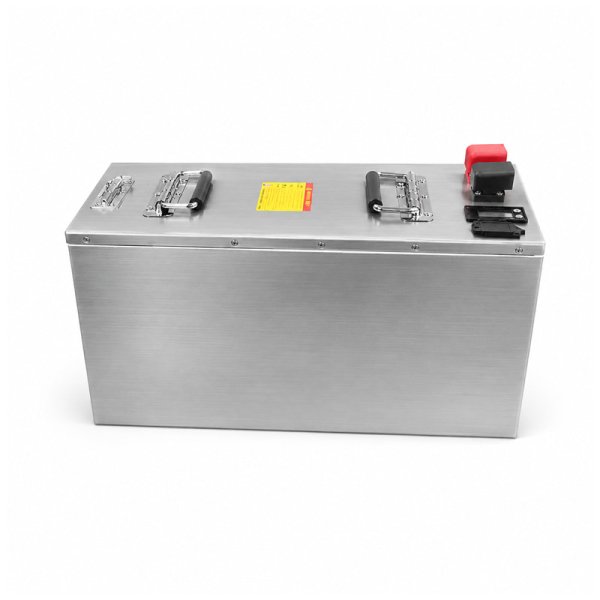
FEBATT’s 72V 45Ah LiFePO4 battery for electric two-wheelers provides 3,240Wh, a listed cycle life of at least 1,200 cycles, a charging range of 0°C to 50°C, and a discharge range of -5°C to 65°C. Its listed integrated protection functions include overcurrent, over-discharge, high- and low-temperature, overload, short-circuit, and automatic disconnection protection. For OEM projects, the bms for lithium ion battery settings, CAN or RS485 communication, connector, enclosure, and mounting can be customized.
The FEBATT 73.6V 30Ah scooter battery provides 2.208kWh, up to 30A continuous discharge and 50A peak discharge, a 57.5V to 83.95V working range, IP54 protection, and optional communication. Its system cycle-life specification is at least 1,500 cycles at 100% depth of discharge, while the cell specification is at least 2,000 cycles at 100% depth of discharge. These values show why a bms for lithium ion battery must be matched to a specific pack rather than selected from voltage alone.
Both examples are references, not universal templates. Controller limits, charger profile, connectors, dimensions, temperature, communication, and vehicle validation must be confirmed before replacement or upgrade.
FAQ About BMS for Lithium Ion Battery
1.Can a LiFePO4 BMS be used with an NMC battery?
A LiFePO4-configured BMS should not be used with an NMC pack unless the hardware supports the required series count and voltage range and the thresholds, balancing behavior, temperature limits, and state-of-charge model are reconfigured and validated for the selected NMC cells. The label bms lithium ion does not prove cross-chemistry compatibility.
2.What BMS current rating is appropriate for a 5,000W electric motorcycle?
At 72V, 5,000W corresponds to about 69.4A before efficiency losses; at 73.6V, it corresponds to about 67.9A. The bms for lithium ion battery must also cover controller continuous and peak current, peak duration, gradient, payload, temperature, cell capability, cables, connectors, busbars, fuse, and engineering margin. Selecting 70A or 100A only from motor power can be unsafe or cause nuisance trips.
3.What is a low-temperature charge cutoff?
A low-temperature charge cutoff prevents charging below the minimum temperature approved for the cell and pack. Some LiFePO4 systems use 0°C, but the correct setting depends on the cell, charge current, sensor placement, accuracy, hysteresis, and any approved heating or derating logic. The bms for lithium ion battery should implement the model-specific limit.
4.What is the difference between a common-port and separate-port BMS?
A common-port design uses the same main negative path for charging and discharging, while a separate-port design uses different controlled paths for charger and load. The choice affects wiring, current rating, fault isolation, connector layout, and service procedures. A bms for lithium battery should be selected according to the charger, controller, required protection behavior, and installation.
5.Does Bluetooth provide remote fleet monitoring?
Bluetooth normally provides short-range access to nearby data such as state of charge, cell voltage, temperature, and alarms. It does not provide wide-area monitoring without a phone, telematics gateway, or cloud-connected controller. When evaluating a bms for lithium ion battery, buyers should distinguish local Bluetooth diagnostics from a complete fleet-data system.
6.Can a BMS prevent every battery fire?
No. A properly designed bms for lithium ion battery can detect and respond to measurable overvoltage, undervoltage, overcurrent, short-circuit, and temperature conditions, which reduces risk. It cannot guarantee control of every internal defect, collision, contamination event, wiring failure, or rapidly developing cell short. Cell quality, fusing, insulation, enclosure design, thermal separation, production control, installation, and maintenance remain necessary.
Conclusion
Choosing a bms for lithium ion battery pack requires more than comparing current ratings or selecting the longest feature list. The system must match chemistry, series count, voltage limits, controller demand, charger behavior, temperature range, balancing needs, communication architecture, enclosure, and mechanical environment.
For B2B motorcycle and scooter projects, the process should begin with documented vehicle requirements and end with pack-level validation. The bms for lithium ion battery should provide accurate monitoring, coordinated protection, controlled balancing, useful diagnostics, and clear fault behavior.
FEBATT supports two-wheel OEM and ODM projects with battery, enclosure, connector, BMS, CAN or RS485 communication, mounting, documentation, and integration options. Buyers can use the 72V 45Ah and 73.6V 30Ah product pages as references, then confirm the final bms for lithium ion battery configuration with engineering before sample approval and mass production.