Commercial fleets are steadily replacing lead-acid systems with lithium batteries to reduce routine maintenance, improve voltage stability, and make vehicle availability more predictable. Golf courses, resorts, campuses, industrial parks, residential communities, airports, and rental operators all depend on vehicles that can complete scheduled routes without unnecessary charging stops.
The decision between a 38.4V 80Ah vs 105Ah golf cart battery should not be based only on choosing the larger specification. The correct capacity depends on daily energy use, route length, passenger or cargo load, terrain, charging access, installation space, and the business cost of downtime.
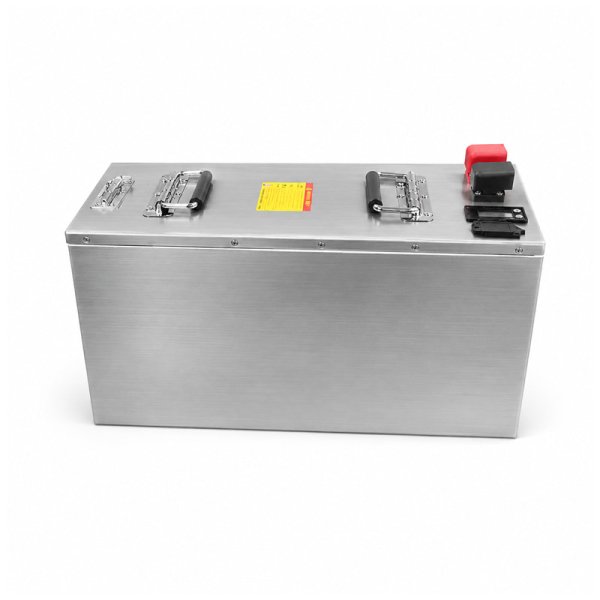
Both options operate on the same 38.4V platform, but they store different amounts of energy. The 80Ah model offers a lower initial investment and a more compact energy reserve for moderate-duty operation. The 105Ah model provides more stored energy for longer shifts, heavier use, and fleets with limited charging opportunities.
What Is the Main Difference Between 80Ah and 105Ah?
The main difference is stored energy. Voltage describes the electrical platform, while ampere-hours describe capacity. Because both batteries use the same nominal voltage, the higher Ah rating directly increases the available nominal energy.
- 4V × 80Ah = 3,072Wh, or approximately 3.07kWh
- 4V × 105Ah = 4,032Wh, or approximately 4.03kWh
The 105Ah model therefore stores approximately 31.25% more nominal energy than the 80Ah model. Under the same vehicle, load, speed, terrain, temperature, and operating conditions, that additional energy can generally support longer runtime or a greater operating reserve.
A 38.4V 80Ah vs 105Ah golf cart battery comparison is therefore a trade-off between acquisition cost and operating endurance. The 80Ah option may be sufficient for predictable routes and regular charging. The 105Ah option becomes more valuable when vehicles must remain active for longer periods or when a charging interruption affects service.
| Comparison factor | 38.4V 80Ah | 38.4V 105Ah |
|---|---|---|
| Nominal energy | 3.07kWh | 4.03kWh |
| Energy difference | Baseline | About 31% more |
| Typical use | Moderate-duty operation | Longer or higher-demand operation |
| Charging frequency | Potentially more frequent | Potentially less frequent |
| Initial cost | Usually lower | Usually higher |
| Pack size and weight | Usually lower | Usually higher |
| Best business objective | Control investment | Increase operating reserve |
These are capacity-level differences. Exact dimensions, weight, discharge current, connectors, charger settings, mounting, and communication requirements must be confirmed from the approved product specifications.
How Does Capacity Affect Daily Fleet Operations?
Battery capacity affects how many trips a vehicle can complete before charging, how much reserve remains during peak periods, and whether the fleet needs spare vehicles or midday charging.
A smaller battery can perform efficiently when routes are short and predictable. For example, a cart used for security patrols inside a residential community may return to base several times each day. In that case, an 80Ah battery may provide enough usable energy without the cost and size of a larger pack.
A higher-capacity battery is more useful when vehicles operate continuously, travel farther from the charging area, carry passengers or equipment, or work during periods when charging is inconvenient. The 105Ah option can provide a larger buffer for route changes, hills, accessories, and increased passenger loads.
The correct 38.4V 80Ah vs 105Ah golf cart battery decision should be based on measured energy demand. Fleet managers should record daily distance, shift length, charging frequency, typical payload, terrain, and remaining State of Charge at the end of the shift.
Leave a practical reserve for weather, aging, unexpected trips, and accessory loads.
Which Applications Are Best Suited to an 80Ah Battery?
An 80Ah battery can be the better commercial choice when operating requirements are moderate and charging is readily available.
A 38.4V 80Ah lithium golf cart battery may suit:
- Small and medium golf courses
- Compact resorts and hotels
- Residential communities
- Private estates
- Schools and corporate campuses
- Property maintenance vehicles
- Short-route passenger transport
- Low-utilization rental fleets
- Light-duty utility carts
The main advantages are a lower initial purchase cost, a smaller energy reserve to recharge, and potentially easier installation because the pack may be more compact and lighter than a higher-capacity version.
For a business with predictable daily mileage, the 80Ah option can provide strong value. Paying for additional capacity that remains unused does not improve productivity. It only increases the initial investment and may add unnecessary size or weight.
In a 38.4V 80Ah vs 105Ah golf cart battery evaluation, 80Ah is usually the smarter choice when the vehicle completes its required work with a reasonable reserve and can charge during natural downtime.

When Does a 105Ah Battery Provide Better Business Value?
The 105Ah option becomes more attractive when vehicle availability has direct commercial value. A larger energy reserve can reduce charging interruptions and make daily scheduling easier.
A 38.4V 105Ah golf buggy battery may be suitable for:
- Large golf courses
- Resorts with all-day guest transport
- Airports and transport facilities
- Industrial parks
- Manufacturing sites
- Tourist attractions
- High-use rental fleets
- Security patrol vehicles
- Utility carts carrying tools or cargo
- Vehicles operating far from charging points
For a resort shuttle, airport cart, or industrial transport vehicle, a charging stop may interrupt passenger service or delay work. In these environments, the higher purchase cost can be justified if the battery helps the vehicle remain productive through the required shift.
In a 38.4V 80Ah vs 105Ah golf cart battery comparison, the 105Ah model is more compelling when the business regularly uses the extra capacity. It is less compelling when routes are short and the battery returns to the charger with a large unused reserve.

How Should Fleet Managers Estimate Driving Range?
No responsible supplier should promise one universal range for every golf cart. Battery energy is only one part of the calculation. Actual range depends on:
- Vehicle efficiency
- Passenger or cargo load
- Average speed
- Acceleration and braking
- Tire pressure
- Terrain and slopes
- Ambient temperature
- Motor and controller efficiency
- Accessory consumption
- Usable discharge limits
- Battery age and condition
A practical estimate is:
Estimated range = usable battery energy ÷ measured vehicle consumption per kilometer
For example, if a cart consumes 70Wh per kilometer under a specific route and load:
- A 3.07kWh battery has a theoretical range of about 44km before applying reserve and system losses.
- A 4.03kWh battery has a theoretical range of about 58km before applying reserve and system losses.
These figures are illustrations, not guarantees. Real operation should leave a reserve, and the vehicle may consume more energy on hills, under heavier loads, or in cold weather.
Test the same cart on the same route with a representative load and record energy use, minimum voltage, remaining State of Charge, and BMS warnings.
How Does Capacity Affect Charging?
Both batteries operate at the same voltage platform, but the 105Ah model stores more energy. If both are discharged by the same percentage and charged with the same power, the 105Ah model will generally take longer to reach full charge.
- Charging time depends on:
- Charger output current
- Starting State of Charge
- BMS limits
- Cell temperature
- Charging profile
- Battery condition
- Whether balancing is required near full charge
A larger battery does not necessarily increase total electricity cost for completing the same work. Energy consumption is driven mainly by the vehicle’s work and system efficiency. However, the 105Ah battery requires more electricity to charge from empty because it stores more energy.
Buyers comparing a 38.4V 80Ah vs 105Ah golf cart battery should confirm charger compatibility rather than assuming that any charger for the same nominal voltage is acceptable. The charger must match the battery chemistry, final charging voltage, current limits, connector, and BMS requirements.
Which Battery Has the Better Total Cost of Ownership?
Total cost of ownership includes more than the purchase price. Fleet buyers should consider:
- Battery acquisition cost
- Installation cost
- Charger requirements
- Electricity consumption
- Charging labor
- Downtime
- Spare vehicle requirements
- Routine inspection
- Replacement frequency
- Lost service or revenue
- Supplier support
An 80Ah battery may provide the better total cost when the vehicle follows short routes, charges regularly, and does not experience operational interruptions.
A 105Ah battery may provide the better total cost when vehicles work long shifts, charging stops disrupt service, or additional reserve reduces the need for spare carts.
The financially correct 38.4V 80Ah vs 105Ah golf cart battery choice depends on the value of uptime. A larger battery may cost more at purchase but save money if it prevents frequent charging, vehicle rotation, or missed trips. A smaller battery may provide a better return when it already covers the full duty cycle.
Does the 105Ah Battery Automatically Last Longer?
No. Capacity alone does not determine service life. Battery lifespan depends on cell quality, BMS settings, operating temperature, charge rate, discharge current, storage conditions, and depth of discharge.
If both packs use comparable cells and protection settings, their design cycle life may be similar. However, the larger battery may experience a lower depth of discharge when completing the same work.
For example:
- Using 40Ah from an 80Ah battery equals 50% of nominal capacity.
- Using 40Ah from a 105Ah battery equals about 38% of nominal capacity.
A lower depth of discharge can reduce daily stress, but it does not guarantee a specific lifespan. High temperatures, excessive current, poor charging practices, or long storage at an unsuitable State of Charge can still accelerate degradation.
In a 38.4V 80Ah vs 105Ah golf cart battery comparison, the 105Ah model may accumulate fewer equivalent full cycles for the same workload. Actual long-term performance must still be evaluated using the supplier’s verified test conditions and the fleet’s operating data.
How Do Size and Weight Affect Vehicle Performance?
A 105Ah battery usually contains more active material than an 80Ah battery, so it may be larger and heavier. Exact values should come from the product drawings.
Battery size and weight can affect:
- Compartment fit
- Mounting points
- Cable routing
- Connector access
- Vehicle balance
- Suspension load
- Payload capacity
- Handling
- Service access
Lithium batteries are often lighter than equivalent lead-acid systems, but this does not remove the need to check vehicle balance. Some carts rely on battery mass as part of their weight distribution. A conversion may require ballast or a revised mounting system.
Before ordering, provide the supplier with the vehicle model, original battery dimensions, weight, connector, polarity, cable position, mounting structure, and required discharge current.
How Do 80Ah and 105Ah Perform in Different Climates?
Both capacities use the same voltage platform, but capacity alone does not determine temperature performance.
Hot Conditions
LiFePO4 chemistry offers strong thermal stability, but prolonged exposure to high temperatures can accelerate aging. A reliable pack should include temperature monitoring, over-temperature protection, and appropriate enclosure design.
Cold Conditions
Low temperatures increase internal resistance and can reduce available power and capacity. The 105Ah battery may provide a larger energy reserve, but it does not automatically have better cold-weather chemistry.
Cold-weather performance depends on cell design, BMS current limits, insulation, heaters, charging protection, and actual cell temperature. Charging below the manufacturer’s permitted temperature can create damage risk.
Storage
Long-term storage should follow the supplier’s recommended State of Charge and temperature range. Batteries should not be stored fully discharged, and electrical connections should be inspected before returning the vehicle to service.
When evaluating a 38.4V 80Ah vs 105Ah golf cart battery for seasonal fleets, buyers should request pack-level temperature limits and charging instructions.
What Safety Features Should Commercial Buyers Check?
Battery capacity should never be evaluated separately from safety and control.
A suitable BMS should monitor:
- Individual cell voltage
- Pack voltage
- Charging current
- Discharge current
- Cell temperature
- State of Charge
- Fault events
- Cell balance
Important protection functions include:
- Overcharge protection
- Over-discharge protection
- Overcurrent protection
- Short-circuit protection
- High-temperature protection
- Low-temperature charging protection
- Cell balancing
- Communication with the charger or vehicle when required
The best 38.4V 80Ah vs 105Ah golf cart battery is not simply the pack with more energy. It is the battery that meets the vehicle’s electrical demand, fits safely, communicates correctly, and operates within documented limits.
Can These Batteries Be Used in Other Vehicle Types?
A 38.4V battery platform may be suitable for golf carts, utility vehicles, electric tricycles, and selected low-speed commercial vehicles. However, voltage compatibility alone is not enough.
Buyers must confirm:
- Continuous discharge current
- Peak current
- Motor and controller compatibility
- Battery dimensions
- Weight
- Connector and polarity
- Charger profile
- BMS communication
- Mounting and vibration resistance
- Environmental protection
- Vehicle balance
The final decision should be validated by the battery supplier and vehicle manufacturer.
Side-by-Side Comparison
| Feature | 38.4V 80Ah | 38.4V 105Ah |
|---|---|---|
| Nominal voltage | 38.4V | 38.4V |
| Capacity | 80Ah | 105Ah |
| Nominal energy | 3.07kWh | 4.03kWh |
| Relative energy | Baseline | About 31% more |
| Typical runtime | Moderate | Longer |
| Charging frequency | Potentially higher | Potentially lower |
| Pack size and weight | Usually lower | Usually higher |
| Initial cost | Usually lower | Usually higher |
| Best fit | Predictable, moderate-duty routes | Longer or higher-demand routes |
| Main value | Cost control | Operating reserve |
This 38.4V 80Ah vs 105Ah golf cart battery table provides a general comparison. Product-specific dimensions, weight, current ratings, and charging parameters should be confirmed before procurement.
Which Capacity Is Better for Your Fleet?
Choose 80Ah when:
- Daily routes are short and predictable
- Charging is readily available
- Vehicles operate for limited hours
- Payload is moderate
- Lower initial cost is important
- Compact installation is preferred
Choose 105Ah when:
- Vehicles operate for longer shifts
- Daily mileage is higher
- Charging opportunities are limited
- Passenger or cargo load varies
- Downtime affects service or revenue
- Additional winter or route reserve is needed
Use measured fleet data, add a practical reserve, and confirm installation requirements.

Procurement Checklist
Before ordering, verify:
Vehicle Data
- Vehicle model and voltage
- Motor and controller ratings
- Battery compartment dimensions
- Original battery weight
- Connector and polarity
- Maximum current demand
- Mounting points
- Charger model
Operating Data
- Daily distance
- Shift length
- Terrain
- Passenger or cargo load
- Accessory power
- Charging opportunities
- Ambient temperature
- Required reserve
Supplier Data
- Cell type and traceability
- BMS functions
- Test conditions
- Safety and transport documents
- Warranty terms
- OEM or private-label capability
- Lead time
- Technical support
FAQ About 38.4V 80Ah vs 105Ah Golf Cart Battery
1.Is a 105Ah golf cart battery always better than an 80Ah battery?
No. The 105Ah model stores about 31% more nominal energy, but the 80Ah model may offer better value for short routes, moderate use, and regular charging access.
2.Can an 80Ah battery be upgraded to 105Ah later?
Possibly. Confirm voltage, dimensions, weight, mounting, connector, polarity, discharge current, charger, BMS communication, and vehicle balance before upgrading.
3.Which battery has the longer service life?
Neither capacity automatically lasts longer. If both use comparable cells and BMS settings, design cycle life may be similar. The 105Ah battery may experience a lower depth of discharge for the same workload.
4.Will a higher capacity battery increase vehicle speed?
No. Capacity mainly affects stored energy and runtime. Vehicle speed depends primarily on voltage, controller settings, motor design, gearing, load, and vehicle limits.
5.Which battery is better for multi-shift commercial operations?
The 105Ah model is often more suitable because it provides more reserve. However, an 80Ah battery may still work when routes are short and opportunity charging is available.
Conclusion
The 38.4V 80Ah vs 105Ah golf cart battery comparison is a choice between lower initial investment and greater stored energy. Neither capacity is universally superior.
The 80Ah option is suitable for predictable routes, moderate workloads, and fleets with regular charging access. The 105Ah option is better suited to longer shifts, limited charging opportunities, variable loads, and operations where downtime carries a higher business cost.
For B2B buyers, the correct battery should match measured daily energy demand, vehicle compatibility, installation space, charging strategy, safety requirements, and total cost of ownership.
A disciplined selection process prevents two expensive mistakes: buying more capacity than the fleet will use or selecting too little capacity to complete the required work. By combining real operating data with supplier engineering support, businesses can choose the battery that delivers the strongest operational and financial fit.