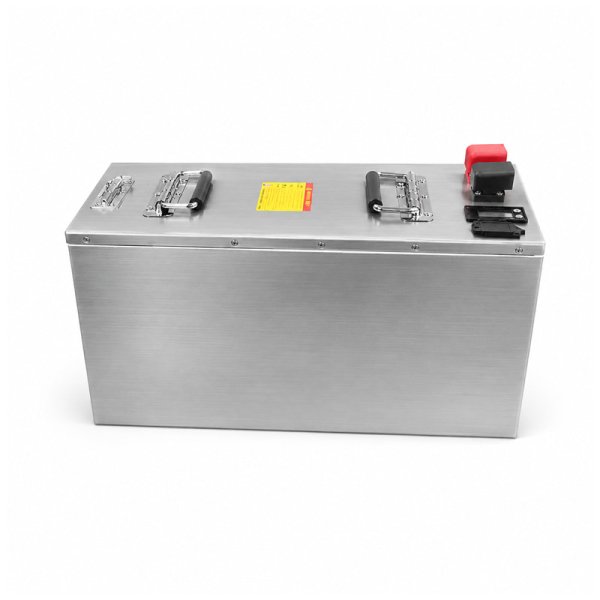
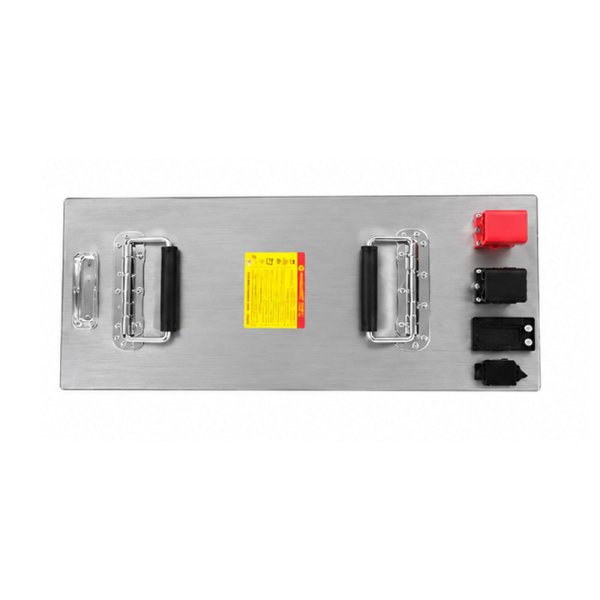
For warehouse operators, OEMs, rental fleets, and material-handling contractors, selecting a 48V forklift battery is not a simple voltage-matching exercise. The pack has to fit the truck electrically, mechanically, thermally, and operationally. Capacity matters, but so do current demand, charger behavior, battery mass, compartment geometry, communication, temperature, and the truck manufacturer’s installation limits.
Lithium, particularly LiFePO4, can reduce watering and equalization work associated with flooded lead-acid systems, support opportunity charging where the duty cycle allows it, and maintain a comparatively stable voltage profile through much of the discharge window. These advantages are useful only when the 48V forklift battery is engineered around the actual truck and work pattern rather than selected from voltage and amp-hour labels alone.
For buyers screening available configurations, this forklift battery range provides a practical reference for voltage and capacity options used in commercial material handling. This article focuses on how B2B teams should evaluate 30Ah and 60Ah platforms, runtime, current capability, charging, retrofit compatibility, counterweight, and OEM integration before approving a production specification.
Why Is 48V Common in Light- and Medium-Duty Material-Handling Platforms?
The 48V class occupies a useful middle ground in electric material handling. It can support more power than many lower-voltage systems without automatically requiring the architecture used by some higher-voltage trucks. A 48V forklift battery may appear in selected rider trucks, narrow-aisle equipment, walkie stackers, pallet trucks, and other compact or medium-duty machines, but the correct voltage always depends on the OEM model and approved electrical system.
From an electrical perspective, increasing system voltage allows a given power level to be delivered at lower current than a lower-voltage architecture. Lower current can reduce resistive losses and conductor heating when the complete system is designed accordingly. This helps explain why the 48 volt forklift battery platform is attractive where designers need a balance among package volume, available power, conductor size, and thermal management.
LiFePO4 chemistry adds a different benefit: its discharge voltage can remain relatively stable across a large part of the usable state-of-charge window. That can help a correctly sized 48V forklift battery provide more consistent equipment behavior than an aging or heavily discharged flooded lead-acid bank. It does not, however, remove the need to size current capability and usable energy correctly.
For OEM or mixed-fleet projects that need more than a standard pack, this power battery solution can help buyers frame voltage, capacity, BMS, communication, charger, enclosure, and application requirements as one integrated system. This application-led process is more reliable than assuming every truck carrying a 48V label can use the same battery. The resulting 48V forklift battery specification should document the vehicle interface as clearly as the cell and BMS limits.
What Is the Difference Between 48V 30Ah and 48V 60Ah Forklift Batteries?
Capacity is the clearest distinction. Using the commercial 48V label, 30Ah represents about 1.44kWh of nominal energy and 60Ah represents about 2.88kWh. If a pack uses a typical 16-series LiFePO4 arrangement with a 51.2V electrochemical nominal voltage, the corresponding nominal energies are approximately 1.54kWh and 3.07kWh. Buyers should confirm which voltage convention the supplier uses before comparing quotations.
A 30Ah 48V forklift battery may suit intermittent operation, short travel distances, controlled lift frequency, or equipment with frequent access to charging. A 60Ah version provides about twice the nominal stored energy at the same voltage convention, giving the designer more energy headroom. That does not guarantee twice the working time because usable SOC window, load profile, temperature, drivetrain efficiency, and current demand also affect runtime.
The larger pack may also support a higher current ceiling, but only if the cells, busbars, BMS, contactors, connectors, cabling, and thermal design are specified for it. Capacity and power capability are related design variables, not interchangeable specifications. A 60Ah pack built for modest current can be less suitable for a demanding truck than a lower-capacity design using a more appropriate power path.
Searches for forklift battery 48v or a 48v forklift battery for sale often group multiple capacities under one voltage label. B2B buyers should instead compare usable energy, continuous and peak current, required battery mass, dimensions, charger interface, and the number of productive hours that the pack must support between planned charging windows.
How Should Buyers Estimate Energy and Runtime for a 48V 60Ah Pack?
A nameplate calculation is the starting point, not the final runtime answer. At 48V and 60Ah, nominal energy is 2.88kWh. At 51.2V nominal for a typical 16S LiFePO4 architecture, the theoretical value is about 3.07kWh. A production 48V forklift battery will normally expose less usable energy than the theoretical maximum because the BMS preserves operating margins and the truck itself introduces electrical losses.
Runtime should therefore be estimated from measured or representative average power demand. For illustration, if a specific pack delivered 2.6kWh of usable energy and the truck averaged 1.2kW over a validated work cycle, a simplified energy-only estimate would be a little over two hours. That example is not a universal specification; it only shows why duty-cycle data matter.

A warehouse with repeated acceleration, long travel lanes, frequent mast movement, high payloads, cold operation, or steep ramps can consume energy faster than a truck doing intermittent stock movement. The same 48V forklift battery can therefore produce very different operating times in two facilities. Average and peak current, lift frequency, payload distribution, travel distance, temperature, idle time, and break schedules should all be included in the sizing model.
The safest commercial claim is not that one battery runs for a fixed number of hours. It is that the selected 48V forklift battery has enough validated usable energy and current margin for the defined duty cycle, with a charging strategy that keeps the truck available without routinely pushing the pack to its protection limits.
What Must Be Verified When Replacing a 48V Lead-Acid System With Lithium?
Four 12V lead-acid batteries connected in series create a 48V nominal system, but that does not make a lithium replacement a plug-and-play conversion. A 48V forklift battery retrofit must match the truck’s approved operating-voltage window while also accounting for different charge voltage, discharge behavior, battery mass, connector design, protection logic, and communication requirements.

The charger is a critical interface. A charger designed for flooded lead acid may use charging stages or voltage targets that are unsuitable for LiFePO4. The lithium charger should match the pack’s approved maximum charge voltage, current limit, connector, and any required communication or interlock strategy. The phrase ’48V charger’ alone is not enough to confirm compatibility.
Mechanical compatibility can be equally important. On many counterbalanced trucks, the original battery contributes to the approved stability envelope. A lighter 48V forklift battery should not be installed simply because it fits the compartment. Buyers must verify the truck data plate, approved battery weight range, compartment dimensions, retaining method, center-of-gravity requirements, cable routing, and OEM installation instructions.
For repeatable B2B conversions, the fleet should validate one configuration for each truck model before wider deployment. The approved bill of materials should define the lithium pack, charger, connectors, ballast if required, communication, mounting, and commissioning checks. This is far safer than allowing ad hoc field substitutions based only on nominal voltage and case dimensions. Each approved 48V forklift battery should remain traceable to the validated truck model and installation procedure.
How Should Continuous and Peak Discharge Current Be Specified?
There is no universal current rating for a 60Ah pack. The BMS has to be coordinated with cell capability, motor-controller demand, conductor cross-section, busbar resistance, contactor rating, connector temperature rise, fuse strategy, and enclosure thermal behavior. A 48V forklift battery with the same 60Ah capacity can therefore be engineered for very different power levels.
As a simple design illustration, a 60Ah pack configured for a 1C continuous discharge rate corresponds to about 60A, while a 2C design corresponds to about 120A. Those figures are examples of the C-rate relationship, not recommendations for every forklift. Short-duration peak current may be higher only when the complete electrical path and the cells are validated for that event.
Forklifts generate sharp transients during acceleration, initial lift, steering, and simultaneous traction and hydraulic demand. For this reason, the continuous rating, peak-current magnitude, permitted peak duration, recovery period, temperature derating, and protection thresholds should be stated together. A 48V forklift battery should never be approved from a BMS current label without confirming the rest of the power path.
For OEM validation, procurement teams should request current limits, temperature limits, connector ratings, fuse information, relevant test data, and any controller or communication requirements. That information is more useful than a single headline peak-current number because it describes whether the pack can repeatedly support the truck without nuisance trips or excessive heating.
How Should Charging Time and Charger Compatibility Be Evaluated?
Charge time depends on starting SOC, usable capacity, charger current, battery charge limit, temperature, and the constant-current/constant-voltage profile. For a 60Ah pack, 30A is approximately 0.5C and 50A is approximately 0.83C. A simple current-only calculation suggests about two hours at 30A or roughly 1.2 hours at 50A before allowing for taper, limits, and losses.
Those calculations should not be turned into universal promises. A production 48V forklift battery can charge only as fast as its cells, BMS, connector, contactor, cabling, thermal design, and charger allow. If the battery is cold, hot, or near the upper SOC limit, charge power may need to be reduced even when the charger can supply more current.
For a typical 16S LiFePO4 stack, 3.65V per cell corresponds mathematically to 58.4V. That is a cell-level reference calculation, not a universal charger setting. Manufacturers may intentionally use a lower upper-voltage limit, and the approved charge profile must come from the actual battery specification and BMS strategy.
Opportunity charging can be useful when it is planned around natural breaks and the site’s electrical capacity. A 48V forklift battery can often be partially replenished without the watering and equalization routines associated with flooded lead-acid systems, but frequent charging still needs a compatible charger and a duty-cycle model that avoids unnecessary thermal or electrochemical stress.
How Does 48V LiFePO4 Compare With Lead Acid in Maintenance, Weight, and Safety Design?
LiFePO4 is widely used in commercial motive-power applications because of its thermal and chemical stability relative to many other lithium-ion cathode chemistries. It also avoids the routine watering and free-liquid acid handling associated with flooded lead-acid systems. A properly engineered 48V forklift battery can therefore reduce several routine maintenance tasks and acid-related service exposures.
Lithium systems also provide higher gravimetric energy density than lead acid, so the energy-storage hardware can be lighter. In a counterbalanced forklift, however, lower mass is not automatically beneficial. If the battery is part of the truck’s approved counterweight, a lighter replacement may need engineered ballast or a different enclosure design to remain within the specified battery weight range.

Safety depends on the complete system rather than chemistry alone. The pack should include appropriate cell monitoring, balancing, overcharge and over-discharge protection, overcurrent and short-circuit response, temperature monitoring, fusing, contactors, insulation, enclosure protection, and charger compatibility. These functions need to be validated for the intended truck and environment.
The defensible comparison is therefore not ‘lithium is automatically safe.’ It is that a well-designed 48V forklift battery can eliminate certain flooded lead-acid maintenance tasks while providing an electronically supervised architecture. Pack engineering, installation quality, operating procedures, and application-specific validation remain essential.
How Should Counterweight and Battery Compartment Fit Be Managed?
Counterweight is one of the most important retrofit checks. On many electric counterbalanced forklifts, battery mass is incorporated into the vehicle’s stability calculation. Replacing a heavy lead-acid assembly with a much lighter 48V forklift battery can change the center of gravity and may affect allowable load handling if the replacement does not meet the truck’s approved battery weight range.
Start with the data plate, battery compartment drawing, minimum and maximum permitted battery mass, retaining features, cover clearance, and OEM service information. The objective is not to make every lithium pack as heavy as the original battery. The objective is to keep the complete installed assembly inside the truck’s approved dimensional and mass envelope.
Where additional mass is required, ballast should be engineered into the enclosure or secured according to the validated design. Location matters because an incorrectly positioned block can alter load distribution even when total weight appears correct. The completed 48V forklift battery assembly should be assessed with cells, enclosure, ballast, connectors, covers, brackets, and lifting features included.
Lithium may also provide packaging flexibility, but no universal percentage of space saving should be promised. Cell format, BMS hardware, structural reinforcement, ballast, connectors, service clearance, isolation distance, and thermal requirements all consume volume. Packaging efficiency should be judged by fit, safety, serviceability, and weight distribution rather than by empty space alone.
How Can B2B Fleet Managers Customize 48V Battery Dimensions for OEM Trucks?
Customization should begin with an interface specification, not a request to make the case smaller. A customized 48V forklift battery must fit the truck while preserving electrical performance, mechanical integrity, serviceability, repeatability, and the required installed mass. Changing enclosure geometry can also change busbar routing, cable length, cell orientation, ballast placement, and thermal behavior.
Procurement teams should provide the OEM model, compartment drawing, approved battery weight range, nominal and operating voltage, expected continuous and peak current, connector standard, charger details, communication protocol, temperature range, ingress requirements, mounting method, and duty cycle. These inputs let the supplier build around real constraints instead of assumptions. A custom 48V forklift battery can then be evaluated against measurable fit, current, mass, charging, and environmental requirements.
Communication can be another major integration layer. Some trucks can operate with a largely independent pack, while others may require CAN messaging, SOC reporting, charger handshake, interlocks, or fault outputs. A 48 volt forklift battery intended for OEM integration should therefore be treated as a mechatronic subsystem rather than a commodity enclosure containing cells.
For buyers searching for a 48v forklift battery for sale in OEM quantities, a disciplined project flow should move from requirements capture to drawing confirmation, prototype build, fit check, electrical validation, pilot deployment, and controlled production. A correctly sized 48V forklift battery is the result of that validation process, not simply a standard box with a different mounting plate.
Frequently Asked Questions About 48V Forklift Battery
1.How Many kWh Is a 48V 60Ah Forklift Battery?
Using a 48V class label, 60Ah equals 2.88kWh. A typical 16S LiFePO4 pack at 51.2V nominal is about 3.07kWh. Confirm the supplier’s actual nominal voltage and usable-energy limits.
2.What Is the Difference Between 48V 30Ah and 48V 60Ah Forklift Batteries?
At the same voltage convention, 60Ah provides about twice the nominal stored energy of 30Ah. Actual runtime still depends on usable SOC, current demand, payload, temperature, travel, and lift frequency.
3.Can I Replace a 48V Lead-Acid Battery With a 48V 60Ah Lithium Pack?
Potentially, but voltage and dimensions alone are insufficient. Verify operating-voltage range, charger, current capability, BMS, connectors, communication, battery mass, compartment fit, and OEM requirements.
4.How Long Does It Take to Charge a 48V 60Ah Lithium Forklift Battery?
Charge time depends on starting SOC, charger current, temperature, BMS limits, and the charge profile. A 30A charger suggests about two hours by simple calculation, while actual charging may take longer.
5.What Is the Expected Lifespan of a 48V LiFePO4 Forklift Battery?
There is no universal lifespan. Service life depends on DoD, temperature, charge rate, current demand, cell quality, BMS strategy, calendar aging, and the capacity threshold used to define end of life.
Conclusion
A 48V forklift battery is best understood as an engineered platform rather than one standardized product. A 30Ah configuration emphasizes compact energy storage, while 60Ah provides more nominal energy reserve. Neither capacity can be selected responsibly without the truck’s current demand, runtime target, charger strategy, temperature, battery weight requirement, and compartment constraints.
For B2B buyers, successful selection or retrofit means aligning electrical and mechanical interfaces before production. The 48V forklift battery should be validated for continuous and peak current, usable energy, approved mass, connector and communication requirements, charger compatibility, thermal conditions, and service procedures. This is especially important where battery mass contributes to forklift stability.
The same discipline applies to OEM customization. A search for forklift battery 48v or a 48v forklift battery for sale may start the sourcing process, but a dependable fleet program ends with validated drawings, defined limits, repeatable installation, and a pack matched to the actual duty cycle.
When these elements are engineered together, the 48V forklift battery becomes more than a replacement power source. It becomes part of the warehouse productivity architecture: predictable runtime, controlled charging, stable load performance, and a configuration that can be supported consistently across the fleet.