

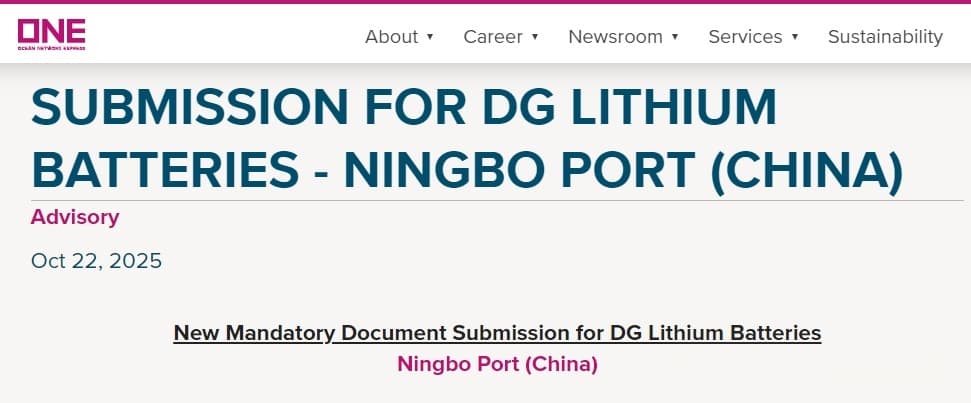
I. Core of the New Rule: UN38.3 Report Becomes a "Customs Clearance Pass"
II. Clear Scope of Application: Coverage Defined by Two Standards
2.1 Applicable Products: Class 9 Dangerous Goods + 5 UN Numbers
- UN3090: Independent lithium metal batteries (not installed in equipment)
- UN3091: Lithium metal batteries installed in or packed with equipment (e.g., lithium metal batteries built into cameras)
- UN3480: Independent lithium-ion batteries (commonly used in power banks and energy storage battery packs)
- UN3481: Lithium-ion batteries installed in or packed with equipment (e.g., built-in batteries for mobile phones and laptops)
- UN3536: Lithium batteries installed in cargo transport units (e.g., power battery systems for container trucks)
2.2 Applicable Scenarios: Full-Process Port Transportation
As long as the transportation involves ports covered by the new rule, regardless of the specific operation type, the new rule must be followed, including four scenarios: export loading, import unloading, port transshipment, and in-transit transportation. There are no exemptions for special scenarios.
III. Required Documents for Booking: Detailed List and Requirements
To ensure smooth booking and customs clearance, enterprises must focus on preparing the following two key documents in addition to submitting other dangerous goods-related materials. The specific requirements are as follows:
Document Name | Regulatory Status | Core Requirements |
UN38.3 Lithium Battery Testing Report | Newly Mandatory (Effective Immediately) | 1. Must correspond to the specific battery model being transported and cannot be used universally; 2. Clearly state compliance with the standards in Section 38.3 of the “UN Manual of Tests and Criteria”; 3. Issued by a qualified third-party testing institution |
Safety Data Sheet (SDS) | Existing Mandatory Requirement | 1. Comply with the format of the Globally Harmonized System of Classification and Labeling of Chemicals (GHS); 2. Complete content covering chemical composition, hazard characteristics, emergency handling, etc.; 3. Provide the latest version, and expired documents are not allowed |
IV. Key Understanding: Which Batteries Require UN38.3 Certification?
Many enterprises have the misunderstanding that “all batteries require certification”. Combining regulations and industry consensus, the following certification boundaries are clarified to avoid unnecessary cost increases:
4.1 Scenarios Requiring Certification
- Battery types: Lithium-ion batteries, lithium metal batteries, and various lithium battery packs;
- Product status: Newly designed lithium batteries, and lithium batteries and battery packs with improved designs;
- Application scenarios: Batteries for consumer electronics and power equipment, including electric vehicles, smartphones, laptops, digital cameras, and drones.
4.2 Exempt Scenarios
- Battery types: Non-lithium batteries such as nickel-cadmium batteries, nickel-metal hydride batteries, and lead-acid batteries;
- Certification status: Lithium batteries that have passed UN38.3 certification and have no changes in product design, materials, or production processes;
- Special cases: Small lithium batteries transported under specific conditions that meet the limited exemption regulations (exemption qualification must be confirmed with customs in advance).
V. Full Process of Applying for UN38.3 Lithium Battery Testing Report
Enterprises needing to apply for a new report or update an existing one can follow the following standardized process to ensure efficiency and compliance:
- Application and Document Preparation: Submit an application to a qualified third-party testing institution, and provide basic materials such as a fully completed application form, battery specification sheet, copy of the manufacturer’s business license, and testing authorization letter;
- Sample Preparation: Provide a sufficient number of samples as required by the institution. The samples must be consistent with the actual transported products and clearly marked with key parameters such as voltage, capacity, and model;
- Laboratory Testing: The institution will conduct multiple core tests in accordance with standards, including high-temperature, low-temperature, vibration, impact, overcharging, short-circuit, drop, and compression tests. The regular testing cycle is 2-4 weeks;
- Report Issuance: After passing the test, the institution issues an official UN38.3 lithium battery testing report, which details the test items, data, and compliance conclusions;
- Supporting Document Preparation: Simultaneously prepare supporting documents such as the “Dangerous Goods Transport Identification Certificate” and “MSDS (Material Safety Data Sheet)” for filing and review during transportation;
- Report Update: If there are changes in product design, materials, or production processes, re-testing and report updating are required to ensure consistency with the actual products.

VI. Industry Impact and Compliance Suggestions
This port new rule is not an isolated case but a clear signal of stricter international maritime dangerous goods regulation. As the global trade volume of lithium batteries continues to rise, port authorities around the world will increasingly strengthen control over transportation safety. The following practical suggestions are put forward for enterprise compliance management:
- Establish Compliance Files: Establish independent compliance files for each battery model, and file the corresponding UN38.3 lithium battery testing report, SDS, and change records to avoid model confusion;
- Strengthen Upstream Management: Require upstream battery suppliers to provide complete compliance documents, and verify the qualification of testing institutions and the validity of reports to control risks from the source;
- Reserve Buffer Time: In logistics plan formulation, reserve sufficient time for document review, report application, or update (it is recommended to start preparation at least 1 month in advance) to avoid booking delays due to document issues;
- Track Policy Dynamics: Arrange special personnel to track policy updates from maritime authorities, shipping companies, and major ports worldwide, and promptly adapt to the special requirements of different ports.
Relevant ports, as important global foreign trade ports, this new rule will directly affect the logistics efficiency of lithium battery import and export enterprises. Enterprises should promptly complete compliance verification of existing orders and products to ensure smooth operation under the new rule framework. For specific compliance questions, you can consult professional third-party testing institutions or maritime authorities for authoritative answers.