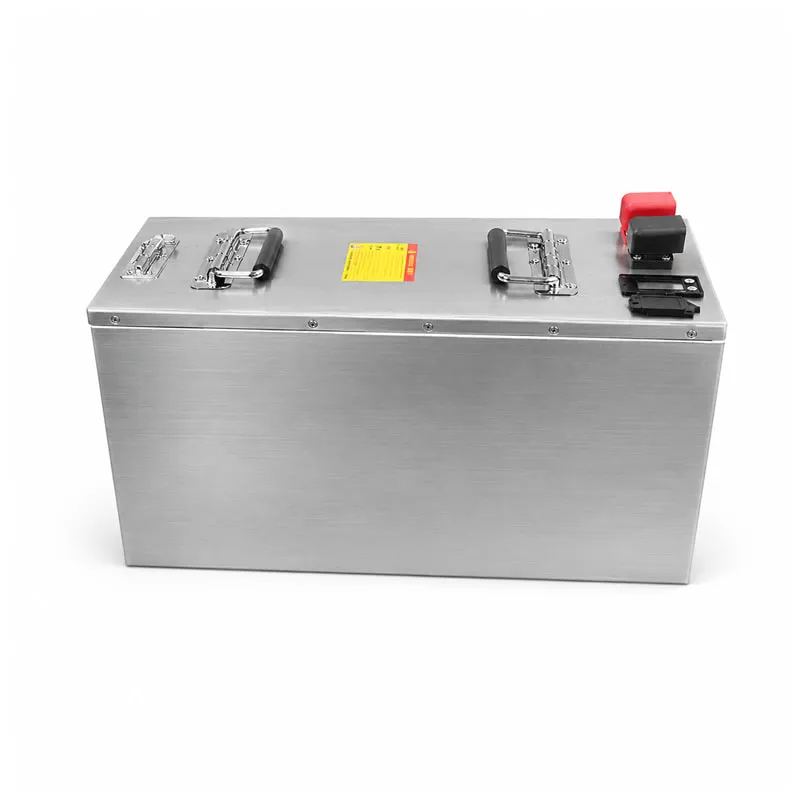
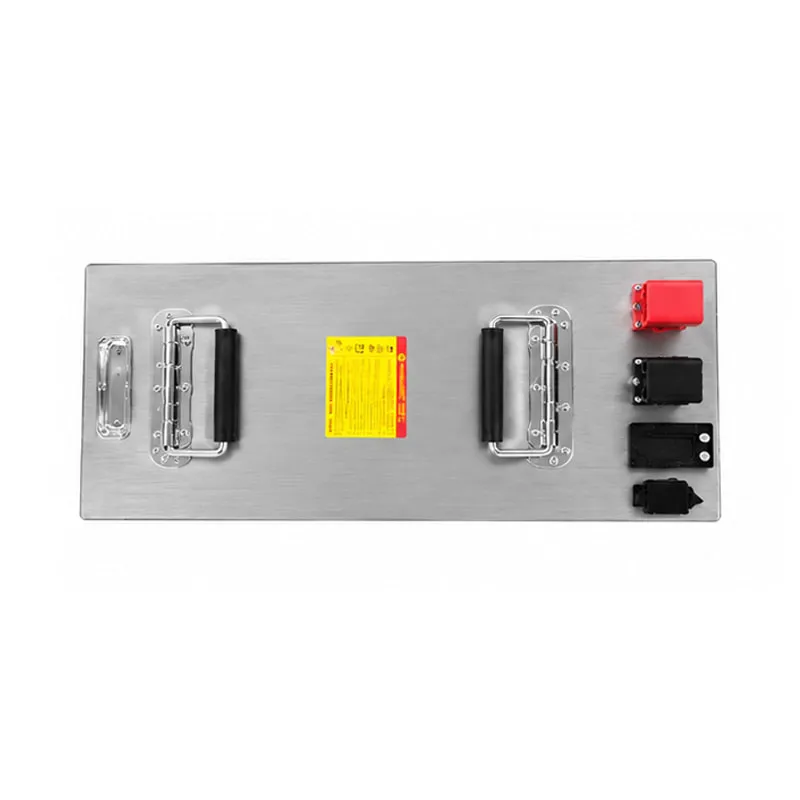
An AMR lithium battery can meet every catalog rating and still strand a robot at the far end of a warehouse. For OEMs, approval hinges on whether the pack behaves predictably during changing missions, regenerative events, controller faults and unattended docking—not simply whether it fits the chassis.
The approval standard is system evidence: validate real-route energy reserves, bidirectional current behavior where regeneration is supported, BMS-to-robot responses, charging recovery, mechanical interfaces and repeatable pilot-lot results. This turns an AMR lithium battery purchase into a defensible production decision.
This guide covers seven OEM approval checks: duty-cycle stress, regenerative and peak currents, return-to-dock energy reserve, BMS fault handling, docking and charging recovery, mechanical and electrical interfaces, and pilot-lot production consistency.
What Duty-Cycle Conditions Must OEMs Test Beyond Catalog Ratings?
A nominal capacity, discharge rating and enclosure drawing describe a component, not a mobile work system. AMRs reroute around congestion, queue at lifts, idle with sensors active and recover from interrupted missions. Those states change energy consumption and expose integration defects that a steady discharge bench test cannot reveal. The AMR lithium battery must also endure repeated wake cycles and sensor loads between tasks.
An AMR lithium battery should therefore be approved against the robot’s duty-cycle envelope: heaviest payload, longest detour, highest accessory load, lowest expected operating temperature and the oldest acceptable in-service pack. Procurement needs objective pass/fail criteria, not a supplier’s assurance of compatibility. Each AMR lithium battery release criterion should identify a test method, operational consequence and responsible approver.

Start with the operating requirements and customization pathways described in this power battery solution, then convert them into a platform-specific acceptance plan. Two robots with identical nominal pack ratings may need different reserve policies, fault handling and charge windows. The question is whether an AMR lithium battery can sustain the customer’s dispatch commitments.
How Should an AMR Lithium Battery Respond to Regenerative Braking and Power Spikes?
Stop-start travel produces short current excursions. Some AMR drive systems also return energy to the DC bus while decelerating or descending ramps; others dissipate braking energy elsewhere. OEMs must first establish whether regeneration actually reaches the AMR lithium battery. That decision determines whether the AMR lithium battery requires reverse-current validation under drive-level braking conditions.
Where it does, characterize the charge-current pulses at high state of charge (SOC), low temperature and after prolonged operation. A nearly full pack may have little charge-acceptance headroom. If the BMS abruptly blocks incoming current, bus voltage may rise unless the drive system has a coordinated alternative, such as a braking resistor or controlled deceleration strategy. Test the AMR lithium battery immediately after a charging session, when its available acceptance margin may be smallest.
Verify both directions of power flow: motor acceleration, lift actuation, simultaneous auxiliary loads, repeated braking and protective intervention. Record bus voltage, current, cell temperatures, BMS limits and fault timestamps. The AMR lithium battery should not oscillate between enable and inhibit states, and the controller must respect updated current limits. Agree on responses before approving the hardware.

How Can OEMs Prove Energy Reserve on Unpredictable AMR Routes?
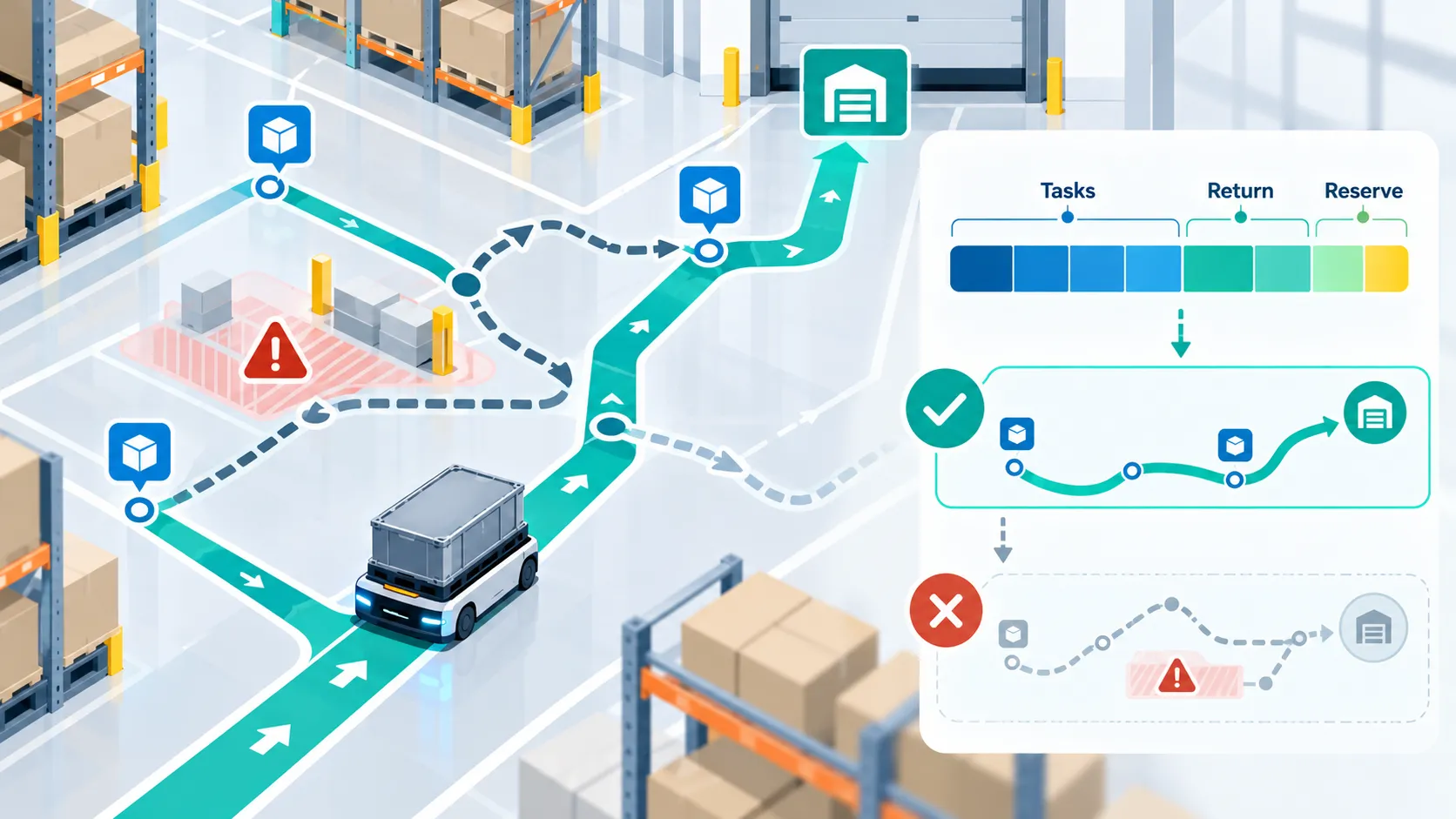
Runtime stated in hours assumes a repeatable load. Real AMR assignments include detours, payload changes, waiting time and docking traffic. A robust AMR lithium battery evaluation estimates energy required to finish the assigned task plus a safe return, rather than relying on a fixed low-SOC percentage. The AMR lithium battery should be judged against actual dispatch patterns, not an isolated full-charge range demonstration.
Build a route-energy model using measured watt-hours for motion, lifting, sensors, compute and idle periods. Test typical, demanding and degraded-capacity cases; include a blocked docking station and a farther alternative dock where the fleet design permits one. Compare coulomb-counted SOC with measured delivered energy over the mission. A drifting SOC estimate can look harmless until a robot accepts one task too many.
For example, an illustrative route budget of 20 tasks at 65 Wh each, 180 Wh to reach a dock and a 20% engineering allowance totals 1,776 Wh. These are planning assumptions, not a universal pack requirement. The actual margin must come from field measurements, aging, temperature and dispatch policy. An AMR lithium battery passes only when the scheduler stops allocating work early enough to preserve verified return energy.
Which BMS Messages and Fault Responses Must the Robot Controller Validate?
CAN or RS485 electrical compatibility does not establish interoperability. For an AMR lithium battery, the OEM should freeze message identifiers, scaling, update rates, timeout windows, alarm severity, charger permissions and firmware versions. The controller needs trustworthy SOC, charge/discharge limits, temperature warnings and fault status at the moments decisions are made. On an AMR lithium battery, stale telemetry can quietly corrupt task acceptance before it becomes a visible fault.
Inject communications loss, stale SOC, implausible telemetry, open-circuit sensors, thermal derating and a BMS reset while the robot is loaded. Define separate responses for a recoverable warning, a request for controlled stop and an immediate protective shutdown. An emergency hardware protection must not be defeated to avoid downtime; conversely, routine derating should not unnecessarily immobilize an AMR in an aisle.
An AMR lithium battery integration review must assign ownership: which action belongs to the BMS, drive controller, fleet software or safety controller? FEBATT’s documented AMR battery integration project illustrates why RS485 communication, physical interfaces and charging equipment were evaluated together. For fleet approval, keep timestamped fault-injection logs—not merely a successful protocol handshake.
How Should OEMs Validate Automatic Docking and Charging-Fault Recovery?
Dock arrival is not evidence of charging. An AMR lithium battery may reach the station while misaligned contacts, contamination or incomplete authorization prevents current flow. Acceptance testing should separate approach, electrical contact, charger enable, measurable current, charge termination and undocking.
Challenge the system with offset contacts, intermittent connection, charger power loss, a charge inhibit, and a communications interruption. Confirm that the AMR detects a failed charge session, attempts only the configured safe retries and then alerts the fleet manager or relocates according to the approved recovery policy. ROS Nav2’s docking architecture likewise distinguishes contact detection from confirmation that charging actually started. The AMR lithium battery and charging system need a shared definition of retry and abort states.
After each fault, inspect whether the AMR lithium battery resumes from a defined state without an uncontrolled restart, unsafe contact energization or duplicated task assignment. Track successful charge starts, time-to-recovery and manual interventions across repeated cycles. A charger that works once in a demonstration cannot establish unattended fleet readiness.
Which Mechanical and Electrical Interfaces Must Remain Frozen?
A few millimeters of connector displacement can force chassis rework across an entire robot fleet. The AMR lithium battery approval drawing must control the outer envelope, mounting datum, restraint, cable exit, bend radius, service clearance, center-of-mass effect and access for replacement. Evaluate repeated vibration, shocks during floor transitions and any relevant ingress exposure.
Electrically, freeze connector make and keying, pin assignment, precharge or inrush strategy where required, protection coordination, fuse and cable ratings, bonding and isolation provisions, and wake/sleep sequencing. Every AMR lithium battery interface change should carry a revision identifier, verification record and written disposition before new packs enter the assembly line.
Include service operations in the trial: can a technician remove a pack without damaging communication harnesses, and can the fleet identify an incompatible hardware or firmware revision? These details govern field interchangeability and maintenance time much more directly than another line on a specification sheet. OEM service teams should confirm that the AMR lithium battery can be replaced without firmware mismatches or connector rework.
What Integration Tests Should OEMs Finish Before AMR Battery Mass Production?
An AMR lithium battery should pass a staged release—not one successful prototype demonstration. Run representative validation on the actual robot, then confirm repeatability across a pilot lot with the production-intent bill of materials (BOM), BMS firmware and end-of-line (EOL) checks. Safety testing and vehicle-level functional testing serve different purposes. Repeat critical acceptance scenarios across multiple AMR lithium battery samples, not just a preferred golden unit.
| Validation gate | Required demonstration | Approval evidence |
|---|---|---|
| Dynamic duty | Small fleets or sites without fixed docking locations | Time-aligned electrical logs |
| Dispatch reserve | Worst-case route, aging allowance, return-to-dock decision | Energy budget and route replay |
| Control faults | Lost/stale BMS data, reset, limit changes, safe-stop behavior | Fault-injection report |
| Docking recovery | Contact loss, charge inhibit, interrupted charge, retry limits | Repeated-session recovery records |
| Pilot-lot consistency | Interfaces, firmware, EOL checks, traceability | Signed baseline and serial-linked results |
For pack-level industrial safety, IEC 62619:2022 specifies requirements and tests for secondary lithium batteries used in industrial applications, including AGVs. It does not replace application-specific robot risk assessment, docking verification or applicable machine-safety requirements. Define the required standards and test evidence for the destination market before quotation approval.
Finally, request a configuration-controlled release pack: drawings, approved BOM, BMS parameter file, interface protocol, verification matrix, nonconformance process and serial-level EOL records. This guide to lithium battery pack production quality control provides related change-control practices. A production-ready AMR lithium battery is one whose behavior and build state remain reproducible after the prototype engineers leave.
What Do OEMs Ask About AMR Lithium Battery Approval?
Q: Can any LiFePO4 battery be used in an AMR?
A: No. An AMR lithium battery must match the robot’s peak loads, communication protocol, physical constraints and charging logic. Pack chemistry alone cannot establish controller compatibility or safe fleet operation.
Q: How does regenerative braking affect an AMR lithium battery?
A: If the drive returns braking energy to the DC bus, the AMR lithium battery must tolerate permitted charge pulses. At high SOC or low temperature, its BMS and drive must coordinate to prevent overvoltage.
Q: What happens if an AMR loses battery communication?
A: The robot must follow its validated fault-response policy. Depending on the system design, the battery may remain energized during a controlled stop or disconnect through protective logic. Dispatch must not rely on stale SOC data.
Q: How can OEMs test low-SOC return-to-dock behavior?
A: Replay heavy-payload and detour routes with an aged-pack allowance. Verify the AMR lithium battery reserve covers completion and return, and that the scheduler rejects missions below the approved threshold.
Q: What tests are required before AMR battery mass production?
A: Complete dynamic-load, BMS fault-injection, docking recovery, interface, safety and pilot-lot tests. Release the AMR lithium battery only with signed acceptance limits, controlled revisions and traceable EOL records.
What Should OEMs Send Before Requesting an AMR Battery Approval Review?
Send FEBATT your AMR model, nominal voltage, usable-energy target, route and payload profiles, peak-current data, installation drawings, BMS communication protocol, docking requirements, operating environment, and annual production forecast. Ask for a proposed AMR lithium battery validation matrix and sample-to-production milestones—not only a unit quotation. Early joint review helps avoid fleet-wide commissioning delays. The approved AMR lithium battery should arrive with shared evidence that engineering, purchasing and fleet operations can all audit.