Forklift battery selection has become a fleet-level operating decision rather than a simple voltage-and-capacity purchase. In a warehouse, distribution center, manufacturing plant, or logistics hub, the battery affects runtime, lifting consistency, charging workflow, maintenance labor, equipment availability, and total cost of ownership. The best battery for forklift applications is therefore the one that matches the truck and its real duty cycle, not the pack with the largest number on the label.
For many high-utilization fleets, lithium—particularly LiFePO4—has become the stronger long-term option because it can combine lower routine maintenance, high usable energy, opportunity charging, stable power delivery, and BMS-based protection. Lead-acid systems can still make sense in low-utilization operations with established infrastructure and disciplined maintenance, but the comparison should include the entire operating system rather than purchase price alone.
A professional battery for forklift specification begins with the forklift platform: approved voltage window, controller demand, compartment dimensions, required battery mass, connector interface, charger, communication requirements, lifting profile, route, temperature, and shift schedule. Buyers can first review FEBATT’s forklift battery portfolio to understand the available lithium configurations, then narrow the selection according to the actual truck and warehouse conditions.

How Do You Choose a Battery for Forklift Applications in Logistics Centers?
Start with the duty cycle. A forklift that moves light pallets for a single shift has a very different energy profile from a reach truck working three shifts with frequent high-rack lifts. Operating hours alone are not enough; buyers should also record travel distance, lifting frequency, average payload, maximum validated payload, floor gradients, idle time, charger access, and the number of natural breaks available during a shift.
The next step is to define electrical requirements. A battery for forklift use must operate inside the voltage range approved for the truck and provide enough continuous and peak current for traction and hydraulic demand. Capacity should be sized from measured or estimated energy use with a practical operating margin. Oversizing can increase cost and mass unnecessarily, while undersizing can create repeated charging interruptions or BMS protection events.

Mechanical integration matters just as much. Battery dimensions, mounting points, service access, center-of-gravity implications, and minimum required battery weight must be checked before conversion. Some forklifts use battery mass as part of the vehicle’s counterbalance design, so replacing a heavy lead-acid unit with a lighter lithium pack may require engineering review or approved ballast rather than a simple drop-in swap.
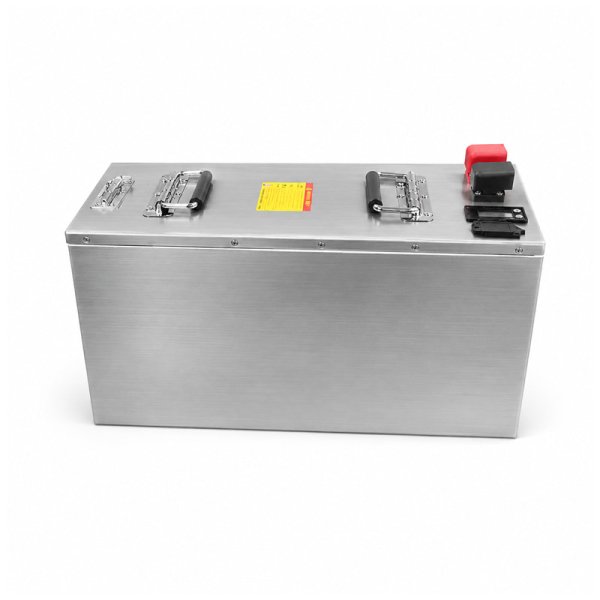
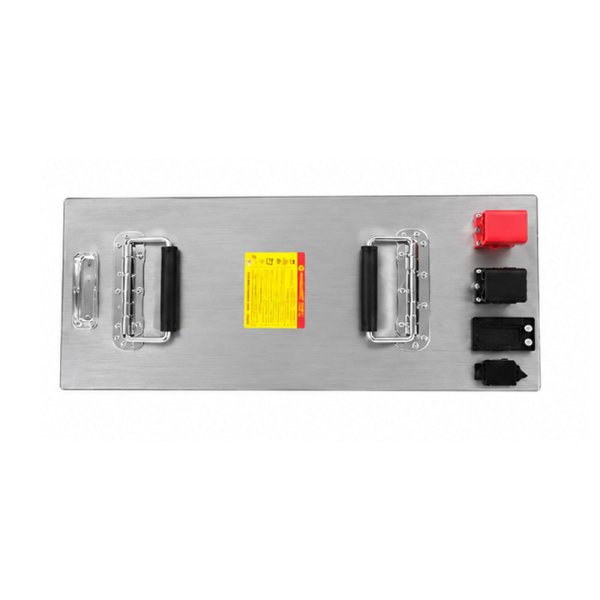
For compact 48V platforms, FEBATT’s 48V 60Ah forklift battery can be used as a reference configuration when the truck, current demand, runtime target, and compartment fit are compatible. It should not be treated as a universal eight-hour solution; actual runtime depends on energy use and available opportunity charging.
What Is the Difference Between 48V 30Ah, 48V 60Ah, and 105Ah Platforms?
Amp-hours describe charge capacity, but they do not tell the whole energy story. Nominal energy depends on both voltage and capacity, so a buyer comparing batteries for forklift use should consider watt-hours, current capability, usable operating window, and the efficiency of the complete battery-and-charger system.
A 48V 30Ah battery for forklift platform may suit compact or lower-energy equipment with short duty cycles and frequent charging access. A 48V 60Ah battery for forklift applications provides more energy reserve while remaining relatively compact. A 105Ah battery for forklift platform offers a deeper energy reserve and may be appropriate for longer operating windows, higher utilization, or heavier work, provided the forklift architecture supports the voltage and current requirements.
The best battery for electric forklift use cannot be selected from amp-hours alone. Two packs with the same capacity can behave differently because of cell design, BMS current limits, voltage architecture, thermal behavior, and internal resistance. Buyers should compare pack-level continuous current, short-duration peak current, charging limits, dimensions, installed mass, and communication capability.
For projects that do not fit a standard configuration, FEBATT can develop a custom power battery solution around the vehicle’s electrical architecture and duty cycle. This is often more reliable than forcing an off-the-shelf pack into a specialized forklift compartment.
How Should 64V 105Ah and 72V 105Ah Batteries Be Matched to High-Duty Forklifts?
High-rack stacking and heavy-duty material handling place repeated demand on traction motors and hydraulic systems. The correct battery for forklift operations must maintain a suitable voltage under those loads while staying within BMS, cable, connector, fuse, and thermal limits.
A higher-voltage system can deliver the same electrical power at lower current than a lower-voltage system, which can reduce resistive losses in the electrical path. That does not mean a 72V system is automatically better than a 64V system. The truck must be designed for the selected voltage. Controller maximum voltage, motor architecture, charger, DC-DC equipment, instrumentation, and other electronics must all be compatible.
For compatible 64V platforms, FEBATT’s 64V 105Ah forklift battery is a useful reference point for higher-energy applications. It should be evaluated against the truck’s actual operating voltage, current demand, compartment dimensions, and battery-mass requirements.
A well-matched forklift power battery should provide repeatable performance throughout the working window. Consistent lifting behavior, predictable voltage response, and appropriate current headroom are more meaningful than one impressive peak-power number. Fleet engineers should also confirm how repeated lift cycles affect voltage, temperature, and SOC across the full shift.
For a forklift engineered around 72V, FEBATT’s 72V 105Ah forklift battery provides another reference configuration with greater nominal energy than a 64V 105Ah pack. The choice between them is a platform-matching decision, not a ranking of which voltage is universally superior.
Why Is Lithium Often the Better Battery for Forklift Fleet Efficiency?
Lithium systems are attractive in fleet operations because they can reduce several recurring losses at the same time. A properly matched LiFePO4 battery for forklift use typically avoids routine watering, maintains a relatively stable discharge profile, supports partial charging, and can provide high usable energy within approved operating limits.
Energy efficiency should still be discussed carefully. Actual charging and round-trip efficiency depend on cell chemistry, charger design, current, temperature, cable losses, state of charge, and operating conditions. Instead of relying on one universal percentage, B2B buyers should compare measured electricity consumption and productive operating hours across equivalent duty cycles.
A lithium battery for forklift can also maintain more predictable power as the shift progresses. Lead-acid voltage typically declines more noticeably with state of charge and high load, while a correctly specified lithium forklift power battery can provide a flatter operating profile. This can be useful in warehouses where repeated lifting and acceleration must remain consistent late in the shift.
Another advantage is workflow flexibility. Lead-acid fleets may depend on long charging windows, spare batteries, or battery swaps. Lithium batteries for forklift applications can support opportunity charging when the cell specification, BMS, charger, and facility electrical system are designed for it. This allows energy replenishment during breaks or idle periods rather than forcing all charging into one long block.
How Can Opportunity Charging Improve Forklift Fleet Uptime?
For a battery for forklift fleet, opportunity charging is not simply “fast charging.” It is a planned operating strategy in which the fleet uses natural pauses to restore useful energy. The value depends on the warehouse schedule, charger power, battery charge limits, site electrical capacity, and the amount of energy consumed between charging opportunities.
A battery for forklift service should therefore be specified together with the charger. Procurement teams should confirm maximum charging voltage, recommended current, connector type, communication requirements, temperature limits, and how the BMS behaves when operating conditions fall outside the approved range.
High charge or discharge capability should also be interpreted in context. A high C-rate may be technically possible, but repeated aggressive charging can add thermal and electrochemical stress. The best battery for electric forklift fleets is not the one with the highest advertised charge rate; it is the system that restores enough energy within the available window while protecting long-term reliability.
For multi-shift operations, this can reduce dependence on spare batteries and battery-changing labor. For lower-utilization fleets, the financial benefit may be smaller. That is why charging strategy should be modeled from actual operating data rather than assumed from chemistry alone.
What BMS Features Matter in a Forklift Power Battery?
The BMS is the control and protection layer of a modern lithium forklift power battery. It monitors battery conditions and applies protection logic when electrical or thermal limits are exceeded.
For a battery for forklift system, important functions can include overcharge protection, over-discharge protection, overcurrent and short-circuit protection, cell voltage monitoring, balancing, temperature protection, fault logging, and communication with the charger or vehicle where required. The exact functions depend on the production design and customer specification.
For B2B buyers, the important question is whether the BMS is matched to the truck. Continuous and peak current limits should exceed validated vehicle demand with appropriate engineering margin. Protection thresholds should not create nuisance shutdowns during normal acceleration or lifting, and communication interfaces should be compatible with the application when CAN, RS485, or other data exchange is required.
A sophisticated BMS cannot compensate for an undersized battery, poor connector selection, or incorrect charger. The battery for forklift system must be engineered as one electrical architecture.
How Does Lower-Routine-Maintenance Lithium Reduce Warehouse Operating Costs?
Maintenance is a major difference between flooded lead-acid batteries and lithium systems. Lead-acid fleets may require watering, electrolyte checks, terminal cleaning, equalization procedures, corrosion management, ventilation controls, and battery handling. The exact schedule depends on battery type, utilization, charger strategy, and manufacturer instructions.
A lithium battery for forklift generally removes routine electrolyte watering and sulfuric-acid handling. Technicians still need to inspect cables, connectors, mounting, enclosure condition, charger operation, and BMS faults, so “lower routine maintenance” is more accurate than “maintenance-free.”
For a battery for forklift fleet, the savings can extend beyond technician time. Fewer battery swaps can reduce handling activity. Simpler charging workflows may reduce dedicated battery-room requirements in some installations. Lower installed maintenance burden can also improve consistency across shifts because battery care depends less on repeated manual procedures.
These advantages make lithium especially compelling for high-utilization facilities. In a single-shift warehouse with mature lead-acid processes, the economic difference may be smaller. A responsible lead acid vs lithium comparison should therefore use the facility’s real labor, infrastructure, electricity, downtime, and replacement data.
What Environmental Limits Should Buyers Check Before Selecting a Battery for Forklift Use?
Industrial warehouses expose batteries to heat, cold, dust, humidity, vibration, shock, and repeated vehicle movement. A battery for forklift use should be evaluated against the environmental conditions of the specific facility.

Charging and discharging temperature limits may differ, and low-temperature charging requires particular attention. Lithium cells should be charged only within their approved temperature range. Where cold-room operation is required, the production battery may need low-temperature charging protection, insulation, or a controlled heating strategy.
Ingress protection should also be interpreted correctly. An IP rating describes resistance to dust and water ingress under defined test conditions; it does not guarantee immunity from every type of moisture, pressure change, impact, or incorrect reassembly. Buyers should review enclosure design, cable glands, connectors, vents, corrosion resistance, mounting, and service procedures together.
Vibration and shock are equally important. Batteries for forklift equipment operate in a mobile industrial environment, so cell restraint, cable routing, busbar design, mounting points, and enclosure strength can affect long-term reliability.
How Should Warehouse Managers Estimate the Payback of a Lithium Conversion?
The business case should start with total cost of ownership rather than battery price. A lithium battery for forklift may cost more initially, but the relevant question is whether lower maintenance, reduced battery handling, charging flexibility, energy performance, and replacement planning offset that premium over the fleet’s ownership period.
For a battery for forklift conversion, a practical model can include battery and charger acquisition, installation, maintenance labor, battery-changing labor, electricity use, charging-related downtime, spare-battery inventory, battery-room infrastructure, end-of-life handling, and the value of productive forklift hours.
A simple payback estimate divides the additional lithium investment by expected annual operating savings. It is useful for screening, but it should not be treated as an exact financial forecast. The strongest model uses conservative assumptions and site-specific data.
For high-utilization operations, lithium often produces the stronger lifecycle proposition because several recurring costs can be reduced simultaneously. For lightly used trucks, lead acid may remain economically reasonable. The best battery for electric forklift fleets should therefore be selected on cost per productive operating hour, not unit purchase price alone.
What Custom Options Matter for Specialized Forklift Compartments?
A custom battery for forklift project may be necessary when the truck uses unusual compartment dimensions, weight requirements, current demand, connectors, or communication protocols. Customization should begin with application data rather than a request for a particular amp-hour number.
Mechanical information should include compartment dimensions, mounting points, service access, lifting features, center-of-gravity requirements, and required installed mass. Electrical information should include operating voltage, controller current, charger requirements, fuse and connector details, and communication interfaces.
For a custom battery for forklift, functional options can include SOC displays, CAN or RS485 communication, fleet data interfaces, low-temperature protection, enclosure modifications, and application-specific diagnostic features. These options should be validated as part of the complete forklift power battery rather than added independently.
Before production deployment, a pilot pack should be tested under representative lifting, travel, charging, temperature, and shift conditions. This is especially important when replacing lead acid because battery weight and voltage behavior may be part of the forklift’s original design assumptions.
Conclusion
Choosing the right battery for forklift operations requires a system-level view. Voltage and amp-hours matter, but they must be evaluated alongside current capability, usable energy, charging strategy, BMS behavior, environmental limits, battery mass, mechanical fit, and total fleet economics.
For high-utilization warehouses, lithium is usually the stronger long-term option because it can reduce routine maintenance, support opportunity charging, provide stable power delivery, and simplify fleet energy management. These benefits are most valuable when the battery is engineered for the truck rather than selected from a generic specification table.
A compact 48V battery for forklift may be ideal for one vehicle, while a higher-energy 64V or 72V configuration may be required for another. There is no universal best voltage or capacity. The best battery for electric forklift use is the one validated against the real workload, charging schedule, and vehicle architecture.
By treating the forklift power battery as part of the complete material-handling system, B2B buyers can make a more defensible purchasing decision and build a fleet power strategy that supports uptime, productivity, and long-term operating value.
Frequently Asked Question About Battery for Forklift
1.How much energy can lithium save compared with lead acid?
There is no universal percentage. Electricity use depends on battery and charger efficiency, duty cycle, temperature, battery condition, current demand, and charging practices. Lithium systems can reduce energy losses compared with conventional lead acid, but B2B buyers should compare measured consumption under equivalent operating conditions.
2.Is 72V 105Ah better than 64V 105Ah for high-stacking forklifts?
Not universally. The correct battery for forklift use must match the forklift’s approved voltage architecture. A 72V 105Ah pack has higher nominal energy than a 64V 105Ah pack, but it is appropriate only for equipment designed for 72V. Controller, motor, charger, DC-DC equipment, communication, current demand, compartment fit, and required battery mass should all be verified.
3.Can a 48V 60Ah battery for forklift run an eight-hour shift?
It may be appropriate for some trucks, but runtime cannot be determined from 48V and 60Ah alone. Actual operating time depends on average power demand, lifting frequency, travel distance, payload, temperature, idle time, usable battery energy, and opportunity charging. Buyers should compare the pack’s usable energy with measured duty-cycle consumption.
4.What safety or compliance documents should B2B buyers verify?
Requirements depend on the battery design, forklift application, destination market, transport method, and customer specifications. Buyers should verify the product-level test reports, transport documentation, and applicable standards required for the actual production battery rather than relying on one universal certification list.
5.Does a lithium forklift fleet need a dedicated charging room?
Not always. Charging-area requirements depend on the battery, charger, fleet size, building design, local rules, insurer or workplace requirements, and site safety procedures. Lithium may allow a different charging layout from flooded lead acid, but every installation should be reviewed at facility level.
6.What information should I provide when requesting batteries for forklift fleets?
Provide forklift make and model, operating voltage, controller current, existing battery dimensions and mass, connector details, shift length, travel and lifting profile, payload, charging windows, temperature, communication requirements, and expected fleet volume. Better application data leads to a better-matched battery for forklift specification.