Electric utility vehicles are entering an application-specific era. A utility vehicle battery is no longer selected only by voltage and amp-hour capacity. Buyers now evaluate chemistry, usable energy, peak current, charging, thermal control, communications, enclosure design and lifecycle cost as one system.
This change matters across forklifts, golf carts, tow tractors, electric tricycles, AGV/AMR platforms and low-speed commercial vehicles. A warehouse truck may need opportunity charging and multi-shift output, while a golf cart fleet may prioritize drop-in installation, low maintenance and stable range.
The leading 2026 developments are not a single “replacement” chemistry. They are a portfolio of technologies: commercially expanding sodium-ion cells, higher-energy semi-solid cells, higher-voltage vehicle architectures, cell-to-pack integration and smarter battery management. The right choice depends on duty cycle, pack space, operating climate, charging access and total cost of ownership. Buyers seeking application-specific engineering can review FEBATT’s custom power battery solutions for support with electrical, mechanical and communication requirements.
Why Is the Utility Vehicle Battery Market Diversifying?
For many years, buyers compared flooded lead-acid, sealed lead-acid and conventional lithium packs mainly by purchase price. That approach is increasingly inadequate. The same utility vehicle battery cannot be optimized simultaneously for maximum energy density, the lowest upfront cost, rapid charging, extreme cold, high peak power and the longest possible service life.
A forklift may face repeated high-current lifting, while a golf cart follows a predictable route. An electric tricycle may encounter rain, vibration and irregular charging, and an AGV needs accurate state-of-charge reporting. These profiles require different cells, BMS settings, structures and validation procedures.
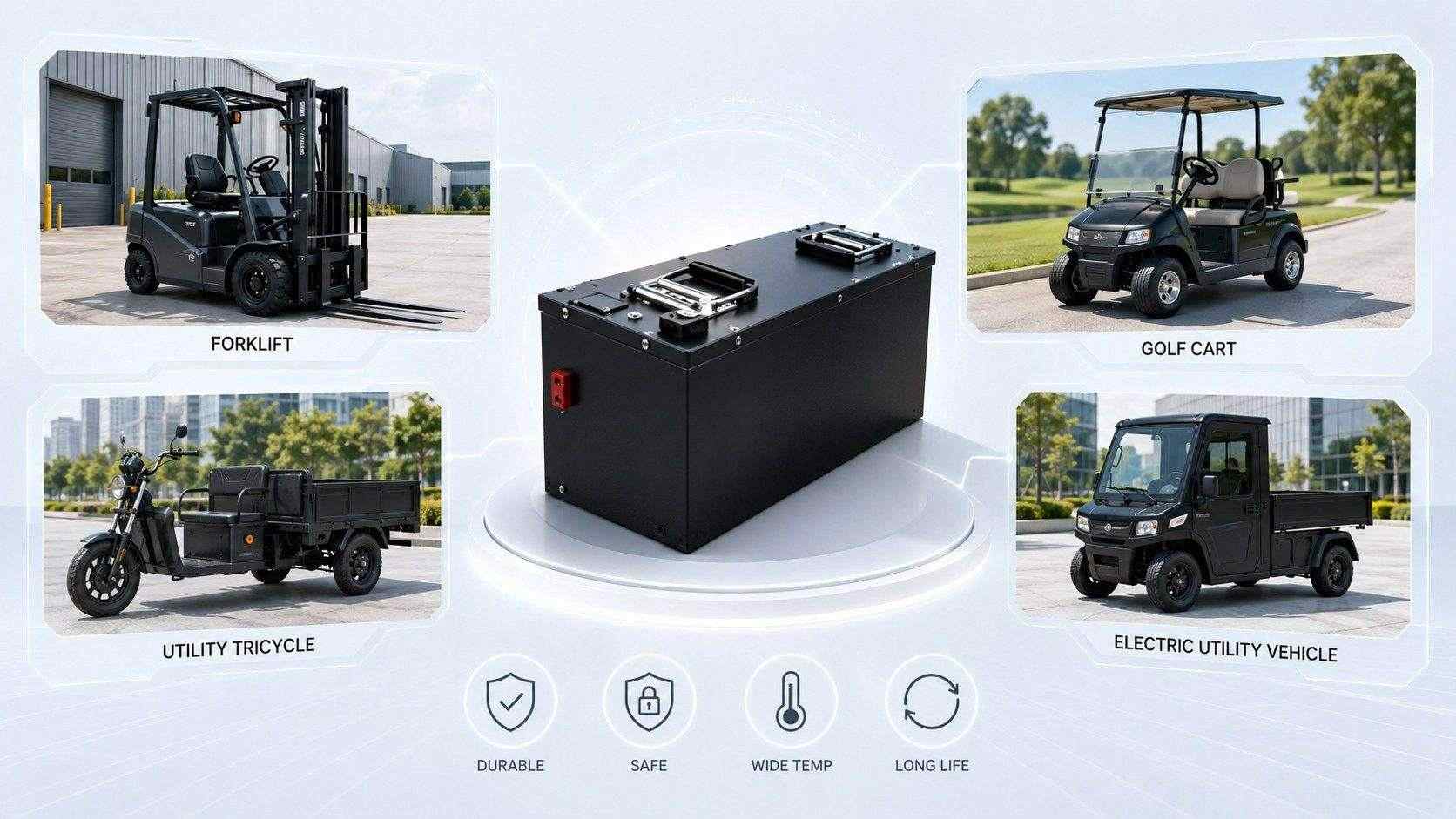
The result is a shift toward custom battery solutions rather than generic replacement. Before selecting a utility vehicle battery, the supplier should confirm voltage, usable energy, continuous and peak current, charger specifications, communication, installation space, temperature range, vibration exposure and required certifications. A pack that meets only voltage and capacity targets may still fail during integration, so matching the battery to the machine is more important than choosing the newest chemistry.
Will Sodium-Ion Change Utility Vehicle Battery Economics?
Sodium-ion is entering broader commercialization. Its materials can reduce dependence on lithium, but buyers should not assume every sodium-ion pack is already cheaper than LFP.
The International Energy Agency reported in February 2026 that latest sodium-ion cells can reach approximately 175 Wh/kg, compared with about 205 Wh/kg for leading LFP cells. The IEA also noted that sodium-ion batteries are not yet consistently cheaper than LFP at current lithium prices. Their future cost advantage will depend on production scale, supply-chain maturity and material prices.
For a utility vehicle battery, lower gravimetric energy density is not always a decisive disadvantage. Golf carts, low-speed utility vehicles, short-route tricycles and some warehouse machines often have more tolerance for pack weight than passenger EVs. In these applications, supply-chain resilience, low-temperature capability and lifecycle economics may carry more value than maximum range per kilogram.
Sodium-ion performance in cold conditions is especially relevant. The IEA has cited recent cells retaining around 90% of capacity at temperatures as low as -40°C. That figure should not be treated as a universal pack guarantee, because results vary by chemistry, test rate, thermal conditioning and BMS settings. Still, it shows why sodium-ion deserves evaluation for fleets operating in cold regions.
Where Does Sodium-Ion Golf Cart Power Make Sense?
Sodium-ion golf cart power is most attractive where routes are predictable, daily energy demand is moderate and low-temperature availability matters. A golf course, resort or industrial campus may accept a slightly heavier utility vehicle battery if it provides stable winter operation and a competitive long-term supply strategy.
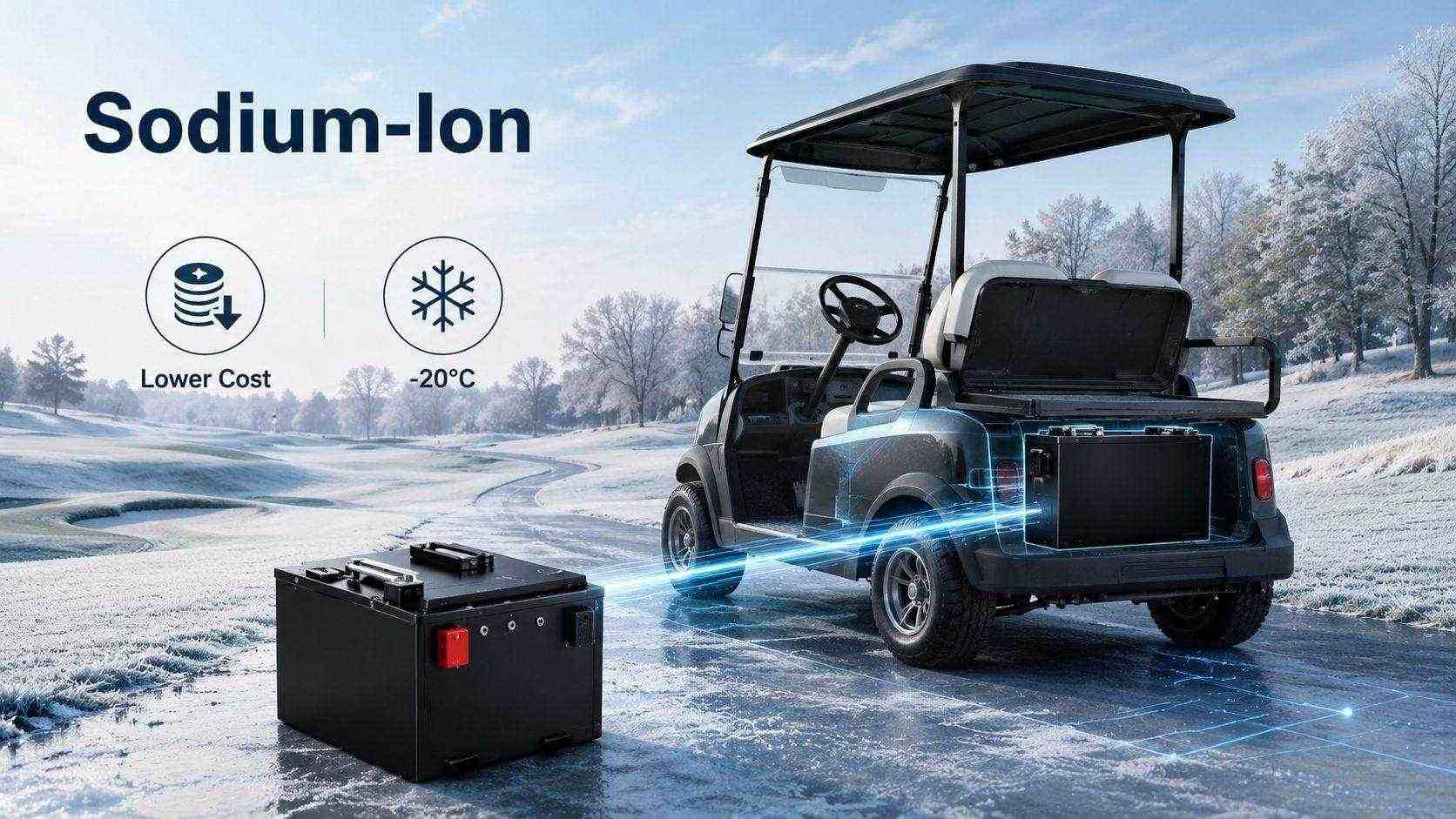
The business case must still be verified with a real pack quotation. Buyers should compare usable kilowatt-hours, cycle-life warranty, charger compatibility, low-temperature charging rules and replacement availability. Sodium-ion golf cart power should not be selected only because the chemistry is new. It should be selected when the duty cycle and commercial terms are stronger than the available LFP alternative.
Sodium-Ion and LFP Comparison
| Evaluation Point | Sodium-Ion | LFP |
|---|---|---|
| Leading cell energy density | Up to about 175 Wh/kg | Up to about 205 Wh/kg |
| Commercial maturity | Expanding, but less established | Broadly commercial and widely available |
| Low-temperature potential | Strong in recent cell designs | Good discharge capability; charging often needs temperature protection or heating |
| Cost position in 2026 | Potential future advantage; not always cheaper today | Highly competitive due to mature scale |
| Suitable applications | Cold-climate fleets, low-speed vehicles, selected golf carts and tricycles | Forklifts, golf carts, AGV/AMR, utility vehicles and industrial fleets |
For most current projects, LFP remains the lower-risk utility vehicle battery choice because its supply chain, charger ecosystem and field history are more mature. Sodium-ion is best treated as a targeted option rather than an automatic replacement.
Are Semi-Solid Cells Ready for Premium Utility Vehicles?
Semi-solid batteries use a hybrid electrolyte design that contains less liquid electrolyte than conventional lithium-ion cells while not being fully solid-state. They are already available in selected commercial applications, but they should not be confused with the fully solid-state batteries still progressing toward broader industrialization.
Commercial semi-solid cell specifications vary. WELION lists products above 300 Wh/kg for high-performance motorcycles and light electric vehicles, and it has documented a 360 Wh/kg cell used in a production passenger vehicle. These are cell-level figures. The complete utility vehicle battery will have lower pack-level energy density after adding the enclosure, cooling components, BMS, busbars, wiring, isolation and safety structures.
The strongest use case is a weight- or space-sensitive vehicle. A premium electric motorcycle or compact specialist platform may justify semi-solid cells because a smaller utility vehicle battery can store more energy than a conventional pack of similar mass.
Semi-solid is not automatically the safest or most economical option. Safety depends on complete-pack design, abuse testing, thermal control and manufacturing consistency. For mainstream forklifts and fleet golf carts, mature LFP custom battery solutions often offer a better balance of cost, durability and availability.
Why Are Higher-Voltage Architectures Expanding?
Heavy-duty electric machines increasingly use 72V, 80V, 96V and higher systems where power demand justifies the change. The engineering reason is straightforward: electrical power equals voltage multiplied by current. For the same power output, raising voltage reduces current. Because resistive losses increase with the square of current, lower current can reduce heat in cables, connectors and power electronics.
A higher-voltage utility vehicle battery can therefore support high-power lifting, acceleration and auxiliary loads with more manageable conductor sizes. This can be valuable for larger forklifts, tow tractors, AGVs and specialist industrial vehicles. It may also help the charging system deliver higher power without requiring extremely high current.
However, voltage must match the complete vehicle architecture. A 48V forklift cannot simply receive a 96V utility vehicle battery. The motor controller, traction motor, charger, DC/DC converter, contactors, fuses, insulation monitoring and wiring must all be designed for the selected voltage range.
Higher voltage does not guarantee faster charging. Charge time still depends on charger power, cell charge rate, temperature, BMS limits and thermal management.
What Determines Forklift Battery Pack Lifespan?
Forklift battery pack lifespan is influenced by much more than chemistry. Important factors include depth of discharge, average state of charge, cell temperature, charge rate, peak current, cell balance, maintenance quality and the number of operating shifts.
A well-designed LFP utility vehicle battery may be specified for several thousand full-equivalent cycles, but the exact rating must come from the cell and pack supplier under defined test conditions. “One cycle” should also be interpreted carefully. Two 50% discharges are approximately one full-equivalent cycle, even though the forklift was charged twice.
To improve forklift battery pack lifespan:
- Size the pack so normal operation does not require repeated maximum-depth discharge.
- Use a charger approved for the pack voltage and communication protocol.
- Keep cells within the supplier’s recommended temperature range.
- Control high-current charging when the pack is cold or hot.
- Maintain accurate cell balancing and state-of-charge estimation.
- Review operating data for abnormal heat, voltage spread or current peaks.
- Avoid changing BMS limits without engineering approval.
Buyers comparing lithium forklift battery systems should request cycle-life conditions, usable depth of discharge, warranty terms and expected energy throughput, not only a headline cycle number.
How Does Cell-to-Pack Integration Improve Packaging?
Traditional battery construction groups cells into modules before installing those modules inside the final enclosure. Cell-to-pack, or CTP, removes part or all of the intermediate module structure. This can increase the percentage of internal pack volume used by active cells and reduce duplicated housings, fasteners and connections.
The improvement is design-specific. CATL’s third-generation Qilin CTP platform reported 72% volume utilization, rising from 55% in its first-generation CTP design. That result demonstrates the potential of high integration, but it should not be applied as a universal specification for every industrial utility vehicle battery.
For golf carts, tricycles, floor scrubbers and other vehicles built around fixed lead-acid trays, better packaging can provide more usable energy within the original space. It may also help reduce pack height or leave room for stronger protection, service disconnects and cooling channels.
CTP also creates trade-offs. High integration may improve stiffness and reduce parts, but repair can become more difficult. Effective custom battery solutions balance packaging efficiency, thermal control, electrical isolation and serviceability.
What Role Does the BMS Play in a Modern Utility Vehicle Battery?
The battery management system is responsible for much more than displaying state of charge. In a commercial utility vehicle battery, the BMS measures cell voltage, pack current and temperatures; controls contactors; manages charge and discharge limits; balances cells; records faults; and communicates with the charger and vehicle controller.
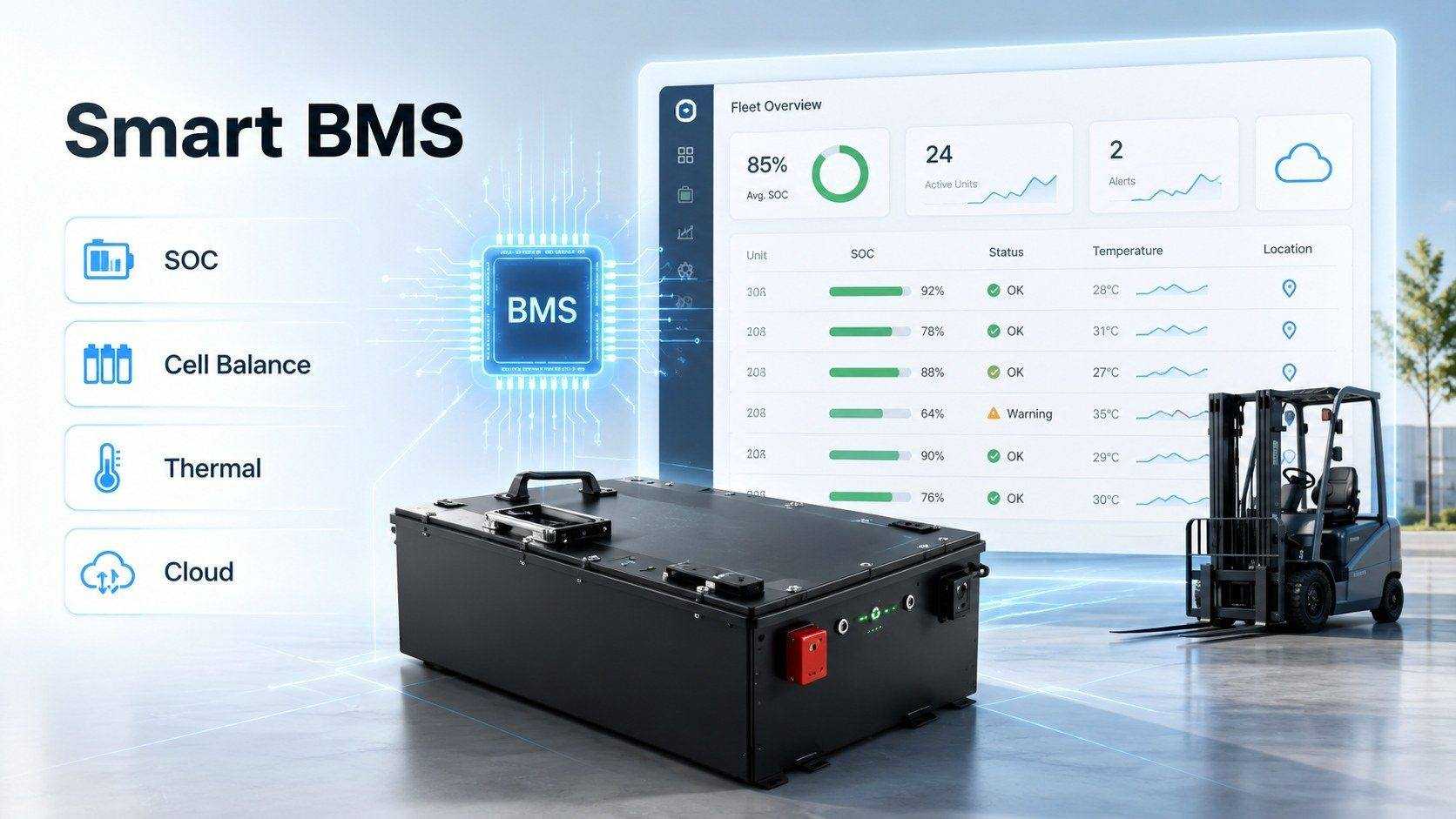
A well-configured BMS limits operation outside validated temperature, current and voltage boundaries. It can also transmit state of charge, state of health, alarms and operating history to the vehicle or fleet platform.
The BMS cannot correct an undersized pack, poor cooling design or incompatible charger. It must be calibrated around the selected cell, current sensor, contactors, fuse strategy and thermal system. For a high-voltage utility vehicle battery, isolation monitoring, pre-charge control and high-voltage interlock functions may also be required.
B2B buyers should confirm communication documentation, fault-code definitions, data logging, firmware control and access permissions before mass production. These details often determine whether the utility vehicle battery integrates smoothly or creates repeated commissioning delays.
How Should Buyers Calculate Battery ROI?
The lowest purchase price does not necessarily produce the lowest fleet cost. A complete ROI calculation should include the pack, charger, installation, engineering, certification, downtime, maintenance, electricity and replacement schedule.
A practical formula is:
ROI = (lifetime savings + productivity gains – total investment) ÷ total investment × 100%
For each utility vehicle battery option, estimate the initial system cost, usable energy, warranted throughput, charging efficiency, maintenance, downtime, replacement timing and vehicle modification cost.
Lead-acid may retain an upfront-price advantage in some projects, but it can require watering, equalization, ventilation, battery changing and more frequent replacement. Lithium may reduce those tasks and support opportunity charging. Sodium-ion may become attractive where cold performance or future material economics justify it. Semi-solid may produce value where reducing weight or pack volume directly improves the vehicle’s commercial performance.
The correct utility vehicle battery is the one that produces the strongest verified cost per operating hour or cost per delivered kilowatt-hour, not the one with the most impressive single specification.
How Do You Match the Battery to Each Application?
Electric Tricycles and Low-Speed Commercial Vehicles
These vehicles often face vibration, rain, irregular charging and price pressure. The utility vehicle battery should prioritize structural durability, stable BMS protection, suitable ingress protection, practical connectors and predictable replacement supply. LFP remains a strong default, while sodium-ion may be evaluated for cold-climate or cost-sensitive future programs.
Multi-Shift Forklifts and Tow Tractors
The central requirements are power consistency, charger access, thermal control and forklift battery pack lifespan. Pack capacity should be based on measured energy use per shift, not only the original lead-acid amp-hour rating. Opportunity charging requires coordinated charger power, BMS limits and break schedules.
Golf Cart and Resort Fleets
A golf-cart utility vehicle battery should fit the existing tray, maintain stable range, communicate with the display when required and account for vehicle weight balance. LFP is widely suitable for fleet conversions. Sodium-ion golf cart power may become attractive for cold locations or projects seeking chemistry diversification, but current availability and total cost must be checked.
AGV, AMR and Automated Equipment
Automated platforms depend on reliable communication and accurate state-of-charge estimation. The utility vehicle battery may need CAN or RS485 integration, automated charging, low-profile packaging and fault reporting to the fleet management system. Small communication errors can stop the vehicle even when the cells remain healthy.
Special and Custom Vehicles
Special vehicles may combine unusual voltage, limited space, high peak current, harsh vibration and low annual volume. These projects usually need custom battery solutions covering electrical architecture, mechanical design, BMS software, prototypes, vehicle testing and controlled production release.
What Information Should Be Sent to a Battery Supplier?
A useful request should include the vehicle type, voltage, motor and controller ratings, continuous and peak current, daily duty cycle, charging windows, pack dimensions, connector location, communication protocol, temperature range, certification market and expected volume. These inputs allow the supplier to determine whether LFP, sodium-ion, a higher-voltage design or another utility vehicle battery configuration is justified.
Relevant Technical FAQ
1.How long does a modern utility vehicle battery last?
Service life depends on chemistry, depth of discharge, temperature, charge rate and pack design. Many commercial LFP packs are marketed for several thousand full-equivalent cycles, but buyers should request the exact test conditions and end-of-life threshold. In real fleets, a properly sized and thermally controlled utility vehicle battery may provide five to ten years of service, while severe heat, deep cycling or incorrect charging can shorten that period substantially.
2.Can a lead-acid battery be replaced directly with lithium?
Sometimes, but it should not be treated as a simple cell swap. The replacement utility vehicle battery must match the vehicle’s operating voltage, peak current, charging system, connector, mounting space and communication needs. The original lead-acid charger may be unsuitable for lithium. Vehicle stability and ballast requirements must also be reviewed because lithium is lighter. A qualified supplier should validate the complete conversion before fleet deployment.
3.What is the best utility vehicle battery for cold weather?
There is no universal best chemistry. Recent sodium-ion cells show strong low-temperature capacity retention and may suit selected cold-climate fleets. LFP can also operate effectively in cold environments when the pack includes appropriate cell selection, insulation, heating and low-temperature BMS protection. Standard LFP charging below 0°C is commonly restricted because high-rate charging can cause lithium plating. Buyers should specify minimum operating and charging temperatures and request verified pack-level test data.
4.Why can a higher-voltage battery be useful for forklifts?
For the same power, higher voltage allows lower current, which can reduce resistive losses and heat in cables and connectors. This is useful in high-power lifting and multi-shift applications. The benefit applies only when the forklift, charger and power electronics are designed for that voltage. Installing a higher-voltage utility vehicle battery in an incompatible truck is unsafe and can damage the electrical system.
5.Are semi-solid batteries safe for electric motorcycles and light vehicles?
Semi-solid cells can offer higher energy density and may reduce the amount of liquid electrolyte, but safety must be evaluated at complete-pack level. Cell chemistry alone does not guarantee a safe utility vehicle battery. Buyers should review abuse-test results, thermal propagation controls, BMS protection, enclosure design, charger compatibility and applicable certification. Semi-solid technology is most appropriate when its weight and space benefits justify the higher cost and integration requirements.
6.Is sodium-ion already cheaper than LFP?
Not consistently. Sodium-ion has the potential to use lower-cost and more widely available materials, but the IEA reported in 2026 that current lithium prices and mature LFP manufacturing still make LFP highly competitive. A sodium-ion utility vehicle battery may become economically attractive as production scales, but buyers should compare actual pack quotations, warranty, energy density, cycle life and charger costs rather than relying on a general chemistry claim.
Conclusion
The 2026 market is moving away from one-size-fits-all batteries. Sodium-ion offers cold-temperature potential and supply-chain diversification. Semi-solid cells provide higher cell-level energy density, while higher-voltage systems and CTP can improve power delivery and packaging. BMS quality, thermal design, communication and duty-cycle validation remain essential.
For B2B buyers, the best utility vehicle battery is not necessarily the newest or highest-voltage product. It is the pack validated for the machine, operating environment, charger, safety requirements and commercial target. Careful application data, prototype testing and controlled production are the foundation of a reliable fleet upgrade.