As the core power guarantee of golf carts, the lithium battery for golf cart relies on stable operation and long-term use to enhance travel experience and control usage costs. With core advantages like long service life, high efficiency, and low maintenance, lithium batteries have become the mainstream upgrade option for golf carts. Through scientific repair methods and standardized maintenance, we can not only fully release their
performance potential but also extend their service life further—achieving the dual benefits of environmental protection and economy. Combining professional technology and practical experience, this article details the repair methods and maintenance techniques of these batteries, offering practical and safe operational guidance.
(I) Types and Core Advantages of Lithium Batteries for Golf Carts——Matching Scenarios with Performance Advantages
The commonly used lithium batteries for golf carts mainly include lithium iron phosphate batteries and ternary lithium batteries, which are suitable for diverse usage scenarios and each has distinct advantages:
- Lithium Iron Phosphate Batteries: Leading in safety with excellent thermal stability and long cycle life, they can withstand high-frequency charging and discharging. Suitable for commercial fleets and high-frequency outdoor use scenarios, they are the preferred choice for users prioritizing reliability.
- Ternary Lithium Batteries: Boasting high energy density, they offer longer driving range under the same volume, faster charging speed, and a lightweight design that enhances vehicle handling flexibility. Ideal for scenarios requiring high driving range and portability.
Both types of lithium batteries feature mature technical systems and comprehensive BMS . By following correct usage and maintenance methods, they can fully exert their efficient and stable power advantages, providing continuous and reliable energy support for golf carts.
(II) Core Repair Technologies for Lithium Batteries in Golf Carts——Targeted Solutions for Common Faults
1. Balancing Repair Technology: Core Solution for Capacity Fade
The decline in cell consistency during lithium battery use is the main cause of capacity fade and shortened driving range. Balancing repair technology restores the overall performance of the battery pack by targeted adjusting the voltage of each cell. It is applicable to lithium batteries with significantly reduced driving range or premature charging termination.
2. Standardized Operation Steps: From Safety Preparation to Performance Activation
- Safety Preparations: Before operation, disconnect the charger from the battery terminals, turn off the vehicle power, select a dry and well-ventilated environment, and wear insulating gloves to avoid static electricity or short-circuit risks.
- Cell Testing: Use a professional battery balancer or multimeter to measure the voltage of each cell in the battery pack one by one, and record the voltage deviation (normal deviation should be ≤ 0.05V).
- Balancing Adjustment: Correctly connect the balancer to the battery pack, start the balancing program according to the equipment instructions, discharge cells with excessively high voltage, and supplement power to cells with low voltage until the voltages of all cells tend to be consistent.
- Standing Observation: After balancing, disconnect the equipment, let the battery stand for 4-8 hours, and re-test the cell voltages to confirm that the consistency meets the standard (deviation ≤ 0.03V).
- Standard Charging: Use a dedicated charger matching the lithium battery’s voltage and current for regular charging for 6-8 hours to activate the overall performance of the battery pack.
3. Safe Operation Points: Avoiding Risks in Every Link
- Avoid metal tools touching both the positive and negative poles of the battery simultaneously throughout the process to prevent short circuits that may burn cells or equipment.
- Strictly select a compatible balancer according to the battery’s rated voltage; never use equipment with mismatched voltage.
- Real-time monitor the battery temperature during balancing. If the temperature exceeds 45℃, stop the operation immediately and resume after cooling.
- Do not disassemble the battery pack casing without authorization. Professional disassembly must be performed by qualified technicians to avoid damaging the BMS.
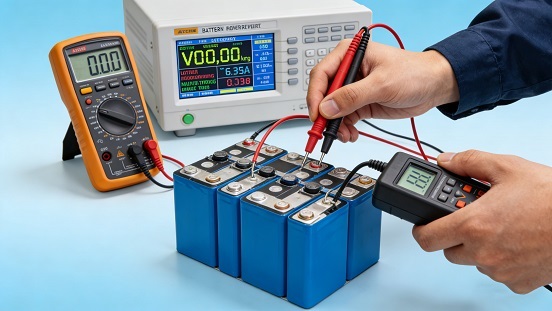
4.Technical Principles & Advantages: Restore Consistency to Unlock Full Capacity
A lithium battery pack consists of multiple cells connected in series. Voltage deviation between individual cells will restrict the overall capacity of the battery pack to the level of the cell with the lowest voltage. Battery balancing repair technology eliminates such deviations via active voltage regulation, enabling all cells to charge and discharge synchronously, thereby fully unlocking the actual capacity of the battery pack.
This method features precise operation and strong target orientation. It can effectively resolve lithium battery issues such as “false full charge” and “sudden range drop” without causing any damage to the battery. As a core maintenance and repair method for both household users and fleet operations, it boasts easy access to materials and equipment as well as outstanding cost-effectiveness.
Case Study: A golf cart rental company ran a fleet of 10 vehicles powered by lithium iron phosphate batteries. After 2 years of operation, the driving range of these vehicles dropped from 80 km to 50 km, and the batteries would indicate a full charge after just 1.5 hours of charging.Technicians conducted a test using battery balancing repair technology and detected that the voltage deviation of some cells in the battery pack reached 0.12V. After balancing adjustment, the voltage deviation of all cells was controlled within 0.02V. Subsequently, the normal charging time of 3 hours was restored, and the driving range bounced back to 75 km, which fully meets daily operational requirements.
5. BMS Optimization Repair: Key Solution for Long-term Stability
The BMS is the “brain” of a lithium battery, responsible for monitoring cell status and managing charging/discharging processes. Abnormal operation of BMS can lead to battery performance degradation. BMS optimization repair restores management functions through system calibration and upgrades, applicable to lithium batteries with abnormal charging or overly sensitive discharge protection.
6. Core Advantages of BMS Optimization: Data-Driven Performance Enhancement
|
Comparison Dimension |
BMS Optimization Repair |
|
Working Mechanism |
Calibrate cell voltage detection accuracy, optimize charging/discharging protection thresholds, update energy management algorithms, and repair system logic deviations |
|
Core Advantages |
Restore the accuracy of battery charging/discharging control, avoiding “premature triggering of overcharge protection” and “sudden power cutoff during discharge”; optimize energy distribution to increase driving range by 10-15%; extend battery cycle life by over 30% and reduce attenuation rate |
|
Compatible Battery Types |
Fully compatible with mainstream golf cart lithium batteries such as LFP and ternary lithium |
|
Effect Verification |
Validated through laboratory cycle tests and long-term field applications, effectively solving performance issues caused by BMS drift |
|
Environmental Impact |
Prolong battery service life, reduce waste battery generation, lower environmental burden, and align with green and environmental protection concepts |
BMS optimization repair is easy to operate without the need for professional disassembly. For some models, upgrade and calibration can be completed by connecting to a computer via dedicated software provided by the manufacturer, while complex issues require professional technicians to handle with special equipment. Data shows that through BMS optimization repair, lithium battery capacity can be restored to over 90% of its new state, effectively avoiding premature battery scrapping due to system abnormalities and saving replacement costs for commercial users.
7. Special Repair Fluid: Supplementary Solution for Auxiliary Improvement
Special repair fluid for golf cart lithium batteries is a chemical agent developed to address electrolyte attenuation and increased internal resistance of lithium batteries. By adding special ionic composite additives, it optimizes electrolyte conductivity and repairs the passivation film on the electrode surface, further improving battery performance. It is applicable to lithium batteries with slight capacity fade and reduced charging efficiency.
When using, strictly follow the manufacturer’s instructions, select products matching the battery type (LFP/ternary lithium), and never mix repair fluids from different brands or blindly inject them into sealed battery packs. Feedback from numerous users indicates that rational use of special repair fluid significantly improves lithium battery charging speed, enhances discharge performance stability in low-temperature environments, and slightly increases driving range. It is an effective supplement for preventive battery maintenance or performance consolidation after repair.
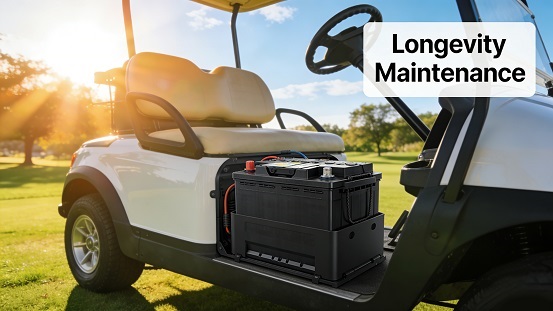
(III) Longevity Maintenance of Lithium Batteries for Golf Carts——Standardized Management Extends Service Life
1. Core Points of Daily Maintenance: Regular Care Ensures Stable Performance
Regular and standardized maintenance is key to extending lithium battery life, ensuring the battery maintains optimal performance at all times:
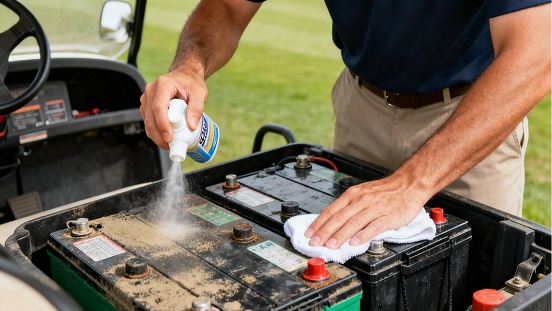
- Monthly Inspection: Check if the battery casing is intact without cracks, bulges, or leaks; inspect the wiring terminals for cleanliness and tightness. If an oxide layer appears, wipe it clean with a dry cloth and fasten to ensure good connection (do not use corrosive cleaning agents).
- Charging Standards: Complete charging within 24 hours after each use to avoid the battery remaining in a low-power state for a long time (remaining power below 20%); must use a dedicated intelligent charger for lithium batteries with constant current, constant voltage, and automatic power-off functions to prevent overcharging damage to cells; never use a lead-acid battery charger for lithium batteries.
- Storage Maintenance: For long-term storage (more than 1 month), first charge the battery to 50-70% power, disconnect the cable connection, and store it in a cool, dry, and well-ventilated environment at 0-25℃, avoiding direct sunlight or proximity to heat sources; check the power every 3 months, and supplement charging if it is below 50%. Never store the battery in a low-power state.
- Special Maintenance: Regularly update the BMS software according to the manufacturer’s requirements to ensure stable system operation; avoid storing the battery in a fully charged state for more than 15 days. If long-term parking is required, it is recommended to charge and discharge once a month to activate cell activity.
(IV) Performance Comparison Reference of Lithium Battery Types: Choosing the Right One for Scenarios
|
Performance Parameter |
Lithium Iron Phosphate (LFP) Battery |
Ternary Lithium Battery |
|
Service Life |
6-12 years, over 4000 charging cycles, outstanding longevity advantage |
5-10 years, approximately 3000-3500 charging cycles, excellent durability |
|
Charging Time |
2-4 hours (regular fast charging), meeting efficient energy supplement needs |
1-3 hours (fast charging mode), higher charging efficiency |
|
Energy Efficiency |
Approximately 98%, high energy conversion rate, stable driving range |
Approximately 99%, top-tier energy utilization rate, better driving range performance |
|
Maintenance Requirements |
Almost no maintenance required, only regular inspection of terminals and BMS status |
No additional maintenance needed, focusing on charger compatibility |
|
Applicable Scenarios |
Commercial fleets, high-frequency outdoor use, users prioritizing safety and long-term performance |
Private users, scenarios pursuing high driving range and fast charging experience |
(V) Suggestions for Optimizing Usage Habits: Good Habits Reduce Attenuation
- Reasonably Control Depth of Discharge: Charge the golf cart in a timely manner when the remaining driving range is 20-30%. Avoid deep discharge (remaining power below 10%) to reduce irreversible damage to cells and extend cycle life.
- Optimize Charging Environment: Avoid charging in high-temperature (above 35℃) or low-temperature (below 0℃) environments. High temperatures accelerate cell aging, while low temperatures reduce charging efficiency. Before charging in cold weather, move the battery to a room-temperature environment for 1-2 hours to improve charging effect and safety.
- Reduce External Damage: Avoid severe bumps and collisions during use and transportation to prevent internal cell displacement and loose wiring in the battery pack. A buffer pad can be installed at the bottom of the battery to enhance protection and maintain the integrity of the battery structure and BMS.
- Safety Operation Specifications: Perform repair and maintenance operations in a well-ventilated and dry environment; use repair materials and equipment produced by regular manufacturers, and do not mix chemical agents arbitrarily; strictly control dosage, time, voltage, and current parameters according to instructions to avoid safety hazards caused by irregular operations.